Gaetano and Pasquale?
by Bob and Dick Chancia
It all began months prior to Easter Sunday, April 12, 1936. Dick & I shared the cramped quarters of a loving Mother’s warm, protective and carefree womb. I heard Dick’s command, “hang on, we’re gettin’ otta here!” My reply was “no way”, we’re warm, safe and secure here; why mess with that?” “there’s a big wide world out there to explore. Don’t worry, just follow me” was his plea.
So between 10:08 pm and 10:13 pm that Easter night, we experienced, with the help of a capable delivery room medical team, our first Double Play! Womb-mates no more, now it was us against the world! Thanks to God, Mom, the Pediatric staff at Utica’s Memorial Hospital and appropriately named Dr. Joy, a series of Double Plays joyfully began!
Being a shock to all, before the days of advanced technology, forecasting gender and such, the first obstacle was what to name this combination? They couldn’t show favoritism by labeling one Jr. after Daddy Alexander so the logical conclusion was the two Grampas. That would mean sending the boys into the trials of life as Gaetano and Pasquale. No way was fiesty little 4’ 11”, 90 lb. Florie gonna do that!
Her own Mom called her 5 sisters, Felicia, Domenica, Avalina, Elena and Clara. She wasn’t about sending her two Easter bunnies into the world as Gaetano and Pasquale! Who cares if we lived in predominantly Italian East Utica, where those monikers would be readily accepted! Instead, her identical bunnies were sent out into the race of life as Richard and Robert.
One uncle, with a reputation for being able to knock down a few beers, brought the news home to the extended family late that Easter night. ? - Well, what is it, a girl or boy? It’s two boys was his news! They were understandably dumbfounded, mostly because of Uncle Tory’s love for the suds. He convinced them and with 5 and a half pound Richard leading the way and 4 and 3/4 Robert, narrowly missing a stint in the incubator, the new DP combo entered the game!
This book is not intended to be a book about twins. Only God knows, how many countless numbers of multiple births He’s designed since Jacob and Easu. With all kinds of studies and lessons to be learned about patterns of behavior and genetic theories, we leave that up to the scientists and psychologists.
This book is intended to share the fun twins can have and the advantages for acceptance and popularity they can easily gain. We made the most of our circumstances instead of striving to claim separate identities. You can get hung up with opinions on the importance of establishing personal identities but we’d rather you just relax and enjoy this series of tales. They will provoke laughter and also show how being unique is important in life.
Sometimes, being unique can even be achieved by being alike! We sensed that very early! In so many facets of life, you’ve gotta have a gimmick. It really is a “gotta have a gimmick” world! We didn’t fight the gimmick that God gave us. We set off to work with it! It wasn’t a calculated intellectual decision; it just happened naturally.
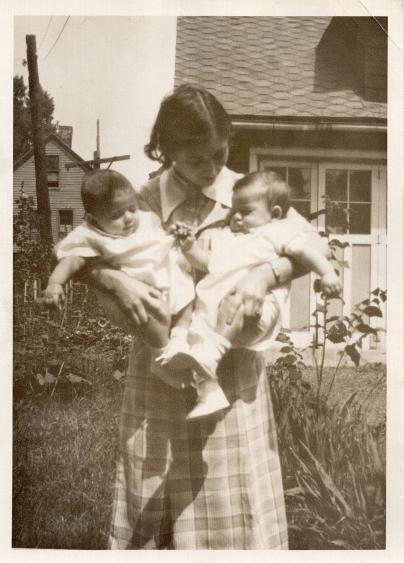
Dick and Bob in their mother's arms.
So let the stories speak for themselves and spin their own tales. For us it was double or nothing and we opted for double! We learned very soon that life is not all fun. There’s a much greater purpose for our existence but life can be joyful in every circumstance.
There’s a time for sorrow and a time for joy; a time for work and a time for play! So double your pleasure ‘cause “one 2 punch” is a time for double plays!!
Timex Guys with Chevy Tastes
By Bob & Dick Chancia
Bob and Dick just turned 90! Two “Great Depression” babies of 1936 fighting the surreal AI crazes of 2026. It’s been a long run but we’re still flyin’ high! There’s lots of turbulence and the fasten your seat belt sign just went on!
Gramps used to say; “gettin’ old ain’t for sissies”. Now we get it, ‘cause suddenly we’re old and misunderstood by the new generations. Most of our peers are gone, so there are few listening ears who lived through our years.
Anyone recall those simple, safer, silent years of the ‘50s? We all admired Harry “the buck stops here” Truman and everyone liked IKE, regardless of political party. We trusted our leaders and were much more united then. Will today’s generations ever experience that or even believe that such a time really existed? Probably not!
They don’t know or even understand our heroes. They rave about Shohei Ohtani and we respond; meet Ted Williams! Taylor Swift may be swift with her footwork, guitar and football hero but we had MARILYN!
We liked simpler things and still do. We’re happy with our Timex versus a Rolex and we still drive a Chevy! Mom and Pop restaurants were authentic with homemade recipes on their menus. Sushi and Thai food were oceans away.
Now, the clutter of terminal fast food chains have captivated our kids and families just for expediency. They’re addicted to junk food! Cafes can’t cut it today unless they’re pricy with exotic ethnic menus. We still prefer Mac ‘n cheese or spaghetti & meatballs. We also loved the Automat and the five and dime counters. Grilled cheese and apple pie just hit the spot!
Today’s Millennials, Gen X and Z crowd won’t tolerate that. Their ambiance isn’t chic enough so they’re not frequented. The old diners are almost as extinct now as our old flashy 2-tone sedans with no air or computer screens.
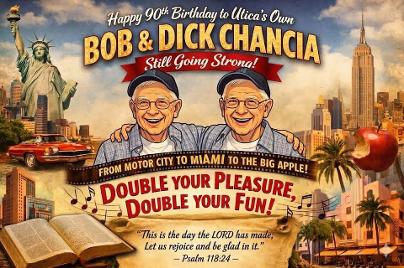
Stop the world, we want off! No way! We must adapt and function online with our devices. All our great carriage stores closed so we shop from home. It’s Amazon or bust! If a job isn’t remote, don’t bother to apply!
Does anybody understand our plight? We understand them ‘cause we lived long enough to know that we don’t have it together yet but we did have it better. AI is exactly that: Artificial! Yep, it’s tough being 90 in a 50 shades of grey world that has lost its way.
So, c’mon folks; whatever your generation, get in touch with your God given inner mind! Find that real peace, contentment and purpose for your life and start living NOW! Be thankful in all circumstances, love your neighbor as yourselves and stop searching for tomorrow! You’ll be 90 before you know it!
"The Day the Town Went Wild"
by Bob Chancia
Today is Opening Day. Baseball is back and it's Spring 2025! I'm in Detroit again, remembering another Thursday afternoon; the one of October 10, 1968. The J.L. Hudson Co. Advertising Department employees were captives of their black and white TV sets on the stores 19th floor.
Finally, all the histrionics of that classic 1968 World Series were over! Southpaw Mickey Lolich just bested Cardinal ace Bob Gibson, winning his 3rd complete series game! Our Tigers won their 3rd World Series Championship in a dramatic, unexpected upset thriller in St. Louis! Now, more than 125 Advertising Department workers opened their 19th floor office windows and added to the downpour of confetti that flurried through the city's sky.
Hudson's had an enticing Tiger Shop on its main floor offering World Series gifts and souvenirs. Perched atop the shop's kiosk was a lovable 4' stuffed Tiger. I kept my eyes on that Tiger all through the series but was repeatedly told it was not for sale!
At the end of that 7th game gem, I raced down to the main floor and desperately asked again if I could buy it. The clerk replied, "we won!Go ahead and take it!" I trudged the 5 blocks home to my apartment building on First and Bagley, clutching my prize amidst hoards of jubilant, confetti covered Motowners celebrating on that day the town went wild!
Some family members were my guests, as Tiger GM Jim Campbell, my next door neighbor, gave me 25 tickets for all 3 series home games! I couldn't wait to show off my new World Series trophy that Hudson's just handed me.
We all agreed that this stuffed gift must be saved for the family's first grandchild. I protected it 'til Aug. 30, 1973 when big Baby Alex was born! As expected, just like those '68 "Sock it to 'em Tigers", our rambunctious, hyper toddler knocked the stuffing out of it!
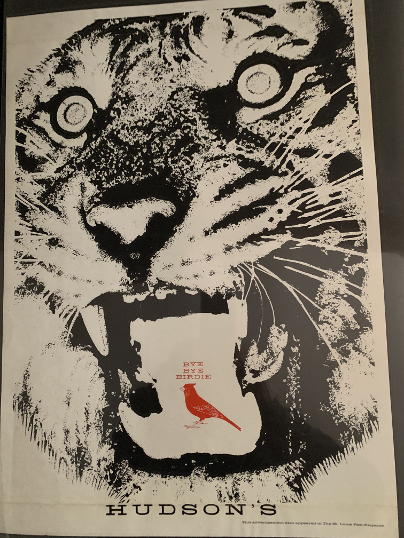
Hudson's had a Tiger Dugout Club for youngsters that year and I created its monthly newsletter. The store also proudly displayed the coveted World Series trophy in their main Woodward Avenue window. They also ran a full page color ad in next day's Detroit Free Press and Daily News. The clever message in the open mouth of the roaring Tiger's face read "Bye Bye Birdie"! Pictured is a photo of that iconic ad!
Hudson's always led the way in promoting Detroit's important events and places. Everything special about Motown was supported by Hudson's. From their annual Turkey Day Parade, Christmas time at Hudson's, the many sidewalk shows around their block, the 4th of July Fireworks on the river to the Detroit Zoo etc. will always be remembered by Detroiters. As for me; I will never forget the day that Tigertown went Wild! Happy Opening Day 2025!
La Nostra Picola Famiglia
by Bob Chancia
There were just four of us but enough to cover every base and home plate. Our household at 610 Plymouth Place was a homer haven!
Mama Florie, christened Fiorenza Marie Mangano was born on August 28, 1910 in Utica, NY, the sixth child of ten. She had a natural style and flair, in spite of her humble environment. Florie could whip up a diversity of mouth-watering and delicately prepared dishes with ease. Every Italian mom’s macaroni sauce and meatballs were tops and Florie’s were right up there! She was always the soothing arbitrator too. Dad always won the dinner table squabbles. His DiMag/Mantle Yanks always prevailed over Dick’s Teddy Williams Bosox and my Larry Doby Tribe. Mom always said; “just wait boys, you will win one day”. We all agreed that her 4-course menus were otta the park!
Encouraged by just a smidgeon of whiskey, she could belt a torch song with the best of ‘em! Her empathy and love for people simply attracted all. A mite over protecting with us, she was way beyond committed, dedicated and the loyal wife and mom anyone could ask for.
She could sew, design clothes, cook, bake and dress to kill! Her dream was To become a fashion designer but she opted for designing a loving family instead. She also outfitted us to a T! That was our Mama!
Dad was a Dapper Dan in his day. Born on St. Joseph’s Day, March 19, 1906 in Utica, the seventh of 10 siblings and the peacock of his clan! He was named Elia George “Alexander” Chancia. A saavy salesman for American Chicle Co. (Adams Gum), he peddled Dentyne and Chiclet products in Central and upper New York State.
Allie was an ace amateur pitcher and even a ringside corner man for Utica’s Bantam Phantom-weight champ, Bushy Graham. Dad always bought us two of everything before any of our neighborhood gang had ‘em and spoiled us to death. He always had the latest gadgets first. His dream of becoming a dentist was foiled by a pragmatic Pop who said, “go to Utica School of Commerce and become a banker. We can’t afford dental school”. So a banker he became at Utica Trust and Deposit Corporation before his long stint as an on the road salesman for Milk Shake Candy Bars & then the Adams Gum products.
Lastly, he fabricated custom Formica tops and designed kitchens to afford our double Syracuse U tuition and room and board. That’s our Pop, the forever Yankee fanatic!
Twin bro Dickey was born first, five minutes before me on Easter Sunday, April 12, 1936 at 10:08 pm at Utica’s Memorial Hospital. He paved the way for me, from the birth canal to life on earth. He led our duo while I played catch-up yelling “wait for me”! He was better in the street sports and even won a high school free throw contest! Once he belted a homer in a college soft ball game that future major league umpire Ron Luciano was catching.
Dickey was the stellar clarinetist, who always played the first part in our duets, leaving me with the second. The competition always spurred me on. His big wooden tone easily won him the first chair in our Proctor High clarinet section.
At Syracuse, his natural skills at drawing and painting surfaced. He always had a work in the Annual Student Exhibit and we still marvel at his college creations and car designs. That’s Dickey, the avid Bosox fan and shortstop wannabe who idolized Ted Williams.
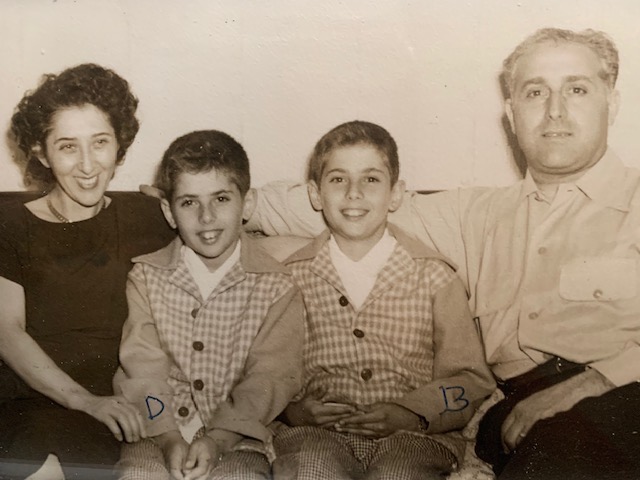
Mom, Dickey, Bobby & Dad.
He became an art director/ad manager, Utica OD columnist, songwriter and skit performer with me. He was the lead sibling! It’s amazing how far a five minute head start can go! He still bleeds Orange, thinks Jim Brown is the best running back ever and adores Buddy Boeheim.
Then there’s me, Bobby, the runt of the litter, born at 10:13 pm on that same 1936 Easter Sunday night. I struggled to keep up but never in a bitter competitive way. I was the 2nd baseman for our sandlot keystone combination and obsessed with Bobby Feller and the Cleveland Indians. My Tribe and his Bosox squared off for the pennant in a 1948 playoff game. I won out, thanks to Lou
Boudreau’s two homers and rookie Gene Beardon’s 20th win!
I couldn’t draw or paint like him; never made an SU student exhibit but I think I was the better graphic artist. I only made 3rd chair in the Proctor High clarinet section but became Pres. of all Syracuse U bands. I out shot him with the M1 rifle at the Fort Dix rifle range and had to deviously qualify for him as our sergeants couldn’t tell who was who!
I also topped him academically and was the more disciplined student. We were neck and neck in everything but I could beat him in tennis and ping-pong. I was serious and he was easy-going. He acted impulsively while I procrastinated. He had more dates but my marks were higher. A friend put it best. “They’re a one-two punch”! We both write stories and songs but I’m the better singer. I always know and carry the lyrics while he’s winging it! I had an ad career too and also bleed Orange! Go Big Jim, Csonka and McNabb!
That’s the high-light reel of our Picola Famiglia, Utica’s answer to the Nelsons and Cleavers!
Christmas time at Proctor-‘50s Style
By Bob Chancia
On the first day of Christmas, Proctor gave to me; A Big Balsa “Li-brar-y” Tree! The photo should recall the memory. Prox classmates partying and trimming the big tree in our library. It was in front of the windows and straight ahead as you entered the library. Yes, tinsel-icicles and many colored lights verses today’s tiny all-white ones.
Do you still remember the Annual Christmas Assembly? It featured our choirs led by Maestro Louise Miner, the major player in our PHS music world. She could master the minor keys well too! The traditional carols and a solo of “O Holy Night” prevailed. What stood out for me was the annual baby grand piano presentation by my Homeroom teacher, Miss Marchetta. That was the “ornament on top of the tree” for me! Her rendition of William Harold Neidlinger’s best song, “Birthday of a King” was first-rate!
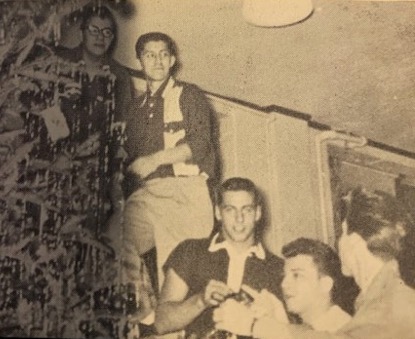
Proctor classmates decorating the library Christmas tree.
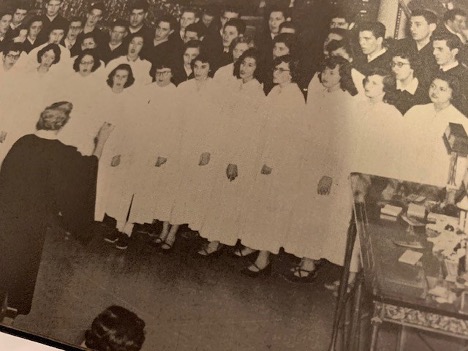
Proctor Senior Choir performing at First National Bank.
The Senior Choir also performed every Christmas season at First National Bank. One year Miss Miner let Dick and I join the choir for that event. Our motive was to skip some classes that morning but now it’s a lasting memory! The choir also did a program at our hallowed Union Station. Yep, Christmas time at Proctor was cool!
Even walking home at night after late games and activities was special. The many images of multi-colored lit trees from the windows of those humble 2 and 3 storied, wood-framed East Utica Victorian houses were truly warm and fuzzy!
Having red and green trim decking our halls and invading our maroon and white world was a great reminder that it really was the season to be jolly! So, enjoy this Christmas 2023 by thinking back to our days at Proctor. At home, there’ll be no bubble lights, cardboard fireplaces, strung popcorn, construction paper chains, tinsel or fancy retro-cut baubles; but again, it’s still the season to be jolly!
Joy to the world, the LORD has come! Let all of Proctor receive it’s KING!
Fa la la la la; la la la la!!!
Vermont Memories
Vermont means “green mountain” and, for me, some of my greenest memories. My wife Marian and I purchased a small rustic summer cottage at Star Lake in Belmont, Vt., in 1979. Belmont sits atop a beautiful green mountain in southern Vermont between the towns of Rutland and Ludlow. It claims the highest altitude of all Vermont’s villages with a post office.
Our cottage sat in a lush cove, smack on Star Lake. Some spots are better than others, and ours was the choicest spot in the village. Clusters of specimen white water lilies populated our section of Star Lake. From those lily pads, noisy frogs sang us to sleep each night and, and sometimes kept us awake. We even dedicated our sunroom to them, and named it The Frog Room! It boasted green decor and country wallpaper, with an over-the-top collection of frog items. On both sides of our long dirt driveway were fields overgrown with a plethora of wildflowers. Birds, bees and various kinds of wildlife also resided there. Marian suggested I gather some rocks and build a wall along the driveway. Instead, I purchased a book about wildflowers and birds to help me identify them.
Many lazy summer days spent there included walks to the General Store, a vintage throwback of authentic small-town Americana retailing. Sunday services at the steepled, white-framed, picture postcard church offered scholarly and memorable Bible lessons from our dedicated Pastor Glenn. Spin casting from our yard or small pier at the town beach provided many surprise catches. Our friend Otis, when he didn’t capsize the rowboat and lose his catch, would always cook a tasty New England supper.
Advantages of living in Belmont were the nearby drives to many local attractions. The annual Labor Day jaunts to Vermont’s State Fair in Rutland call to mind the old carny days in upstate New York during the 1940s. Pizza parties with family and friends at the rustic Farmhouse Lodge on old Route 100 are indelible memories also. Historic trips to President Calvin Coolidge’s birthplace in Plymouth were a must-visit with guests. Scenic drives along Rescue Lake, visiting the Bridgewater Mill and sylvan villages en route to historic Woodstock stand out.
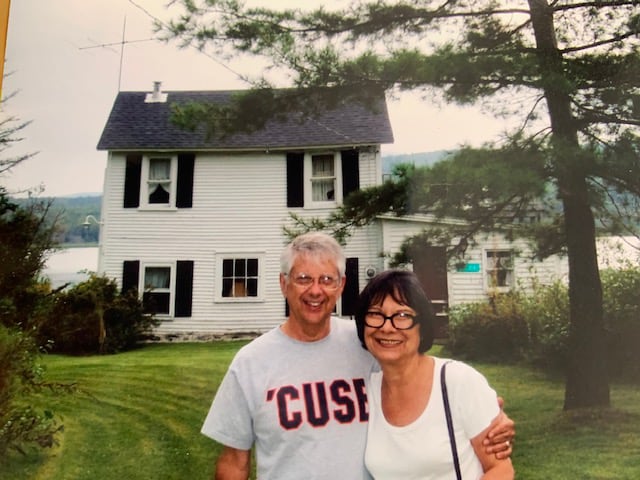
The author and his wife.
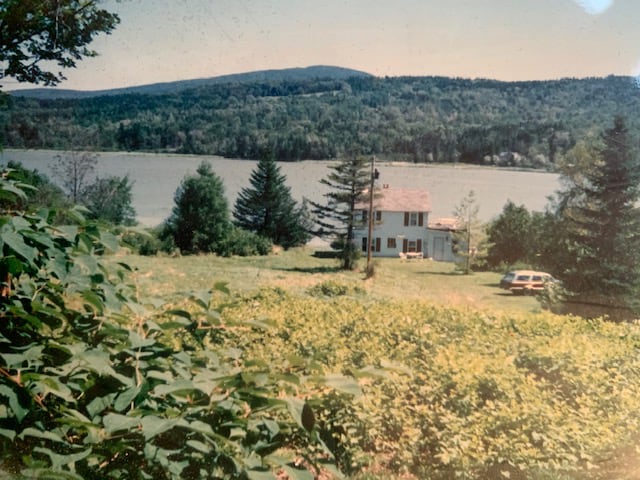
The author’s cottage on Star Lake.
Nearby Weston village, with its New England menus and country stores, always made the good old days retrievable. Evenings at the Weston Playhouse definitely satisfied our urban culture quest, with their Broadway quality summer theater company productions. The old road to Weston from Belmont displayed an impressive archway of maple trees, brilliant every season, but especially majestic for peeping during fall foliage time. Belmont offered a library, town hall, and museum, plus an annual Cider Press on its town green.
The volunteer Fire Department hosted a fair and field day each summer, and I’ll never forget playing my clarinet the loudest in the annual Fourth of July parade. Swimming and picnic lunches at Ludlow’s beach and creek, plus all its quaint eateries on Main Street were special. The Hatchery or Cafe at Delight for breakfast, and dinner at DJ’s were favorites.
Okemo Mountain, along with Stowe, are Vermont’s only ski mountains with a village directly at their base. Ludlow boasts spectacular views from the lookout peaks of Okemo. Playing baseball with my brother Dick and nephew Alex in Ludlow’s park was a summertime hit. The Crowley Cheese Store and Factory tour delighted every hungry taste bud, as did Archie’s steak dinners, Nicky’s and Harry’s ethnic roadside recipes. I can’t omit the hikes to the swimming hole at Buttermilk Falls, and finding treasures from the past at Vermont’s many antique barns. Chester and Brandon, the home and studio of famous American folk artist and fellow Syracuse University grad Warren Kimble were always inspiring side trips.
These are just some of my Vermont recollections. How green was my Vermont? So green that I hope it made you feel good, and not green with envy.
Written by Robert Chancia.
Fazul, Turk & Stretch?
Do people address you formally?... Mister, Miss, Peter, Alexander...or casually...Pete, Al?
Exceptionally creative Proctor kids relied on humorous nicknames that in most cases were very affectionate.
Here are a few popular ones: Ron Daprano, a gangly long limbed basketball star became "Stretch". Another hoop star, Robert Borgovini got "Beanie" which evolved to "Fazul", after the Italian peasant dish, pasta fagiole. (macaroni and beans) Two other hoop guys, Angelo DiRuzza and John Arcuri were known as "Lardy" and "Ace". We don't know the origin of the next two Anthonys: "Ishkie" Collea and "Squeaky" Calenzo.
Here's a funny story: from childhood, Angelo Giacovelli loved grated Romano cheese on his macaroni (pasta) Obviously he was dubbed "Cheesy".
Future American League umpire, Alex Salerno was known only as "Bobie" and Boston Red Sox 2nd baseman Ted Lepcio was called "Chubby" in high school. Catcher Tony "Bull" Fabbio completes the Prox baseball trio.
Two of the most affectionate monikers belonged to Anthony "Muzzy" Garramone and popular Robert "Charms" Giruzzi.
When your name is Ronald Bush, "Twig" is a no brainer! Art Batista inherited "Dooley" from his Pop. Football receiver Thomas "Gluefingers" Gigliotti just kept dropping passes and handsome halfback Al Grimaldi; a sharp dresser, was "Shaggy". Why?
Diminutive Fran Joseph, of Lebanese descent loved to be called "Turk" and Anthony "Bones" Rastani obviously was skinny.
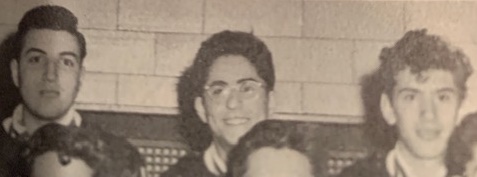
Picture Caption: Fazul, Turk, and Stretch.
There were a couple of admired big guys: Art "Truck" Dishiavo and Ralph "Train" Antone. Future Attorney Frank "Cookie" Giruzzi will have to explain that one along with Bob "Cat" Hanower.
Not to slight the fairer sex, our Gals also had nicknames. We'll close with four of the most popular: Cheerleader Diane "Dixie" Martelli, popular Virginia "Pinky" Inserra, band and orchestra flutist, Eileen "Tweety" McGuire and Delores "Babe" Aceto.
One Saturday evening our Mom asked us what we did that day? "We met Fazul, Turk, Stretch and Gluefingers at Ben & Bernies. Headed to the Huddle to ask Dixie, Pinky, Tweety and Babe to join us for a matinee at the"Ri".(Rialto) What? Who? Where?
Yours truly,
Bob and Dick "Chance" Chancia
GUEST COLUMN: Pair recall greatness of Jim Brown
By Bob and Dick Chancia
The national media has well documented the history and legacy of Jim Brown; but here’s a one-two punch of our own experiences with the Hall of Fame running back.
We were freshmen at Syracuse University in the fall of 1954. As members of SU’s “100 Men & A Girl” football band, we were eyewitnesses to all of the legendary running back’s college games, seeing the All-American trample over all of the opponents he faced on the gridiron during his varsity career.
The climax was at the 1957 Cotton Bowl, where Brown scored three touchdowns. His third extra point attempt was blocked and SU lost to Texas Christian University 28-27.
We marched in that New Year’s Eve Cotton Bowl parade ahead of a fire truck, carrying Brown, suited in a dapper olive green corduroy suit. Later, Dick bought the identical suit at Manny’s on Marshall Street.
We watched Brown play every varsity basketball game at the Syracuse War Memorial as members of SU’s Pep Band. We watched him win two events in a track meet vs Colgate one morning, enough to give SU the win! After changing uniforms, he led Syracuse to a victory over Army in lacrosse that same day!
The highlight of our Brown encounters was as classmates in a 15-member genetics class in Lyman Hall. Now that’s the luck of the Orange! On the first day of class, Professor Gillette remarked, “This is an interesting genetics class; we have an African-American and a set of identical twins!”
When walking down Lyman’s steps after a test, Jim asked, “How did you answer question No. 2?” Bob responded, “The right answer was C.” Jim replied, “Good deal!”
Brown led his ‘57 class as the class marshal, in his Army ROTC uniform at commencement while we played our clarinets in SU’s band. We followed every black and white telecast of his Cleveland Browns games. When working in Detroit, our press-agent friend escorted us to the sidelines to try to get a picture with Brown, but he declined due to his pre-game warmup.
Our last encounter with Jim Brown was at SU’s New York City Lubin House for an alumni presentation by the Hall of Fame back. Dick asked him about that disappointing blocked extra point at the ‘57 Cotton Bowl. Jim replied, “An SU tackle missed his assignment, allowing TCU’s Chico Mendoza to block the kick.”
Ironically, we had lunch at the Varsity the day after Brown passed, recalling the many times we saw him there playing the pinball machines in the 50s. That same evening we learned of his death.
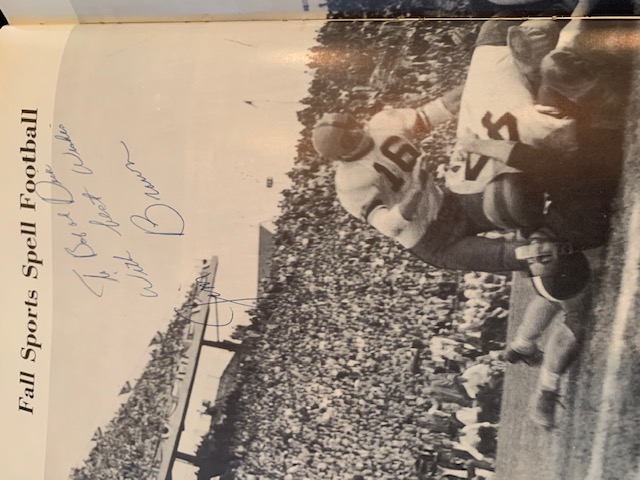
PictureCaption: A photo of Syracuse University football legend Jim Brown, signed for the authors Bob and Dick Chancia.
We watched Jim Brown put SU on the map; now, we can say; “RIP fellow Orangeman. Thanks for Running-In-Perfection and running into us along the way.”
Utica’s Union Station is still chugging along!
By Bob & Dick Chancia
We spell the name of our home town, Utica, NY: YOUtica ‘cause there’s so much for YOU to still experience and savor from its glory days. One, being our iconic railroad terminal called Union Station that’s still operating. Most of our country’s grand old stations have vanished with the advent of super highways, speedy air travel and the disposable mindset that “new is better”.
Indelible in our minds will always be the mesmerizing model train layout plus treasured memories of tearfully seeing our uncles depart for WW2 from that enchanting place. Red Caps, shoe shine stands, fancy restaurant, news stand and barber shop, all left their remnants for us to revisit today. The stately Botticino Italian marble columns and terrazzo floor have been re-polished and are one awesome sight!
Expecting Utica to become our state’s hub city, with its strategic location near Bagg’s Square by the Mohawk River and Erie Canal, probably was the intention for this marvelous edifice to be built in 1912 to 1914. Terminals in Albany, Rome, Syracuse, Rochester and Buffalo have all terminated in favor of small utilitarian outposts in the outskirts of those cities.
New York City architects Stem and Fellheimer brought their experience from work on N.Y. City’s Grand Central Station and Detroit’s Michigan Central to the project. The classically-inspired Beaux Arts structure served 12 tracks for NY Central Railroad trains and was added to the National Register of Historic Places in 1975.
Now called the Boehlert Transportation Center at Union Station, it remains special to us as the former U.S. Congressman Sherry, was our best friend from Roosevelt School in the 40s. Our Proctor Boys gang from the 50s meets there monthly at the Trackside Restaurant to relish the memories.
Only a few cities, including New York, Philadelphia, Washington DC, Los Angeles, Chicago and YOUtica can boast of these architectural treasures still operating. Our son and nephew Alex took us on a tour of the Houston Astros Minute Maid Park and wouldn’t you know, the Astros built many features of their new ballpark into the old glorious 1911 vintage Houston Union Station.
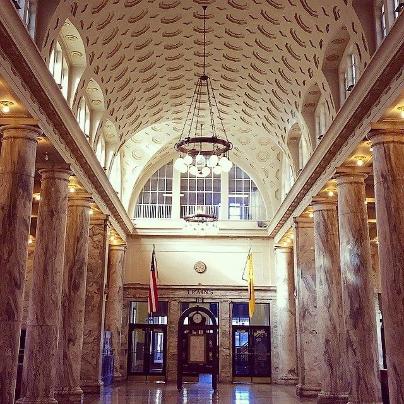
Picture Caption: Caroline Chancia’s impressive photo captures the 47-foot high vaulted ceiling supported by 34 Botticino Italian marble columns.
Utica’s Union Station has retained its original waiting room benches, heated by steam pipes and vents. The large clock flanked by eagle sculptures and tall arched windows make the exterior as impressive as the inside! Right of the ticket window, don’t miss the 1947 picture of railroad workers, Carmen and Vincent Fondario; brothers of 50s Proctor star athlete Lou Fondario.
If you are craving a blast from the past; take an Adirondack Railroad trip from Union Station or see the USA via Amtrak from there. Utica’s gem is a must see and it’s still chugging along!
There used to be a Ballpark right here!
By Bob and Dick Chancia
In 1946 we outgrew our “Roy Rogers, King of the Cowboys” phase. For the next few years it was the Utica Blue Sox all the way.
It began with Sunday afternoon family drives in Dad’s ’41 Buick Special, listening to Nick Stemmler’s play by play of Blue Sox games. His typical baseball voice plus the “Quick- quick my Beverwyck” beer ads were music to our 10 year old ears.
We were hooked, especially after our first visit to the splintery old iconic ballpark in north Utica. It was located where the Red Roof Inn sits right now. Yep, there used to be a Ballpark right there!
Our infatuation with baseball started right there! Dick’s revised lyrics to the Joe Raposo classic song* with Sinatra vocal say it all.
Crack some peanuts with a hot dog and beer…let the new lyrics take you back to a treasured time in Utica history:
We’d leave our muddy sandlot on a warm day in July
Thumb a ride way north on Genesee with our ball mitts by our side
Soon we’d smell the sizzling hot dogs and the foamy Beverwyck beer
Yes, there used to be a ballpark right here
Sawyer, Yogi, Caballero, Lou Possehl would get the win
Lopata, Granny Hamner and at first base, Billy Glynn
No creaky wooden grandstand or young heroes left to cheer
Yes, there used to be a ballpark right here
The Blue Sox would host Albany, maybe Elmira Pioneers
It didn’t seem to matter, Richie Ashburn got the cheers
Now a brand new Red Roof Inn has replaced McConnell Field
And the summer went so quickly those years
Yes, there used to be a ballpark right here!
*To listen to the original Raposo/Sinatra song, Google; There Used To Be A Ballpark.
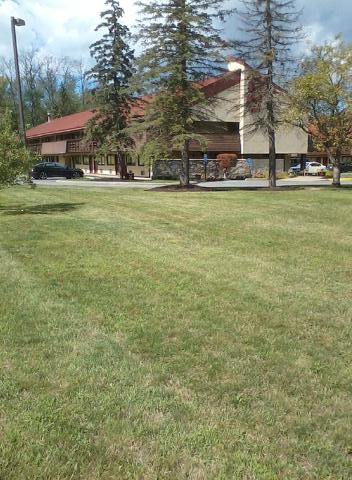
Red Roof Inn on old ball park site today.
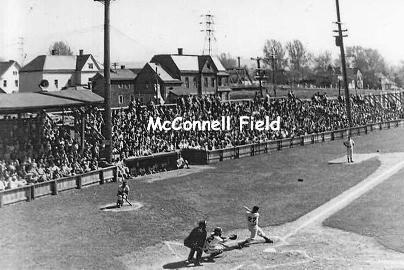
Photo caption: The glory days at the old ballpark in north Utica
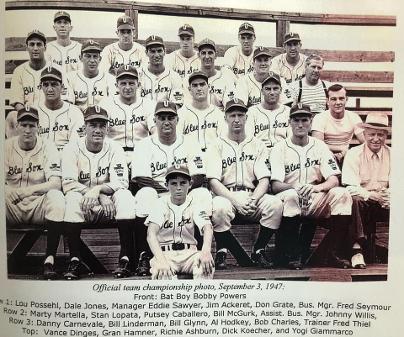
1947 Champion Utica Blue Sox team.
Remembering morning radio host Hank Brown
By Bob Chancia and Dick Chancia
Special to Utica Observer-Dispatch
USA TODAY NETWORK
Utica's renowned morning radio host for coffee and toast passed away May 9th in Middlebury, Vt. Hank Brown graduated from a Philadelphia broadcast school in 1957 and headed for WLFH in Little Falls, NY. That was the start of over 55 years as Utica's 'Dean of Broadcasters'.
Later in his career, Hank bought and owned his three hour show. He sold commercials to local advertisers, wrote the copy and did the spots live, embellishing the messages with his gift of entertainment and sincerity. Clients got three minutes for the cost of a sixty second ad. His closing line: 'Tell em Hank sent ya' was classic.
In 2004, Bob and I wrote our Christmas song, 'Digital Christmas'. We didn't know Hank but owning his show, we knew he would air our song.
Hank played the song four times a morning every Christmas season. That started an 18 year friendship with this interesting guy.
Hank was a proud Irish Catholic lad from Philly. He grew up on the playgrounds and starred in parochial high school sports. He loved to tell the story of his Mother Superior promising no homework if Notre Dame won on Saturday. The 'Fighting Irish' usually did and Notre Dame became Hank's favorite team for life. He grew up with Wilt 'the Stilt' Chamberlain and 'Jellybean' Bryant, father of the late NBA legend, Kobe Bryant.
Hank affectionately used a convincing Irish brogue when he told stories about his Mom and police officer Dad, who walked the beat in downtown Philadelphia. He served in Korea with the US Navy.
A gifted raconteur; Hank told stories on and off the air of encounters with 'The Greatest'; Ali, Mike Tyson, Utica native, Olympic boxing ref, Tony Filipelli, Carmine Basilio, Willy Mays, footballers, Sid Luckman and Chuck Bednarik plus entertainers, Frank Sinatra, boyhood friend, Al Martino, Patti Page and many more. Hank's show was a one-two punch: the popular hits of the 1940's-50's plus daily doses of wisdom.
Hank Brown created and hosted a weekly live WKTV dance show, 'Twist-o-Rama,' which became the top rated show in its time slot from 1964 to 1968. T-o-R was a local version of Utican Dick Clark's 'American Bandstand' which took the country by storm out of Philadelphia.
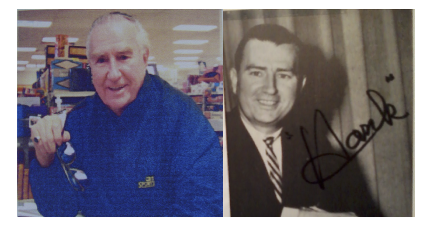
Hank Brown, left, Toast of morning radio host. At right, an image of Brown in the mid-1960's as the host of 'Twist-o-Rama.' Photo provided by Richard Chancia.
He also announced boxing events on ABC's Wide World of Sports, where he teamed up with sports broadcast legend Howard Cosell. Hank announced the 1966 Olympic Game's boxing from Atlanta and was inducted into the Greater Utica Sports Hall of Fame plus the International Boxing Hall of Fame.
His most generous effort was the annual Christmas party for needy kids. He rallied local businesses to donate toys, bicycles, food and candy for them and their families.
*We sat in the press box at Cooperstown's Hall of Fame game, compliments of ABC sports. Each year we received the commemorative pin engraved with the names of each inductee.
Hank's life was Global sports and show business gigs plus a deep affection for the people of Greater Utica where he chose to work for 55+ years. Hank raised his family in nearby Little Falls.
Our 'Dean of Broadcasters' retired in 2013. The Browns moved to the Montclair, NJ area to be closer to their son and grandkids. Hank missed the snowy Mohawk Valley that he daily described as 'Colder than a Mother-in-Law's kiss'. Wherever he went, Hank was recognized. 'You're Hank Brown. I enjoyed your show every morning'. Hank Brown's Irish blues would glisten and light up warmer than a Mother-in- Law's smile.
Coffee and toast aren't the same without ya, Morning Man!
Home Sweet Homeroom!
By Bob & Dick Chancia
How sweet it was! Our home away from home at Proctor HS was Homeroom 202 with Miss Marchetta. She was attractive, personable but also no nonsense. We were kept after school a few times for being disruptive.
Our school day began and ended in room 202. The Pledge of Allegiance, intercom announcements with news and reports from Bank Day Bob were a few of the staticky messages. Mr. Thompson would sometimes predict game outcomes and weather.
Our fellow roommates made homeroom memorable. We sat toward the center providing a perfect overview of the room. Baseball slugger Artie Battista and all sports star Ralph Antone sat by the blackboard wall, flanked by the two doors. Ralph was by the back door next to the honor roll, written in cursive on the board.
He was an honor student, so appropriately placed. Ralph was always jabbering with teammate Rock Giruzzi who was right next door in Miss Denn’s homeroom 204. We all had assigned seats, to maintain order.
Adjacent to us was our grade school mate and neighbor Pattie Calderella. Indelible in our memories is the fine gold chain she wore, holding an inch wide gold football pendant that commemorated her Dad’s stellar gridiron feats at Clarkson University. Occasionally, she brought in football game programs from Cornell U. where her brother Jim and sister Julianne attended.
A photo of West Point QB Arnold Galiffa from a Cornell/Army game program comes to mind. Those programs ignited in us a passion to also attend a big university.
Pattie was smart as was Joan Cifonelli, who sat behind us. Both went on to SUNY colleges and enjoyed productive careers in our local school systems.
Santina Bretti was also a 202 gal. With shiny black hair framing her striking face, it’s no wonder we call her our homeroom heart throb today! Tina was always clad in hip styles of the ‘50s. Jeanette Commisso, Phyllis Colacicco, Dan Bottoni and ’53 salutatorian Rosemary Arcuri were also in 202.
That was our Proctor High homeroom away from home. Yours had to be special too. Utica’s infamous former Naval officer and acclaimed pioneer ophthalmologist, Dr. Anthony Palumbo recalls Mr. Fisher’s homeroom, that included scholars Phyllis LoParco, Joe Karam plus head cheerleader Julie Mondi. 4 touchdown halfback George Fanelli was with his cousin Mike in Mr. Roemer’s 214. Marie Garcia, Dick Smith and Bill Fragetta were also there.
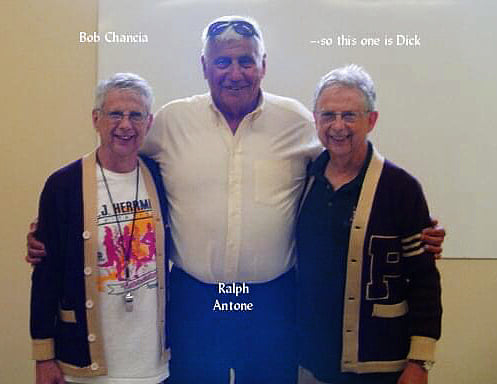
Photo caption: Bob, homeroom 202 all-star Ralph Antone and Dick at Ralph’s 2008 Greater Utica Sports Hall of Fame luncheon.
Homerooms defined us in a way. They provided a secure and familiar refuge before and after the final bell. Like those good ole Italian “sangweeches” (peppers and eggs) we brought for lunch; we savored what was between the bread but the quality of the slices on each end is what made them great.
Maybe you had Mr. Henry, Zoecklar, Ross, Mrs. Porter, Studor or Makuch, it didn’t matter…speaking of Spanish teacher Makuch; can’t leave out this tidbit. She tried to get us transferred to her homeroom 233. She had a crush on our Dad back in the ‘20s and held a special fondness for us.
We balked at that opportunity but compromised and took 3 years of Spanish. We remained in 202 with Miss Marchetta and she was sweet. There was no place like it.
The Talk of the Town House
By Bob and Dick Chancia
Life is a voyage, whether one stays close to home or moves about. Both involve phases, experiences, changes and milestones. After graduating Proctor High our path led to sojourning. A solid upbringing in Utica prepared us for the challenges at Syracuse University. We savored those rah rah collegiate years.
Advertising, our chosen occupation, led us to opportunities in Rochester, NY. We did enough growing up there to take on a bigger city; Detroit MI. A colleague there led us to the Town House apartments. Ten years later, at 36 years old, we left what would become our favorite stopping off point.
Miami, Los Angeles and New York City, all more heralded than Motown, came later but that Town House in the Motor City became the soft spot in our hearts. Why? Conveniently tucked downtown between the main business area and Detroit’s Tiger Stadium, it was home to many other sojourners.
The diversity of the tenants made the Town House unique. Our neighbors included United Artist press agent Howard Pearl, Akron tire exec Stan Latter, ‘68 World Series hero Mickey Lolich, radio station owner Dick Jones, restauranteur Renie Russell, Franklin Simon sales mgr. Manny Marcus, Tiger trainer Bill Behm and Coach Tony Cuccinello. American Airlines housed their stewardesses there and some Detroit Tiger and Lion’s players called it home.
Pepsi ad exec Bob Johnson, assistant Lion coach Carl Taseff, and Playboy Magazine rep John Thompson roamed the lobby. Tiger stars Norm Cash and Frank Lary were summer residents. Lary had Billy Martin’s old penthouse #5, which we took over. Martin was known for making spaghetti sauce there and we continued that tradition. Lion coach Taseff showed us scouting films of our college hero and then Cleveland Brown’s super star Jim Brown.
Off the lobby was Ma & Pa Volpe’s convenient grocery commissary. Across the parking lot was Detroit’s Lindell AC. Many athletes, mainly Lion Alex Karras plus local and visiting players hung out there.
The building’s lobby and penthouse roof- top became social headquarters for most tenants and we were at an age more prepared to find our social niche. That roof- top became an observation tower during the 1967 summer riots. Our apartment, penthouse #5 became “riot central” providing food and drink for those tracking the progress of fires destroying the perimeter of Detroit.
The champion Detroit Tigers brought the World Series to Tiger Stadium in 1968 and our neighbor, Tiger GM Jim Campbell provided tickets for our friends and families. When major league umpire and ‘40’s Proctor High star Bobey Salerno called games at Tiger Stadium, he’d borrow our ’59 red Chevy convertible in exchange for game tickets. Detroit is a small/big town where one can more easily break down some barriers. The Michiganders were loyal and friendly and the outsiders were stimulating and interesting.
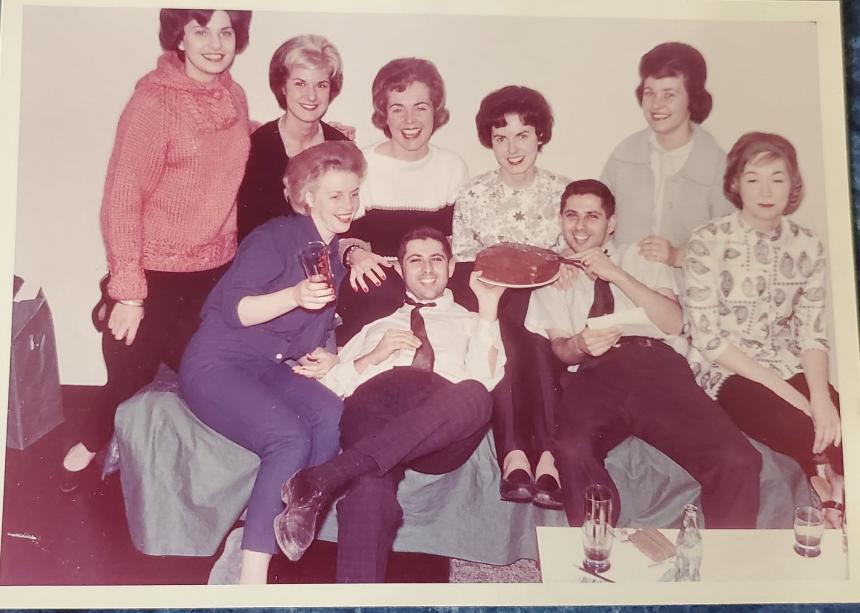
Picture caption: Town House airline stewardesses help Dick and Bob celebrate their 27th birthday.
When the bell rang and it was time to move on; we did. We took on the normal sequence of life’s demands but the Town House in Detroit was our coming of age place. Can you go back? No, but you can come back!
Bob did come back at the ripe age of 83. He discovered Town House 2. (What we call his apt. building in downtown Detroit’s Capitol Park) The building is one of a cluster surrounding Cap. Park. The park, not a roof top is the new meeting place frequented by tenants of many buildings.
You also must have a warm spot in your heart for a place or time that stands out? If you return you may be disappointed. The original Town House still remains but has been totally renovated as the Town Residences. Bob took a risk and chose Capitol Park online. The recent Detroit revival provided favorable vibes. Old acquaintances are now replaced by new friends but many familiar reference points remain.
Bob now keeps Dick informed of the goings on at Town House 2 and “the Brack Pack”. (Our name for the Capitol Park gang) Dick even gets to visit occasionally.
Can you go back? No but you sure can come back!
Who’s Zu-Zu?
By Bob & Dick Chancia
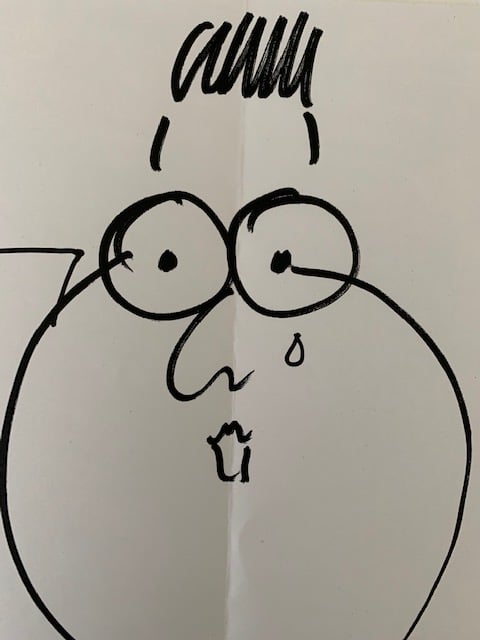
Can you tell by that caricature? Hint: he’s a popular ’53 Prox grad. Zu-Zu was our best friend growing up and inspired us in many ways.
Proverbs 18:24 says; There are “friends” who destroy each other, but a real friend sticks closer than a brother. Growing up, Joe Karam was our brother!
The 1940’s:
It was spring of ’42. We just moved to 610 Plymouth Place from 522 Mary Street. Pedaling his trike down our new dead-end street was 5 year old Zu-Zu, wearing a fleece-lined leather aviator cap with earflaps, chin strap and goggles.
His family lovingly called him Zu-Zu but he said; “my name’s Joe, what’s yours?” A lifelong connection began. The 40’s were great except when Joe spent some of the summer at his family’s compound in Milford, PA. We muttered to each other as we often did when he left; “we lost him.”
We visited Milford one summer after accompanying Dad on a sales trip to Binghamton. Now we know why the Mandour family loved that Delaware River resort town. Joe’s cousins were regular visitors to Plymouth Place: Brooklyn’s Donny and Diane and Joe and Regina from Lehighton, PA. We loved those Dodger and Philly fanatics too.
Every September 26, Joe’s parents threw a huge birthday bash for Zu-Zu. His cousins and street friends savored it. Joe went to BSS (Blessed Sacrament School) and was so smart, he skipped a grade so was a year ahead of us, though 6 months younger. The gang on the corner of Mohawk and James streets (John DeKime, B.J. Johnson, Bobby Isgro and Beanie Borgavini ) would coax young Joe to read textbooks and signs, amazed by his skills. Shortly after, the BSS nuns skipped him ahead; they thought his lack of focus might be better remedied in public school.
Zu-Zu found himself a grade up on us at Roosevelt School. There, he never studied but got by with his brains and wit. At his ’49 graduation, he won no awards and was heavily rebuked by his folks, Gabe and Lila.
From our driveway, the entire neighborhood heard him calling out “Twins!” He was the first to get an erector and chemistry set, ball point pen or jack knife. Joe introduced us to hum-a-zoos, peashooters and Goody Filipino-twirler yo-yos from Trads or Mame Cronin’s.
Zu-Zu set the pace and we followed. Lila took us to movies downtown and taught us to perform skits for her Syrlebana ladies club. We sang, did impersonations and told jokes and stories.
In the fall of ’49, Joe went off to Proctor High and won over the older guys. Seniors Ace Arcuri, Mike Caruso and Joe “Black” Saraceno razzed him by playing the 1949 Johnny Desmond hit “Don’t Cry Joe” on the Campus Inn juke box. There was an element of sadness about Zu-Zu’s outgoing persona.
The 50’s:
We hiked to the Parkway and Proctor Park with baloney sandwiches and canteens of Kool-Aid. We played soccer and stick ball in the street and rode our 2-wheelers everywhere. Joe was a decent athlete and held his own as the catcher on our Plymouth Pirates Kiwanis League team. We followed him as high school team managers. Our Renaissance man had brains, brawn and even did some wild neighborhood babysitting.
We wrote songs together and drove to Syracuse’s 3 Rivers Inn to entice Julius La Rosa’s manager with our doo-wop creation “Carbonated Cutie”. In the car, we wrote” Porto la Bottiglia,” (Get the Bottle) figuring they’d go for an Italian novelty tune. We got the inevitable brush off. At parties, Joe did a hilarious monologue of the 50’s popular radio sit-com “Life with Luigi” with an impeccable Italian dialect.
After graduation in 1953, again with no honors, and another strong rebuke from Papa Gabe, Joe headed to Cornell University. He aced the college boards and won a full tuition Regents scholarship. No Surprise! Joe boarded with Uncle Mike Hanna, an Ithaca radio station owner who prodded the homesick 16 year old Zu-Zu to stick it out. Joe made his ’57 commencement again with no plaudits or honors, although he excelled at campus radio station WVBR.
We were S.U. seniors when Joe joined us at Syracuse to pursue an MBA in economics. He finished the course work but not the required MBA thesis. He had fun at CUSE, auditing our Ad design class and band rehearsals. Our Ad design prof, Mr. Roters, demanded that Joe make the coffee as long as he was coming to class.
When our regular marching band PA announcer caught the flu, band Pres. Bob tossed Joe in the booth with the script. When the crowd at old Archbold Stadium heard his voice boom over the PA, it was curtains for the regular announcer.
While auditing a symphonic band rehearsal in Crouse Hall, director Dr. Harwood Simmons summoned Joe from the auditorium to bang the wood blocks. Zu-Zu became a regular in the percussion section.
His most famous cadenza came on tour at the end of encore selection “Amperito Roca”. We warned Doc Simmons that Joe didn’t know about the abrupt pause at the end. When the huge crescendo soared to the dead silence pause – CRASH- came from Joe’s cymbals. Simmons said; “no sweat, I covered it up with a flip of my baton.”
Joe was our prop man with the marching band, before his PA stint. At the Pitt game, a dragon on a Pitt float was spewing smoke. Joe left the side lines and spontaneously doused the float with the fire extinguisher he had for our half-time show. A small riot ensued which a local Pittsburgh TV crew filmed before the game. Later we heard from Proctor’s famous Mr. Hammes, who saw the TV broadcast on network news and questioned Joe’s motive.
Last SU story: Proctor’s Radio Guild head, Miss McCarthy was visiting SU and happened on the prone Joe, filming us running on SU’s Quad during a snow storm. It was a photography class, stop-the-action assignment. Miss McCarthy was taken aback!
The 60’s through 2000s:
We went our separate ways. Joe did stints with RADC (Rome Air Development Center) before dabbling in Utica politics and urban renewal. He was the force behind the rise of Mayor Assaro and rode the famous Bobby Kennedy campaign train. We chose advertising gigs in Rochester, Detroit, Miami, LA and NYC and met up occasionally with Joe.
Zu-Zu brought Dick’s wedding assembly to tears with over-the-top renditions of Gounod’s Ave Maria, the Lord’s Prayer and Whither Thou Goest. He repeated the performance at Bob’s NYC wedding.
Let’s wrap this up. With his Mom’s influence, Joe was a natural on stage. He could sing with the best, dabbled with the slide trombone and Gibson electric guitar but acting was his forte. The humor he brought to his senior play role in Louis Soloman and Harold Buchman’s “Snafu” was brilliant.
In 1955, Joe emceed a Variety Show for Proctor’s Alumni scholarship fund, played in Lou Angelini’s “Festa” production besides the recent Supper club drama about Utica’s history, at Grimaldi’s restaurant.
He was a stellar performer, promoter, director and supporter of Utica’s Players’ drama group. His Nicely-Nicely Johnson character in “Guys and Dolls” was Jackie Gleason-esque. Zu-Zu’s rendition of “Sit down you’re rockin’ the boat” rivaled Broadway’s original cast performer, Stubby Kaye and stopped the show!
Joe stayed close and loyal to his beloved Utica family, Aunt Marie, Uncle Braheem, cousins Gail and Tony Mandour, Jimmy Hage and countless friends.
If you attended Proctor in the early 50s, you had to love him. Zu-Zu was so much more than nicely-nicely and he would stop any show anytime, anywhere!
Joseph Gabriel Richard Karam will always be Zu-Zu to us!
We were all about The Neighborhood
By Bob and Dick Chancia
Back up to life in the forties and fifties. The neighborhood defined us and we defined the neighborhood. It was a two-way street! Unlike today, we were bussed nowhere, had no soccer Moms chauffeuring us all over in mini vans to another structured activity. The street where we lived was our anchor.
Today, when driving around Utica, we always go down Plymouth Place. That was our block. You had your block too and everyone’s block was the best block. Plymouth Place was a small dead-end street off Mohawk, south of Arthur and north of James Street.
There were 17 houses on the block; seven on the south side and 10 on the north. Our dead-end street was the hub of our lives. In back of the 7 houses on the south side was a wilderness-like gulf that went from Ballou Street, also off Mohawk and curved around to Arthur Street. We affectionately called it “the dump” although no one ever dumped anything there.
It was enchanting, with wild life (deer, pheasants, squirrels etc.), plus wild flowers, weeds of every sort including burdocks, (the forerunner of Velcro) In 1941, Swiss engineer George de Mestral was hunting in rural Switzerland and noticed small burrs, later identified as the burdock plant, stuck to his pant leg...the rest is history. Patented in 1948, the Velcro name came from the French word for velvet (“velours”) and hook (“crochet”).
We hiked to Roosevelt School on Taylor Ave off of Arthur Street via “the dump”. A homeless guy made his dwelling there and we’d walk by him on our way to school without a trace of fear, just intrigue. We built huts in the dump, dug out mini creeks and poured sprinkling cans of water to simulate a stream.
The highlight of the dump was “grass hill”, where we sledded till soaking wet from snow. The older Clemention Street gang built an elaborate hut they called “Happy Dale Sanitarium”. It had multi-level rooms with bunks that really impressed us. We tried to imitate it but ours was a lame attempt. Whatever, it gave us the feeling of our own hide-away and shelter.
After the Saturday cartoons and Westerns at the James theatre, out came our belted holsters, cap guns and cowboy hats. Suddenly we became Roy Rogers, The Durango Kid or Lash LaRue. The dump remains indelible in our hearts.
We rode bikes and scooters all over the block and played serious stick ball games in the street. We used the popular pink Spaldine rubber ball so they must have been serious. If you hit one over Dolly Darmin’s white picket fence ya had a dinger. Soccer, touch football and roller skating were also big on the street.
Getting caught up with all the activity is misleading ‘cause what made the street special was it’s people. The kids, Joe Karam, Joan and Priscilla Capecelatro, Larry Luizzi ( son of orchestra leader Lawrence ), Dorothy Looft, Patty and Mike Didio, Rita, Helen and Butch Lonero, PK and Peter Zogby, Marilyn and Tony Howland, Joe and Marie DeLorenzo to name a few. Our hero George Fanelli didn’t live on Plymouth Place.
Close by neighbors Patty Calderella and Jimmy Ulrich from Mohawk Street, Frank Caviola, Roger and Deanna Bruni from Arthur Street were also part of the block. We knew every household, what they did and what make car they drove. Everyone got along and helped each other. Mr.Ulrich helped our Dad lay a cement block foundation and build the sturdiest garage on the block.
A couple Moms directed us in annual backyard circuses to raise money for an orphanage. The OD did a photo-op of one of our productions. They also featured Plymouth Place in their special “Folks at Home” series, showing off our beautiful tree shaded street.
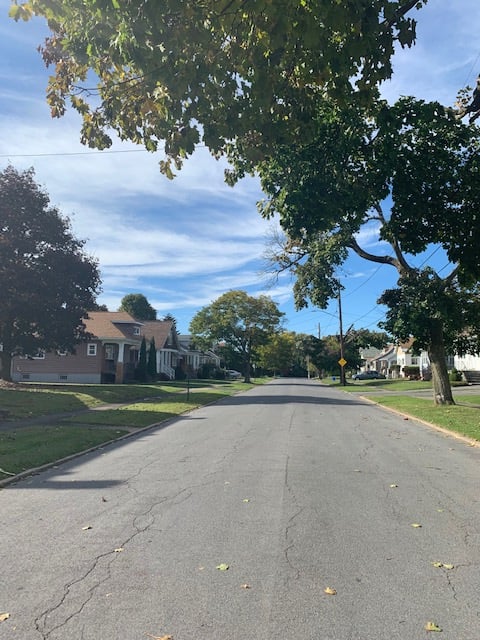
Plymouth Place 2021.
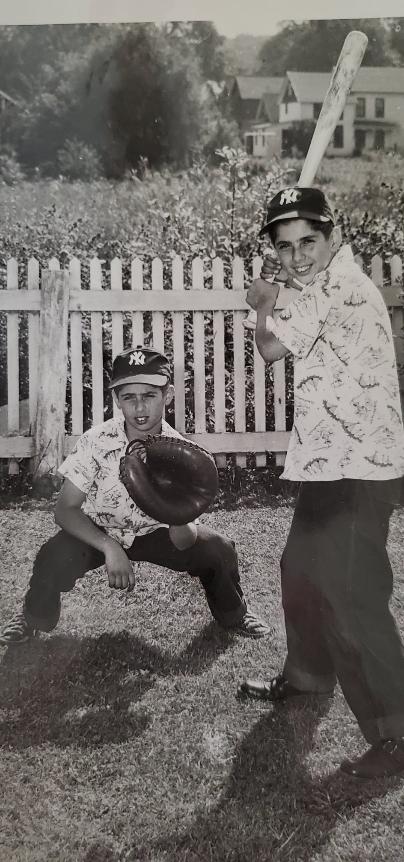
Hitter Bob and Catcher Dick with picket fence in 1949.
Mr. Owens delivered milk to our milk shoots from his cream and orange Graffenburg Dairy horse drawn wagon. The Hathaway bakery man came right into our kitchen with assorted baked goods. Domsers delivered eggs and crocks of butter and yes, the Fuller Brush man was a regular.
Gab sessions were held under the street light or on our front porch glider. We went trick or treating without parental escorts, hoping Belle Capecelatro wouldn’t run out of pop corn balls.
Plymouth Place was innocent, mysterious; a genuine fantasy land without today’s hi-tech distractions. Neighbors freely dropped in to visit and Gramma Lonero was always welcome with her hot homemade tomato pie. Parodi cigar salesman Mike DeLorenzo’s garage filled with promo give-aways was a treat.
The grocery man and his son Philip came by daily in the summer and all the Moms chatted around his truck of fresh produce bought for that night’s supper. His hanging metal scale on chains was the truck’s centerpiece.
Mel Allen blared from open windows bringing the Yankees right to our driveway. Neighborhood birthday parties with more kids than family were the norm. Everyone had cousins that visited often and they too became regulars on the street.
When we were teenagers, bulldozers leveled the dump, replacing it with a playground plus a little league baseball and football field. The block had lost some of its mystique.
So what was your block like? The same kind of bonding and affection existed for you too. Houses were so close that we got familiar with each other without Facebook. Doors were unlocked, and bikes and toys were never stolen. Happy pre suburban people, purposely captive were positively content on their Plymouth Places way before Mr. Rogers talked about the neighborhood.
How do ya get to Carnegie Hall?
By Bob and Dick Chancia
Question: rumor has it that a pedestrian stopped Jascha Heifetz and inquired, “Could you tell me how to get to Carnegie Hall?” “Yes”, said Heifetz, “Practice!”
Many legendary classical, jazz and popular musicians performed there: Arturo Toscanini, Leonard Bernstein, Benny Goodman, Duke Ellington, Glenn Miller, Billy Eckstine, Judy Garland and Frank Sinatra, to name a few. Rock and roll first came to Carnegie Hall in 1955 with Bill Haley & His Comets followed by The Beatles, Led Zeppelin and the Rolling Stones.The Hall has also been the site of many famous lectures including Booker T. Washington and Mark Twain. Obviously those people did a little practicing.
Next question: How did we make it to Carnegie Hall? What? You’re surprised? You didn’t know that we tootled our licorice sticks (clarinets) on stage at Carnegie Hall to a full house! Before we get to the answer to that fair question, let’s do a little history lesson on the Hall.
Carnegie Hall, one of the most prestigious concert venues in the world is on 7th Ave. between 6th and 7th Ave. in Midtown Manhattan in New York City. Architect William Burnet Tuthill designed it and philanthropist Andrew Carnegie built it in 1891.
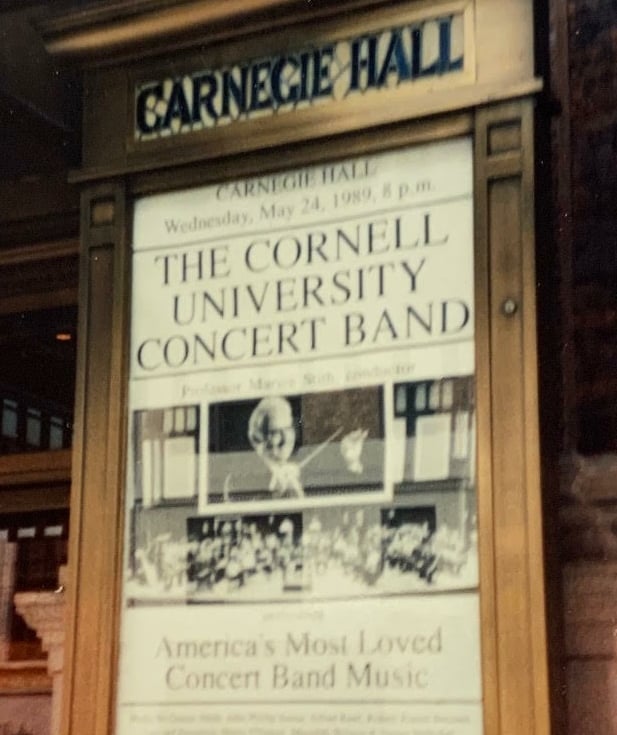
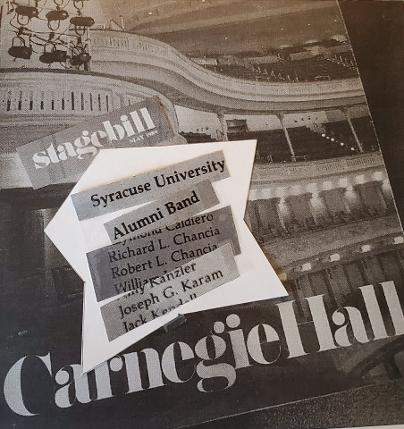
OK, you’re on the edge of your couches. (There’s a word from the 1940’s) You all agree that it’s a big deal to perform at Carnegie Hall? Actually, 3 guys from Proctor High did the gig at the Hall 32 years ago on the same evening. Yep…Wednesday night, May, 24, 1989.
Long answer short: Bob and Dick played their horns in the Syracuse University bands for director Marice Stith. (1954-58) Our pal Joe Karam (Proctor ’53) and Cornell University (’57) spent 1958 doing grad work at S.U.
Joe never played cymbals, a percussion section instrument but Bob, former President of S.U. bands had some clout, so old buddy Joe had connections, hence did some cymbal crashing for Syracuse band director Marice Stith.
Stith went on to Cornell, where he spent 23 years as director of bands. He conducted his final concert with the Cornell University Concert Band at…you guessed it-Carnegie Hall. To commemorate Stith’s entire career, a select group of his “CUSE alumni marching band members were handpicked to join the Cornell combined band for their last number. The Chancia boys made the cut and Bob made a call to Stith. Believe it. Joe Karam was added to crash the cymbals! Capish? You know how that stuff works.
The 3 guys from Utica Proctor joined the club with Sinatra, Toscanini, Bernstein, Glenn Miller, Mark Twain etc. as X- Carnegie Hall artists. You all don’t doubt us but we do have the printed program to prove it. We celebrated with Stith and 30 band people at an after concert reception down 57th street at the Salisbury Hotel.
Final note: CRASH! Karam played the cymbals by ear!
Mother’s Day Bride
By Bob & Dick Chancia
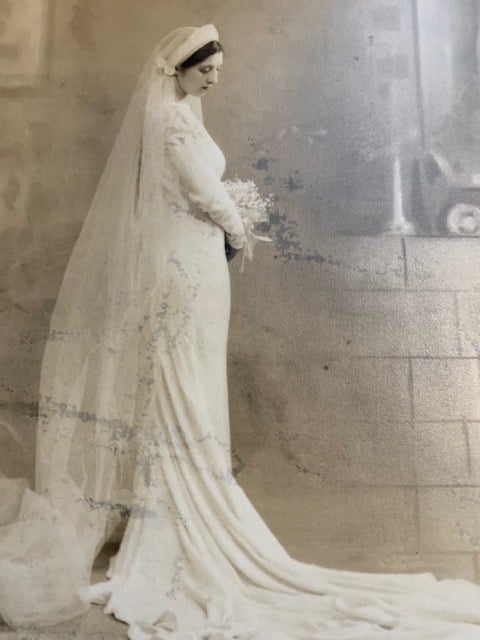
Here’s our wonderful Mom on her wedding day, May 8, 1935. She was 3 months and 20 days shy of her 25th birthday. Florie spotted her dapper Dan, (Allie) at the Utica Trust & Deposit Company, when making a weekly dollar deposit.
Quickly realizing, this is my man, she looked forward to making more deposits there. Allie thought; where did this flower come from? The rest is history!
The picture, taken in one of Bleecker Street’s photo studios, (either Rotundo or the Modern Studio) really says it all. Wouldn’t you agree that whoever snapped the shutter couldn’t miss?
Maybe we’re partial ‘cause she’s our Mom but…is that a beautiful bride or is that a beautiful bride? Florie’s angelic beauty radiated from the depth of her soul. She sure inspired us with a dedication and example that demonstrated selfless care.
She’s carrying a nosegay of lily of the valley, the flower of May. A perfect choice for our special lily of the Mohawk Valley.
Do not neglect your mother’s instruction. It will crown you with grace… (From Proverbs 1: 8 & 9)
Blessed Mother’s Day 2021 to our Mom: Florenza Marie Mangano Chancia!
Summer Jobs…UGH!
By Bob & Dick Chancia
In 1952 we turned sweet 16. In reality, it was sweet and sour 16. A couple of big milestones were ahead. First a trip to the DMV. (Dept. of Motor Vehicles) for driving permits. Then to City Hall for UGH….working papers.
Dad had a ’52 Plymouth. You guessed right…stick shift. One must coordinate the brake, clutch, accelerator and transmission shift simultaneously. Uncle Lou, having more patience than Dad, was the designated driving teacher.
This story is about the sour side of turning 16; time to get a summer job! UGH! Pop knew Louie Chanatry, thus we became “bag boys” at Chanatry’s market on Bleecker St. We packed groceries at the register then carried the heavy brown paper bags to the customer’s cars parked on the street. The bag boys all hoped to land at pretty Vita Rossi’s register. When the registers were quiet we pushed brooms. Mr. Chanatry didn’t allow any down time.
Two of our friends started at the store at the same time. Their Dads were much closer to Louie so they drew a cushier assignment: stocking shelves that payed a few dimes an hour more. That eventually upset us and we quit. The real world had lessons to teach and we were ill prepared to realize that partiality politics were part of life’s circumstances.
Summer jobs were not the exception for high schoolers. The Utica Department of Recreation headed by Duke Roemer placed many students at city playgrounds as directors and at the 2 municipal swimming pools ( Buckley and Addison Miler ) as life guards, checkers, operators etc. City Parks Dept. hired groundskeepers and many local businesses put young people to work.
In East Utica, some Proctor students worked at Caruso Cheese Factory, Gold Medal Packing, Saraceno Construction and Pride of Utica Ice Cream, to name 4. Those with administrative /office skills, trained at banks and the telephone company. Some of the gals, like Pat Calderella waitressed at Pinto’s in Old Forge and had a blast! The New York State Thruway under construction in the early 1950’s, was a new source for summer jobs. The pay was so attractive, many dropped out of school to hit the road full time.
A very popular summer job was bean picking. Teenagers, both guys and gals got a taste of the scorching sun as harvesters. A bus picked up pickers in the early morning at neighborhood stops and transported them to farms on route 5-S. The pay was by the bucket. More speed brought more bucks. Remo Zegarelli was fast and most of the girls had dexterity. That meant more bean$. Butch Polera quit on the intense heat and asked for an early ride home. “Nope, the truck leaves at 5pm.” Butch hoofed it Back to East Utica. Kids walked in those days.
After Chanatry, we learned how to manufacture ice cream novelties ( popsicles, fudgsicles, Eskimo pies and creamsicles ) at Joe and Fred Zogby’s Pride of Utica Ice Cream on South St near Quinn playground. There, believe it or not was a mini mass production assembly line concept. We had to pull, stick, freeze and package the products. Again, speed and dexterity were important.
As summer break college students, we progressed to the Dept. of Recreation. Bob was a playground director at Proctor. He set up and took down equipment; ( swings ) and umpired Kiwanis league baseball games. Umpires were taught baseball rules ( ex: Infield fly rule ) from the dean of Utica umpires, Ed Hinko. Umpiring was Bob’s nemesis. Players and parent’s tempers flared after close calls.
Dick was an assistant operator at Buckley Pool under director Elliot Hunt. ( A Proctor teacher ) He tested chlorine levels frequently with a simple instrument and assisted in opening and closing the building. Dick and an un-named friend pushed a pretty off duty lifeguard, fully clothed, in the pool; an immature display of adolescent showing off. A lifelong lesson was learned. Dick finished that summer working much harder fabricating Formica counter tops with his Dad.
The laminate was glued to 3/4 inch plywood and clamped in a press for 12 hours. He learned how jig/band saws, routers, lathes and sanders contributed to the finished product. Dad was an expert with wood. It wasn’t Dick’s shtick.

Sorry Butcho…the Bean picker’s truck leaves at 5 pm. Take a hike! UGH!
Many teens were fortunate to work in their family businesses. Joe Tantillo, B.J. Johnson, Bob and Joe Isgro delivered groceries for their family markets. Sal and former Mayor Mike Caruso worked with many friends at the Tilden Ave. cheese plant and Joe and Cosmo Saraceno plus a bevy of buddies did hard labor for the family construction company.
Bob was head director at Proctor playground his 3rd year and worked with classmates Charles Ganim, Joan Nole, Peter Vatalaro, Joe Majka and Pidgie Lupia. That summer, Dick at Miller playground with Bob at Proctor and Joe Karam from Murnane built the Proctor, Miller & Murnane circus train for the city-wide end of summer field day. That float won the blue ribbon.
There was a bottom line to summer jobs… when stickball, sandlot baseball, roller skating and hopscotch days were over. We earned money to defray college costs, contributed to family expenses and made some spending money. Much more important than money, we learned responsibility and that no job was too small.
Science nerd and Amazon CEO Jeff Bezos ( the richest man on the planet - $182.2 billion ) spent a summer as a fry cook at McDonald’s. While responding to the many buzzers that told him when to scramble eggs, flip burgers and pull fries from the vat, he studied the company’s automation improvements. He also taught camp for 10 yr. olds with his girlfriend. Their curriculum went from space colonies to TV and advertising.
“Whatever you do, work at it with all your heart, as working for the Lord, not for men.” ( Col. 3:23 ) So work hard kids, ‘cause you reap what you sow! That’s God’s reward! Way back then we would have thought, Sow What!
You Scream-a, I Scream-a, We All Scream-a for…PIZZA!
By Bob & Dick Chancia
There are many legends about Pizza. We’ll have some fun and tell our story. We bet it compares to yours.
Our Mama didn’t make her own dough. Dad bought it at Rintrona or one of the many East Utica bakeries: DeRisio, DeIorio, Raspante, DeVito etc., obviously he had options. First, Mama put the dough in a bowl and covered it with a towel to rise. She then sprinkled a little flour and brushed it with oil to prevent sticking while kneading it by hand. Maybe she cheated a little with the aid of a rolling pin?
Our pizza wasn’t round. She stretched it to fit a rectangular pan. Next the tomato sauce… Marinara. (no meat) The final touch was a sprinkling of grated Romano cheese before baking. The result was tomato pie that we called “pizza”. Our Pop wanted us to be surgeons. No way…we lacked dexterity. We ate our pizza the correct Italian way; with a knife and fork. Did that set off his delusion?
One legend has it; to honor the Queen consort of Italy, Margherita of Savoy, the Neapolitan pizza maker, Raffaele Esposito (now there’s a popular East Utica name) created Pizza Margherita. That pie, garnished with RED tomatoes, WHITE mozzarella, and GREEN basil, represented the colors of Italy’s flag.
Pizza wasn’t popular to the masses in the U.S. until World War II. American GIs brought the idea home. Our first pizzeria experience was at Trinos on Bleecker Street near the Florentine Pastry Shop. As freshmen in high school, spreading our wings, we ran into classmates Jim Paravati and Lou D’Amore enjoying a pie plus clams on the half shell. The Trino pie was round, thin, crispy with melted mozzarella cheese stretching on top. (Oregano of course) It was divided in triangular slices and we were impressed!
We wasted no time telling Mama she was doing it all wrong! She complied, changed to a round pan and added the stretchy stuff.
Our pizza search has never ended. Utica was a great town for pizza. Ventura on Kossuth had a unique little pie; Grimaldi’s was excellent; Nofri was popular and Graziano’s Regal on Bleecker and Jefferson was right up there. O’scugnizzo, the King of Pizza created “Utica Style”. He placed the mozzarella under the sauce. That became known as “Upside Down” pizza.
We wrote a song on that innovation. A sample lyric goes…”First the dough then the cheese, then ya put da sauce on da top”. In the 1958 comedy film, “Houseboat”, bombshell nanny Cinzia (Sophia Loren) showed young Robert (Charles Herbert) how to eat a slice the easy way! (fold it down the middle)
The pizza was adequate during our 4 years at Syracuse University but not on par with Utica. Burgers and subs from the campus “dingle” man (a bell ringing food truck) satisfied the late night hunger pains of young students. We remember the Villa off East Genesee having good pizza and Italian cuisine. The Varsity restaurant is now Varsity Pizza and is very good. It’s tough to get in after games. Rochester was 3rd behind Syracuse during our 3 years there. (1958-61)
Sadly our favorite town, Detroit, (1961-69) got a 4th place. Motown’s Italian cooking was Bolognese style rather than the Neapolitan that we were accustomed to. We did frequent LaLanterna in the sixties and Bob, now living there, spends time in the new hi-tech Lanterna, re-opened by the grandson of the original owner, Eduardo Barbieri. Today its Detroit’s best! Detroit is now famous for “Detroit Style” pizza and Pizza Hut is currently promoting its version of that Motown Pie. Bob now frequents Buddy’s in Detroit for the thicker Sicilian style SQUARES with the mozzarella also under the sauce.
In the 1960’s we ate a lot of pizza at Detroit’s Luigis and had an encounter there with Roger Maris and Mickey Mantle, also enjoying an after ballgame pie. Hey…why not? One weekend we found our way to the windy city. We sampled Chicago deep dish style at the world famous Uno’s. (we deep sixed it)
From 1970 on, we were fortunate to live in Manhattan, America’s “Pizza Heaven” where every variety is available within walking distance: brick-oven, wood fired, NY style, thin crust, thick crust, designer, (gourmet) pick your passion... it’s all there! Angelo’s on 57th St. has a coal oven Margherita style that’s over the top. After- work treks to Greenwich Village with buyer Alan Rosenberg and copywriter Dick Dotz confirmed, John’s Pizza takes the PIE!
Dick’s young son Alex appeared in classroom scenes in Woody Allen’s movie “Radio Days.” At the casting interview, Woody asked the boy if he heard of him. Alex’s reply: “I saw your picture on the wall at John’s Pizza”.
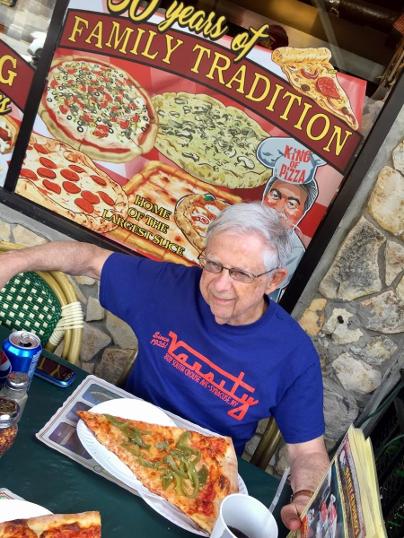
Dick at Benny Tudino’s “biggest slice” spot in Sinatra’s town: Hoboken, NJ. Photo by Caroline Chancia
Dick’s daughter Caroline moved to Hoboken, (a great place for pizza) so he now frequents Benny Tudino’s Biggest slice in town. You can enjoy a humongous slice and check out hometown hero Frank Sinatra pics on the walls. Tip for seniors: Dick’s son Rob taught us to grill pizza using NAAN Original Flatbreads. Try it.
Americans eat approximately 100 acres of pizza each day or 350 slices per second. The top topping is pepperoni. Surprise! Norway consumes the most pizza per capita – about 11 pies per person per year.
The big chains: Little Caesar, Pizza Hut, Papa John and Domino dominate with national advertising, although 65% of the pizza sold in the USA is from locally owned restaurants. The availability of pizza surrounds us. Super markets provide complete assortments of frozen varieties. (DiGiorno-not delivery, Tombstone, & Celeste, to name 3). If you’re APT to have a pizza APP on your phone…click… your favorite pie comes right to your doorstep.
This winter, Sno-bird Bob had no pizza luck in Sunny Isles Beach, FL. Solution: his sister-in-law Anne did a weekly pizza night in her apt.
We have enjoyed pizza for over 80 years; from Mama’s rectangle without melted cheese to Manhattan’s designer stuff. One last word of advice: Never put pineapple on your pizza! That’s a mortal sin. Father Pizzolio would assign heavy penance. ROUND pizza, cut in TRIANGLES and delivered in a SQUARE box? Don’t try understanding that.” When the moon hits your eye like a big pizza pie… dats Amore!”
1950’s Décor Had It All Together!
By Bob & Dick Chancia
So many things define a decade. One is décor and the 1950s didn’t lack distinct style. It was so distinct that a current style rage (Mid-Century) is in!
We hiked along Armory Drive to Proctor High in those happy, safe times and recall passing by many 3-section picture windows with a favorite lamp prominently placed in the center section. The post-war building boom made its impact with many capes and 1-floor ranch homes.
Inside the picture windows were the furnishings: beanbag and butterfly chairs, pole lamps, blond furniture and Formica, Formica, everywhere. Our Dad was a fabricator, so we knew all the patterns: charcoal and pink Skylark, Linen, Moonglow and Mother-of-Pearl to name a few.
Besides Formica counter tops, shiny surfaces of chrome dinettes complimented thick vinyl covered chairs. A sweeping 3-piece turquoise sectional spanned our living room. There we watched Uncle Miltie, Ozzie & Harriet and Your Show of Shows. Saturday afternoon was college football with pal Larry Luizzi, on his B&W round screen Zenith TV. Rabbit ears only! No remotes, modems or tangled wires crawling the floors.
Many homeowners replaced dark wood framed moldings and French doors with archways. Our windows were crowned with jig-saw scalloped wood cornices capping plush draperies or curtains. Walls and wallpaper came down and paneling went up; often knotty-pine. Wall-to-wall carpeting covered varnished hardwood floors. ”Modernistic” abstract design fabrics replaced pas-se Victorian prints.
Thin slant-legged side tables held ash trays as most people smoked. Sleek, simple stackable cabinets and chests offered many set-up options to hold china or our stereophonic sound systems. We were proud of our amplifier, Garrard turntable and Fisher speakers.
Enoch Light’s Command Record label produced “Persuasive Percussion.” His technical pioneering brought heightened stereo effects and fidelity into our living rooms. Measures of music could now be separated from speaker to speaker. Every “cool cat” had a stereo system. Perry Como and Doris Day’s hits came to life in our dens.
Paul Mc Cobb was the foremost ‘50s American modern furniture designer. After spotting one of his dining room sets in Leed’s furniture window on Bleecker Street, we talked our folks into buying it. His pieces are rare and valuable today. What McCobb said about his designs apply to the boom years also. “It is a period of its own and should not be confused with any other periods.”
We attempted to imitate the 1950’s decor of our freshman dorm at SU, (Watson Hall) that just opened when we arrived in September 1954. Our room was painted Chinese red and onion-skin. Uncle Lou re-painted our bedroom at home to match.
No doubt your homes had some 1950’s accents. If not, you had to remember the red Formica tables in Uncle Bill Rizzo’s Campus Inn.
Why all the fascination with 1950’s style? Maybe ‘cause things were drastically changing after the war. A life-shift took place. Change brings growth and we were growing up.
Let’s hope the Covid 19 life-shift is as productive. If spring ever arrives in the Mohawk Valley, check out a flea market or garage sale. You may find some old memories like a Melmac dish or an “I like IKE” button and recall the “boom years” when we all liked each other and had it all together!
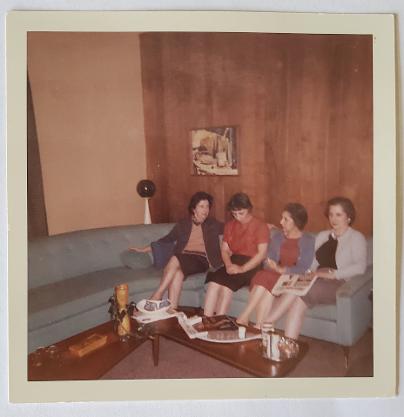
Aunts Helen, Clara, Mom and Aunt Ev, comfortable on our turquoise sectional. Note boom-a-rang coffee table. Popular paneled wall is the background.
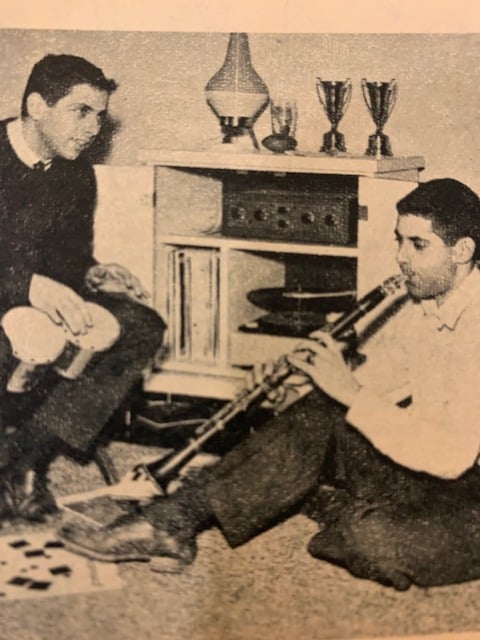
Bob tapping bongos and Dick playing clarinet to Enoch Light’s Persuasive Percussion recording.
Time to Honor the Honor Roll!
By Bob and Dick Chancia
Here’s a fact of life: we don’t applaud scholarship but love to acknowledge and pamper sports/entertainment heroes! When was the last time you saw a Rhodes Scholar or Princeton valedictorian doing a shaving commercial?
Sports and show-biz stars are all over the media: hosting, co-hosting, waving from floats or broadcasting the Rose parade while the academic achievers are… who knows where?
Somehow, just one monumental sports achievement like Joe Namath’s miraculous Super Bowl upset, which he predicted, vaults him into a life-time pop culture career complete with branding. (Broadway Joe)
We were guilty of that in our youth also. There were honor rolls and the National Honor Society and that was good BUT…sports stars always got top billing. We recall homeroom 202 at Proctor with Miss Marchetta. Each month she wrote on the blackboard in Palmer Method; the Honor Roll, to remind us that marks mattered.
Best athlete Ralph Antone ’54 was always on it. He was an exception but that inspired us to want to see our names up there too. Bet your homeroom teacher did likewise.
Today’s culture is obsessed with pop stars, and when they fall like Tiger or O.J., we’re bombarded with more exposure plus personal disappointment. The focus of this column is to recognize a few achievers that were impressive in high school and beyond.
Gene Nassar ’53, was a true scholar, gentleman and professor who dedicated his life encouraging our local students to improve. Gene was a Rhodes Scholar! How about that?
Lois Geraci ’51, reached the pinnacle of Madison Avenue recognition creating award winning national ad campaigns as did her classmate, Guy Cimbalo. His brother Bob ’54, was a U.C. art professor and also a renowned Italian-American folk artist. CEO Pat Locanto ’54, headed up the Big 4 accounting firm Deloitte & Touche’s Management Consulting.
Gerard Moses ’56, is an actor, director and professor emeritus of drama at S.U. Angela Zegarelli Vanderhoof ’53, is the former executive director of The Arc that serves people with intellectual and developmental disabilities.
Eugene Corasante ’48, established CONMED in 1970, a technological leader of medical supplies. David D. D’Alessandro ’68, is the former chief executive and President of John Hancock Financial Services. Proctor’s football stadium carries his name. Phillip Bean ’82, former Associate Dean of Haverford College, is now the Executive Director of Central N.Y. Conservancy.
Prof. Richard Benedetto ’59, was a stalwart White House correspondent/columnist in Washington, DC for U.S.A. Today. He emphasized that Proctor to so many was and still is our “guiding star…no matter where we are.” PHD Frank Lentricchia ’58, was literature and film studies professor at Duke University. Tom Yacovella ’56, became an acclaimed award-winning American wildlife artist. (Outdoorsmen Hall of Fame 1985)
They are just a few of our Prox accomplishers who excelled with their skills and passions. We will end this column by recognizing our unsung heroes, the class pacesetters of the 1950s.
Valedictorians Salutatorians
’50 Robert Lupi Loretta Taylor
’51 Lois Geraci Anita Scalise
’52 Vita Rossi James Ferro
’53 John Iacovino Rosemary Arcuri
’54 Mary Karros Donald Green
’55 Yvonne Graziano Joan Nole
’56 Angela Rabbia Gerard Moses
’57 Eugenia Roman John Raymonda
’58 Elaine Mancuso Carol Arcuri
’59 Mary Ann Bello Suzanne Tranquille
We’re gonna add one more to the list ‘cause she’s our 1st Cuz: Pamela Ciancia – ’64 Valedictorian.
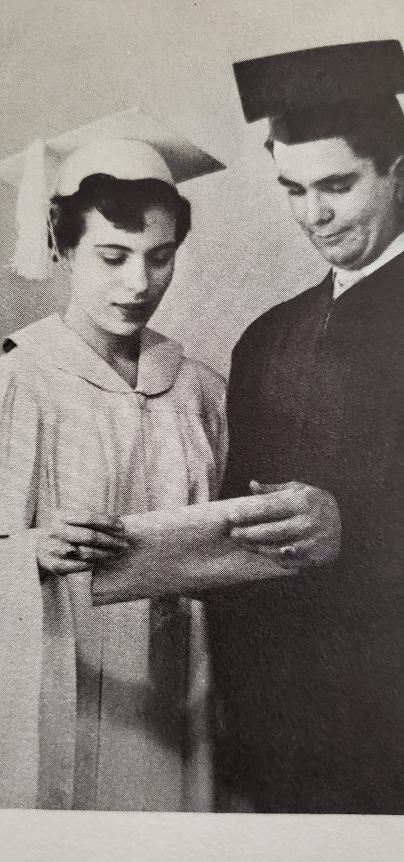
Shown are 1953 Salutatorian Rosemary Arcuri and Valedictorian John Iacovino
There you have it! Genuine achievers who are our most glittering statistics! Albert Einstein once said: “Try not to become a man of success, but rather try to become a man of value.” So crack those books kids – it’ll pay off!
Where are your treasures?
By Bob and Dick Chancia
On April 12 at 10:08 pm Dick will be 85 and 5 minutes later at 10:13 pm Bob will hit that mid eighty mark; a couple of Octogenarians who like to step back in time. How did they do it? Bob created a time capsule: a tall cabinet with glass doors.
He carefully edited his memorabilia, selecting only keepsakes that put a smile on his face. The showcase was the focal point of his living room. Dick was quick to copy Bob. Why not? Copying Bob’s homework always worked in school! Yep, 250 miles upstate, Dick set up a similar display.
Here’s the philosophy behind these time capsules: when one sees something from years ago, the magic is not in the items but the warm memories that they conjure up. Keep in mind; these collectibles aren’t worth a lot of money…no, no, no. They just retrieve those “good old days”.
Packages of gum that Our Dad sold for 30 years: Beemans, Black Jack, Clove, Dentyne, Chiclets and even tiny paper bags of Sen Sen. Remember them? They bring back the sweet fragrance that permeated Pop’s 1941 Buick Special; the family car that we took so many rides in.
Dick has a tin ash tray he made at Camp Assisium in 1949, complete with Dad’s name (Allie) engraved on it. Remember the flip-top Zippo lighters? Dad’s is there with his John Hancock (Allie Chancia) on the face of it. He lit many White Owl cigars and that mellow aroma comes right back to mind.
Bob’s Graffenburg Dairy milk bottle reminds us of our next door milkman, Mr. Owens. His horse and delivery wagon were in his driveway every lunch hour.
Autographed baseballs feature both displays. One signed by Joe DiMaggio and another by the 1968 World Champion Detroit Tigers. The 1954 gold Proctor HS class ring with deep ruby- like stone out sparkles the bigger 1958 Syracuse U gold ring with…what else but an ORANGE stone. Our first wrist watch; a 1944 Westclock, sans strap completes the jewelry category. There are also 1958 SU freshman beanies in both cases.
The feature items in both displays; model CARS from the 40s and 50s. We owned a fire- truck red 1959 Chevy Impala convertible and a 1967 plum-mist Pontiac Firebird. Replicas of both are among many others from that colorful era like the 1948 futuristic Tucker.
Peek through the glass doors and see bobble-head dolls depicting our sports heroes, Carmello Anthony, Donovan McNabb and Mark McGwire. The nostalgia continues: sentimental kiddie hand drawn pins, a 1955 Duncan yo-yo, our 1st regiment Army A sleeve patch, plus Kewpee and Schultz & Dooley snow globes.
When Bob liquidated his New York City apartment, he brought in a prospective antique buyer to pick and choose. He ignored the silver, furnishings and accessories but zeroed in on the Memorabilia cabinet. Our guess: the nostalgia put a smile on his face also. Do you have glass doors you can look through and feel those “good old days”?
The Oneida County Historical Society has meticulously displayed artifacts of our area’s history. Munson Williams Proctor Arts Institute is our regional center exhibiting a substantial collection of internationally recognized works.
The new Proctor gym has a Hall of Fame to acknowledge past sports heroes and highlights. You can see Prox 2nd baseman George Fanelli sliding safely into 3rd base in 1951. Visits to all are well worth your time.
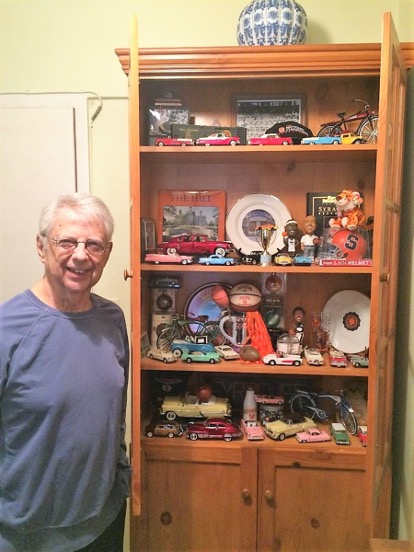
Bob standing next to his trophy cabinet of memories!
At our 65th Proctor reunion, we were taken aback by the heartfelt passion of classmate Marge LaBarbera Calenzo. She shared memorabilia of our 4 school years and carefully displayed her treasures so all could recall those special years. Her vast collection even included her cheerleading sweater. That’s Rah Rah zeal 65 years later!
Let’s allow these earthly trophies to remind us that growing up in Central NY was indeed a blessing! Most importantly, the real hidden and timeless treasures are where we find God’s wisdom and understanding; perceiving and valuing Him as Savior and source of ALL!
Our pal, Dr. Frank Paladino once said after a visit to the Met in NYC: “Don’t collect anything. Its already been collected”. There’s some practical advice to glean from.
“Do not store up for yourselves treasures on earth…But store up for yourselves treasures in heaven…For where your treasure is, there your heart will be also”. (Matthew 6: 19-21)
Day by Day: The 50’s were FAB!
By Bob and Dick Chancia
We had no devices and weren’t googling online for everything. We had structure, knew what to expect and were satisfied with simplicity. There was something sacred about that.
Our hearts were warmed by routine, unlike this present new ICE age. ( Information – Communication and Entertainment ) Remember cars with fins instead of dashboard screens? Each day consistency prevailed. It was the FABulous 50’s!
On Sundays we did Mass and dealt with the Nuns – ugh! Mother Superior – Sister Pius clacked her hand clicker to keep us in line on those hard pews. After the Sunday school storm came the sunshine for peddling our trikes and scooters.
Perry Winkle, Captain Marvel, Dick Tracy, Lil Abner, Gasoline Alley, Joe Palooka, and the Teenie Weenies in the colorful Sunday funnies were our social media. Then, the aroma of the sauce and meatballs sizzling in oil was a ritual. Many times Dad took the family for a ride around the Mohawk Valley, stopping for a sundae at one of the soda fountains where he peddled Adams chewing gum.
On Monday it was back to school but Monday night meant DOWNTOWN! “The lights are much brighter there. You can forget all your troubles, forget all your cares so go downtown”! The busy corner was our meeting place before the malls. The Boston Store, Wicks & Greenman and Morrow’s Nut House had it all.
Tuesdays meant homework and then Dish Night at the Ri. Those black and white silver screen gems with Lana, Clark, Bette Davis or John Wayne plus previews, popcorn and the news reels were a full plate. Look Mom – no I-phone!
Wednesday, we left school early for religious instruction to face the Nuns again. In Cornhill we got a sugar-high at Mame Cronins before confronting the scary ladies. If we got lucky, it was pretty Sister Marie’s class and our sugar habit was really satisfied!
The Wednesday night fights by Pabst Blue Ribbon brought Kid Gavilan, Carmen Basilio, Rex Layne, Chico Vejar or Sugar Ray right to our living room. We met with neighbors Larry Luizzi and Joe Karam for a weekly Fight Club with Wise chips, Pepsi and Utica Club.
Thursday was Prince Spaghetti night in Boston but in Utica it was Gioia and P&R night. Same thrill! Then off to the Parkway band shell concerts. The domed stage was back of the tennis courts and we sat on the ski slope facing the music. We ran into classmates and some even kindled new romances.
During Holy Week, Thursday was special. We visited the eastside churches; a yearly sacred and colorful tradition. The solemn purple draped statues, Stations of the Cross and ornately decorated altars reminded us of the hope of Resurrection Sunday. The blossoms of spring meant new life. “I am the resurrection and the life. He who believes in me will live, even though he dies; and whoever lives and believes in me will never die” ( John 11:25 ).
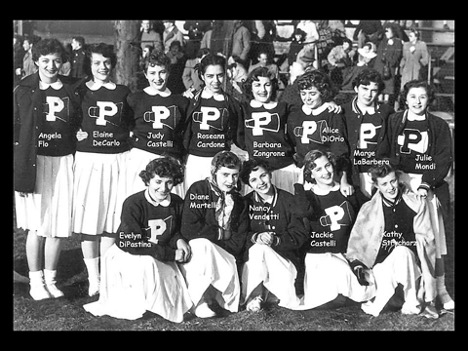
Saturday at Murnane Field 1952: our bevy of pretty Proctor cheerleaders
The main thing about Friday was NO MEAT and school let out. If it wasn’t Baccala at home, it was Jean’s Beans in King Cole Plaza for fish fry. At night, the Proctor gym held our dances complete with a Bobby DelBuono floor show and Coke with chips in the locker room. Many recall chatting with our friendly cop always on guard duty.
Saturday meant football games at Murnane. We showed off our bevy of pretty cheerleaders and band while Lou Fondario scored touchdowns. Watching cartoons, westerns with the Cisco Kid, Hop-a-long or Gene Autry was the afternoon fare at the Ri, Family and James Theaters.
If you were cool enough to have a Saturday night date, it meant a main feature at the Stanley, Avon or Olympic. Proctor steadies like John ( Otto Graham ) Fanelli cozying up to cute Ruth Cozza were a familiar sight. They capped off the night at Venturas or Trinos for pizza. Sammy Cahn’s lyrics to the 1945 hit popular in the 50’s said it all…”and day by day, my love seems to grow”!
Those were the weeks that “wuz”! They were predictable, fancy-free and FABulous. Hey – it was the 50’s and they’ll always belong to US!
Merry Old Mary Street had Soul!
By Bob and Dick Chancia
The popularity of Ancestry.com confirms that many of us want to know who came before us. What parts of the world did they come from? We won’t go back that far. We’ll keep it simple.
What’s the first dwelling place that you remember? For us it’s 522 Mary Street. Our Grandfather Chancia bought a small house there in the late 1890’s, soon after arriving from Missanello, a town in the Southern Italian region of Basilicata. (West of Puglia). This skilled cobbler operated a shoe repair shop on Devereux Street in downtown Utica, with elite cliental.
As a young man he was engaged to shine the shoes of “Teddy” Roosevelt, who was visiting the former Butterfield House, on Genesee Street. He also made artistically crafted leather shoes. He hand-stitched a regulation size genuine leather baseball for us. Instead of the familiar white horsehide, it was brown with black stitching.
His entrepreneurial spirit led him to expand the single family dwelling to a three story brick tenement building. It included a master apartment on the ground floor and two apartments on each upper floor. One toilet and sink at the rear of each floor was shared by the occupants of the floor.
He added a six stall cement-block garage in the back yard, to rent for additional income. A wrought iron fenced-in yard on the east side of the building included a cherry tree facing Mary Street. We remember digging in the dirt there with toy tin shovels and dump trucks.
Milkman Eddie Lee and his large family were our neighbors to the west and the Coluccis and their son Humbert lived east. We later attended Proctor High School with these friends. Philomena Ciruzzi lived across the street. Uncle Louie Ciruzzi shared plump, delicious mahogany colored cherries with us. Up the block, Mr. Greco, a police officer, was often on the porch of his neatly kept home.
Cousin Jerry Sessa was our play leader. He’d parade us around the cobblestone yard with toy drums, handmade wooden rifles and American flags. Our future pal, George Fanelli didn’t live on Mary Street. He was the Yo-Yo champ of Catherine Street.
A photographer, complete with cowboy/girl garb and a pony stopped by and took our pics atop the pony. We’ll bet many of you have a similar photo in that same saddle?
Gramma and Grampa raised four daughters and five sons in that first floor flat. We remember some of them living upstairs (the old folks would say…”on-copa”) after they married. Our space included a small parlor, eat-in kitchen to the rear and two bedrooms. How Mom dealt with sharing a bathroom in the hallway with other tenants, still baffles us. We have no recollection of that ever being an inconvenience. All we remember is warm extended family, love and tender care.
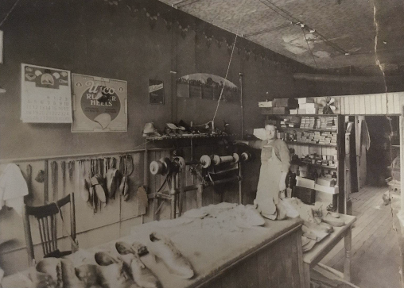
The authors' Grandfather, Gaetano Ciancia (Chancia) in his shoe shop on Devereux Street.
The grape-vine laden 500 block didn’t lack for adventure. Occasional marches by the Red Band and refreshing visits by the lemon ice man are unforgettable. Trosset’s (the Utica Catholic Bookstore family) Mom and Pop grocery store, east on Mary and Second ave. was complete with metal scoops to portion quantities of foodstuffs. Packaged goods were rare in the late thirties.
On Third ave., Wonder Bread Bakery filled the air with a sweet aroma of fresh baked bread. Elizabeth Street was the home of Dahl Motors where Uncle Bill purchased his new black Ford every year. Within walking distance was Chancellor Park, and Bleecker Street School, where we attended kindergarten and first grade.
There we met the first love of our young lives; kindergarten teacher, Miss O’Rielly. Mom invited her and first grade teacher, Miss Buckley for a macaroni and meatball dinner. A few classmates were Florio Vitullo, of Florentine pastry fame, and models to be; the Castelli twins.
After the depression Dad purchased our first home; a clapboard craftsman bungalow on Plymouth Place for $3700 but we’ll never forget that humble abode on Mary Street: safe, secure and filled with soul!
Student Team Managers learned to serve
By Bob and Dick Chancia
Part of our 50’s high school experience included being team managers. Having adequate athletic coordination but lacking our growth spurt hindered competing with the big guys. So we settled for team managers. We earned a coveted “Block P” which allowed us in what we considered then, to be the in crowd.
That was our initial motivation but hidden in that experience was an opportunity to perform necessary behind the scene tasks without any student adoration. The jocks got all the glory while the managers learned to serve. Those lessons proved useful later, as abilities to multi-task developed leadership skills. Selfless service builds character. Admittedly, those weren’t our motives then.
What did team managers do? We readied equipment for use, took attendance, refereed practice games and manned the official scorer’s table during games. First aid kits had to be available and player performance stats were recorded. We called in post game highlights to the local newspaper. That required responsibility, punctuality and accuracy. These chores far exceeded the common perceptions of a water boy.
Players, who we admired, hounded us to get their names in the paper. Coach Phil Hammes, the quintessential taskmaster, assigned Bob, JV basketball manager, a challenging job. After studying the required manual, “Net Scoring” stats were recorded during every game. Bob, perched high in the stands, carefully marked down who shot and from where. Assists, blocks and steals were also tabulated. Placing dots on floor charts demanded total concentration for maximum accuracy.
Coach Hammes collected the charts after each game from one bleary-eyed student manager. Unable to enjoy the game, those efforts were early lessons in dealing with work pressure.
Another chore: packing all road-game equipment. When the JV hoop squad traveled to play Rome School for the deaf, we realized we forgot to pack the duffle bags of practice balls. Anticipating Hammes’s fiery rebuke, we dashed off the bus to ask the nearest person at the gym to lend us some basketballs.
Everyone was deaf! Employing crude sign language got us some balls in the nick of time. We dodged a frightening Hammes bullet!
Pressure, duty, selfless service along with developing a work ethic offered some hard lessons. Besides molding character, we learned managerial skills.
Some diligent student managers from those years were: Louie Luce, Mike Calenzo, Joe Karam. Robert Jones, Joe Beratta, Sam Saccoia, Martin Henry, Jimmy Montana and Tommy Trinco, the “Dean” of all Prox managers!
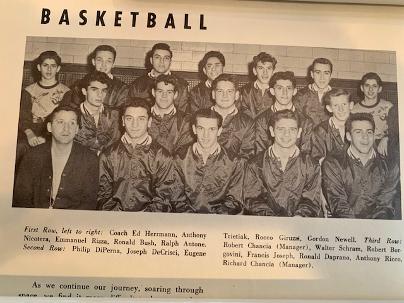
The 1998 American sports comedy film “Waterboy” starred Adam Sandler. Sandler was nominated for a Golden Raspberry Award for Worst Actor. His geekish performance of low humor and cheap gags were an insult to the student manager genre.
Today, colleges offer Sports Management degree programs involving finance, communication, sports law, history, marketing plus event and facility management.
Our friend Bill Behm, a student manager at Wake Forest was Detroit Tiger trainer from 1966-84. Brian DeStefano, a former Duke Manager, is now associate head coach at Harvard. Mark Evans, equipment manager at Kentucky, was a student manager at both Memphis and Kentucky. Brothers Brian and Kevin Paugas, the patron saints of managers now serve as San Antonio Spurs director of scouting and Michigan State director of operations.
So laugh if you like at these earnest efforts to serve their peers. Remember, in Matthew 20:26, Jesus said “Whoever wishes to be great among you must be your servant…the Son of Man came not to be served but to serve”. Should we desire any less?
Bubble lights and tinsel recall past Christmases
By Bob Chancia
66 years ago, I left Utica for college. After graduation, a brief career in Rochester, NY was interrupted by a short Army stint at Fort Dix. The 60s were spent in Detroit, then Miami before a 49 year stretch in New York City.
Christmas in each place was special, including my formative years in Utica. Now a widower, I returned to Detroit in 2020.
Robert Brooks, a life long friend from Roosevelt School e-mailed this message:
“I’m glad you are happy in Detroit and I can see how you would find it particularly interesting. Detroit was a big, prosperous and exciting city when you and Dick, small town boys, lived there. Now the city, having gone through a long and devastating decline, is on its way back and you are there again, now a mature (to say the least) and experienced citizen, to share in its rebirth”.
Praise God rebirths don’t leave memories behind. Departing New York was difficult; what to keep and what to discard? Two boxes stored for 49 years in my roof-top locker made the United Van Lines inventory to Detroit. One was labeled 1940s Christmas ornaments and the other, Bubble lights. Remember them?
Dad, an impulse shopper, had to be the first with the latest rage. When bubble lights appeared, he rushed to Tehans on James St. before they ran out.
Each year without fail, dear friends from Oregon send presents, meticulously chosen and wrapped. One, a small box of Christmas tree icicles (tinsel) also made the cut. Remember them?
Barely able to navigate my iphone, I struggled through the online purchase of a small artificial tree, reminiscent of a 40s Balsa variety. As I unpacked and assembled it, visions of Christmas in every place I’d been emerged.
I unraveled the string of bubble lights, circa 1951 from Utica, recalling how placing the lights was the most tedious job for Dad. The 40s ornaments were fragile glittery glass, with hooks or a looped string. A few were shattered but enough remained in tact to fill my 2&1/2 foot tree.
The shiny-bright tinsel from Oregon completed my throw-back treasure. Their quality wasn’t up to the 40s icicles that my folks patiently placed one by one on real sparse branches. I hurriedly tossed clumps of tinsel on fake branches.
Suddenly, the miniature nativity figures in a small antique tin of odds and ends my wife left came to mind. I couldn’t omit the truth of what Christmas is about; the birth of the Savior who offers all mankind, joy, rebirth and everlasting life. One indelible memory was visiting Uncle Eugene on the 5-Points. His detailed, hand crafted, lighted layout of Bethlehem was mesmerizing!
Now, in apartment 610, at a renewed downtown Detroit landmark building, proudly stands my retro tree. I grew up at 610 Plymouth Place in Utica; God sure has a sense of humor and records all of our meanderings.
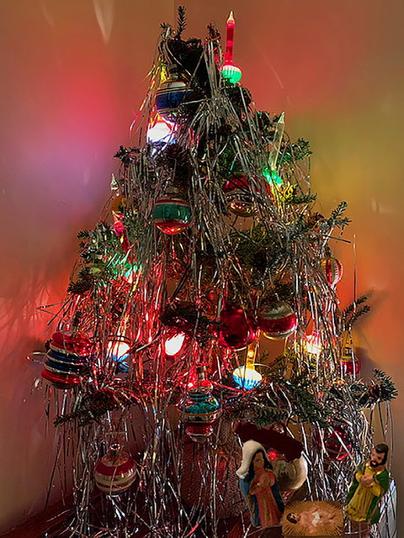
My 1950’s throwback-tree, including nativity figures, reflects the warmth of home.
In the midst of COVID 19, disturbing national discord plus the mind boggling digital age with its confusing lingo, I plugged in my retro assemblage. It is beyond glorious! It’s like a ZOOM meeting with glaring colors, sparkling lights and shimmering tinsel transmitting all the data from my life’s Christmas memory file, WOW!
Wherever Christmas finds me, wherever its love light gleams, I’ll be home for Christmas, if only in my dreams!*
*”I’ll be Home for Christmas” – Kim Gannon and Walter Kemp 1943.
Commentary: Recalling the great days of high school productions
By Bob & DickChancia - October 11, 2020
Most American high schools have a history in stage productions. Proctor High was no exception.
To recall the golden age of theater at PHS, our years (1950-54) typify the story.
Enter Peter Dodge and Senatro LaBella (LB) — the Orson Welles and Hal Prince of Proctor. The key to any production is its director, the presentation’s creative visionary. If they presented Tony’s for high school productions, LB and Mr. D would easily have surpassed Hal Prince’s record of 21. They aptly complemented each other and were the force behind so many successes. Student performers quickly caught their passion for the stage.
Each year, they directed two productions: the Senior Play, cast from the graduating class and the Dramatics Club presentation open student-wide.
As freshmen in 1950, we saw the Class of ’51 re-enact Ralph Thomas Kettering’s 1928 Broadway thriller, “The Clutching Claw.” Ben Carucci played the anxious John Thornton, who re-wrote his will but was strangled anyway. Mike Fanelli was the scary clutching claw, killed in the final act but never identified for the audience. Joanna Anguish, Barbara D’Iorio, Joan Spost, Felix Gigliotti and Joan Cutcheon also starred.
The Dramatics Club play that year was Dodge and LaBella’s most ambitious effort; James Hilton’s “Lost Horizon” (1937). This adventure classic followed five plane crash survivors who landed in mythical Eden-like Shangri-La, a place of peace and contentment hidden in the Himalayas. We can’t forget this one.
Here’s why: as freshmen roaming the halls, we caught the astute eye of director Dodge. He immediately escorted us to LB’s English class, where he interrupted with the question – “Well, what do you think”? LB’s response – “They’re perfect.”
We landed the roles playing two pageboys to the High Lama (Mike Fanelli) of that utopian civilization. Other cast members included Ben Carucci, Lois Geraci, Pete Migliaccio, Carmen Graziano and Nunzio Melchiore.
In 1952, Dodge and LaBella, with the music department, challenged the high schoolers to their first attempt at an Operetta. Singing, dancing and acting resulted in “The Spanish Grandee.” With festive costumes, superb choreography by Vinnie Ruggiero, plus choir and orchestra backing, it was a three-night Broadway-like smash!
In 1953, the seniors presented Louis Soloman and Harold Buchman’s sparkling comedy, “Snafu.” Frank Moreno played a problem child who ran away from home at 14 and illegally joined the army until he got found out. Elizabeth Russo, Rosemary Arcuri, Cynthia Boris, and Angela Zegarelli complemented the humor injected by Joe Karam, Antoinette Giudice and Mario Fumarola.
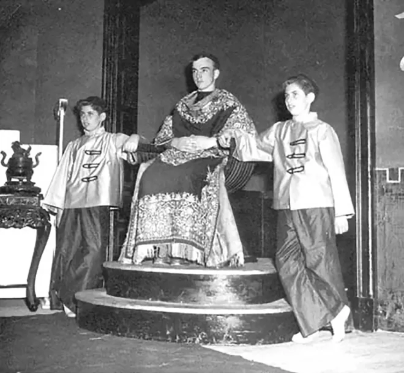
Proctor High School Dramatic Club's presentation of "Lost Horizon" in 1951. From left: Richard Chancia, Mike Fanelli and Robert Chancia.
The class of ’54 showcased Reginald Denham and Mary Orr’s 3-act comedy, “Be Your Age.” Jean Loosli played the high-spirited college coed who threw over her handsome young fiancée, hoping to marry an elderly psychologist who went to college with her father. Dick Cerri, Elaine Lacatena, Malio Cardarelli, Pinky Inserra and Ralph Antone had key roles.
That year, the Dramatics Club brought “Our Town.” Thornton Wilder’s story of small-town Americana in the early 1900s to our stage. Yvonne Graziano and Sam Durso starred. This small sampling, spearheaded by Dodge and LaBella, hopefully, recognizes the quality and diversity of theater they brought to our audiences.
“When we close up the curtain, this much is for certain, the ones who laughed the most, were not the ones who paid but the ones who played the host." It's a line taken from Bob Isgro’s song The Show is Over.
A virtual education shift will dramatically rob tomorrow’s kids. Performers and stagehands, past and present, especially Peter Dodge and Senatro LaBella – take one more walk down, one last bow and another well-deserved curtain call.
COMMENTARY: Summer carnivals brightened Utica’s past
By Bob & Dick Chancia - August 23, 2020
With the COVID 19 scare, Bob opted for an Amtrak sleeper compartment, maximizing isolation during his delayed exodus from the Sunshine State. Two days later he’d arrive in his new Detroit apartment.
Approaching Orlando, the view out his window was a collection of old James E. Strates show train cars on a side track. Other colorful carny cars were stored there as well.
Funny, just the night before, Dick called and said, “I’ve got an idea for our next memoir. How ‘bout our summer escapades to the James E. Strates and O.C. Buck shows?”
The next day, Bob’s train window framed this rail yard of old carnival cars from an era gone by.
Suddenly, that scene mentally morphed into the vast rural parking lot adjacent to the dazzling wonderland of a traveling carnival on the edge of Utica.
For adolescents in the ‘50s, this meant escaping with peers, fantasizing wanderlust dreams tinged with an aura of imagined freedom. The gypsy or drifter life took on a glamour and intrigue that opposed our controlled, safe and expectant Utica upbringing.
Hidden beneath the meteoric glare of a nighttime midway was the forbidden dark side life of a carny. We’d pile out of George Fanelli’s ’38 Pontiac and roam along the dirt and dried grass, being lured by many tent offerings, freak shows, animal acts, and the funhouse. Carnival barkers enticed us with their peep shows.
Without parental supervision, did we dare sneak a peek at Georgia Southern or Rita Cortes? We knew that was taboo. There was plenty more to safely indulge in. We gorged on candy cotton, fries, burgers and red-hots before the franchises made them routine.
You’d win a glitzy prize if they couldn’t guess your age or weight. Arcades, thrill rides and the Ferris wheel crowned the summer night sky. It was all so thrilling and yet so elementary compared to now!
The James E. Strates story is typical of early 20th-century hardworking-immigrants in America. After a series of odd jobs, young James learned to wrestle at the Endicott, NY YMCA.
He started his midway career in 1919 as a professional wrestler, Strangler Lewis. In 1922, he acquired the small Southern Tier Shows which included a merry-go-round, Ferris wheel, athletic show, 15 concessions and 3 sideshows.
James bought out his partners, survived the Great Depression and, in 1923, founded the James E. Strates shows. America’s only railroad carnival traveled the U.S. during a seven-month season, transporting personnel and equipment with 61 cars and 34 trucks.
The Greek immigrant passed away in 1959 at age 65, and his son, E. James, took over. The shows, based in Orlando, Florida, provide rides, games and concessions for local county and state fairs throughout the nation.
Dick met Theodora Strates, the daughter of James E. Strates at a family gathering. Dick’s wife Ellen’s first cousin married Theodora’s daughter. Teddy, as she was called, told of her exciting life growing up with the carnival and actually living in a railroad car/home for seven months each year. Dick, never forgetting Rita Cortes, asked about her. Teddy stated that Rita was a happy grandma, retired in Florida.
The 1980 movie, “Carny,” starring Jodi Foster and Gary Busey, is as close as it comes to depicting the exciting carnival life that we romanticized in the early 1950s.
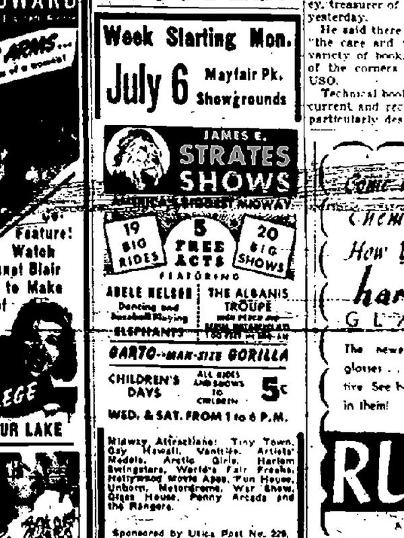
This advertisement for the James E. Strates shows is from a 1942 Utica Observer newspaper. O-D ARCHIVES
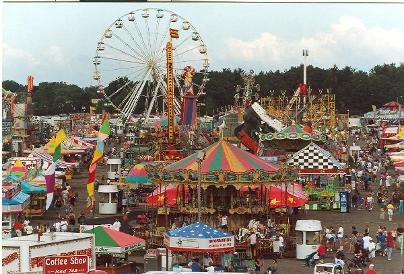
Why were the James E. Strates and O.C. Buck (out of Troy, NY) shows so fascinating?
‘Cause they ignited our big imaginations -- that’s why!
COMMENTARY: Uticans’ America’s Got Talent run stalled by COVID
By Bob & Dick Chancia - July 12, 2020
Life begins at 40? 60? How ‘bout 84?
Long story short; five years ago after over 60 years of writing songs, former Utican, Hollywood song producer Joe Saraceno suggested we write a hip-hop song. Hip-hop is hot!
Knowing nothing about this music genre, we listened to a few rap and hip-hop radio stations. Our first few concepts were negative. Then…Bam! We had it. “Who says Grampa’s too old to do hip-hop?”
Two identical octogenarians performed it everywhere imaginable.
Last September, Bob opened a New York City variety show to an audience of 200. A chorus of 3 young gals backed him up. The director said: “I had to kick-off the show with a winner.”
A friend in the audience recorded the song on her phone. Not happy with the quality, she forwarded our website, (twoabsurd.com) to a national TV show, America’s Got Talent. Surprise! The show notified us that we were invited to audition on Jan. 21 in Detroit.
We met in Utica, jumped in the car and headed to Motown. The 10-hour drive was our rehearsal time. We did it as a lark — ala journalist George Plimpton’s many stunts as an amateur. He sparred three rounds with Archie Moore and Sugar Ray. He ran a few plays as a quarterback with the Detroit Lions; all recalled in the book “Paper Lion” which became a 1968 movie starring Alan Alda.
On Jan. 21, hundreds of young wannabes met in a huge Detroit audition facility. After registering, they stuck a cattle call number on us in a holding room mobbed with other contestants.
A spokesperson and camera crew singled us out for a 20-minute interview. We felt we nailed it and were told to exit the cattle call for an early audition. The holding room gig was probably pre-determined?
There were seven other acts in the audition room. The instructions: introduce yourselves and take 90 seconds to perform. A few singers started, then a comedian, a magician, two absurd (that was us) in the fifth slot, and 3 more acts. “You’re done for today. We’ll contact you by email. Thanks for coming.”
“Twins… stay put.”
Wow! We survived.
“You guys gave it 100 percent. We’re sending you to a second audition,” they said.
They challenged us; “give it 200 percent; they’re looking to see if you can fill a room and how you react with the judges.”
They escorted us a few hundred yards to the opposite side of the building and up an escalator. This audition was much more extensive with no time restraints.
There, five judges and a camera crew grilled and recorded us. We nailed it again. One judge opened our website on his laptop and insisted we do it with our recorded music bed. Again we nailed it and the judges agreed. They requested we sing portions of three of our other songs.
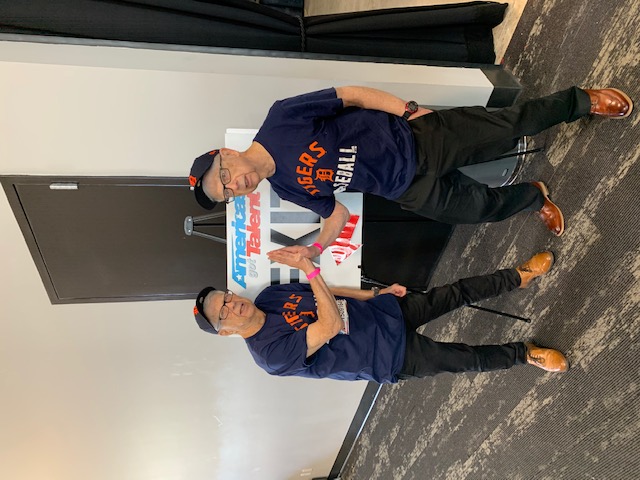
The Chancia brothers, Bob, left, and Dick, in January at the America's Got Talent audition venue in Detroit.
They informed us that the last of six U.S. auditions would be in Vegas the following week.
We left Detroit sky high.
We received an email in mid-February requesting a video for the third round. Then COVID 19 hit. Season 15 (2020) might go virtual? Bob was in Miami and Dick in Utica. A video was impossible.
We were done!
Rappin Grampas knocked down by a Coronavirus lockdown. Showbiz life did not begin at 84. Maybe it begins at 85?
We’ve been invited back.
Graduation Day, 70 years before COVID-19
By Bob and Dick Chancia
It was an azure sky day and the old Theodore Roosevelt School on Taylor Avenue in Utica’s Cornhill section provided the backdrop. The June Class of 1950 was carefully assembled for our official 8th grade graduation photo. It was beyond our comprehension that 70 years later commencements would be virtual or drive-thru.
Class President Sherwood “Sherry” Boehlert was seated front row center with Vice Pres. Pat Calderella to his right and Treasurer John Wallace at her right. It’s somewhat prophetic that Boehlert was our Pres., as he later served many years in the U.S. Congress.
We joked that one day he’d become President of the United States. His name, Sherwood, sure sounded presidential. Bob Brooks, who went on to UFA, Hamilton College and finally U of Michigan Law School became a Chicago attorney and professor at Northwestern University. Valedictorian Maureen Bouziden edged out Brooks, the salutatorian.
We’ll never forget that day! We proudly flaunted our royal blue and white silk streamers, emblematic of the graduating class, pinned to our waists.
The class sat on the stage. Principal A. Ray Calhoun, Physical Ed, teacher Pete Hussey, pretty English teacher Ellen Weigel, Industrial Arts instructor Bob Langworthy and Art teacher Abe Blumberg filled the first row. We still have the wooden plank wishing well pump lamp made in Mr. Langworthy’s shop class.
Miss Weigel had a crush on Mr. Hussey or vice versa and Miss Wood taught us how to sing, hopefully to become the next Enrico Caruso or Ethel Merman. Those Normal School grads prepared us well, for high school, college or whatever vocation would follow.
After a few speeches, achievement awards were presented as academic success was the most prized honor. We weren’t awarded any but our best friend; the late Rocco Giruzzi nabbed two: best athlete and the art prize.
We performed a clarinet duet, “Moonlight and Roses”, by English organist and composer Edwin Lemare. Miss Wood accompanied us and the vibes from the audience made us feel like Artie Shaw and Benny Goodman. Let Jim Reeves’ lyrics resonate: “June light discloses loves golden dreams sparkling, anew”…
There were no robes or flat mortar boards with tassels to shift sides when certificates were presented. We wore gray dress slacks, green corduroy sport coats, white shirts and ties, all from My Boy Shops. The girls were attired in new white dresses and shoes as this was a special occasion. 8th grade was our first graduation, unlike today’s rites held after pre-school, kindergarten, middle school etc.
The rolled up diplomas, tied with royal blue ribbon, were as coveted as getting a driver’s license. Glancing at that picture makes it seem like it was yesterday. 80% of our class went on to UFA and 20% to Proctor as Conkling Avenue was the divider.
We kept track of Boehlert through the years. He worked for Wyandotte Chemical in Detroit during our years in Motown. Dick sat with him at Utica College basketball games in the mid 1990’s when our Alex played for the Pioneers.
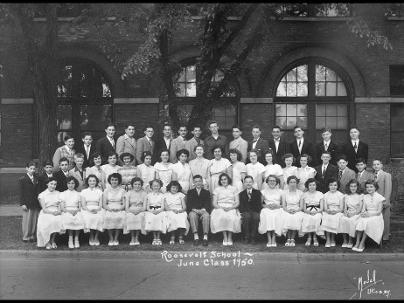
Theodore Roosevelt School’s 8th grade graduation Class of June 1950 included Class President Sherwood Boehlert, who later represented Central NY in the House of Representatives from 1983-2007.
Proctorites, like Whitesboro educator Pat Calderella and others are still among our friends. Insurance broker Jim Paravati was from the Blue Ribbon Dairy family. Joe Girmondi, of Twin Ponds Golf & Country Club was the first to get a TV in 1949. It was a black and white RCA that we watched in awe at his 13th birthday party.
Roosevelt School was situated on one of the many majestic elm shaded avenues, sloping down from Parkway East into the valley. Being in Cornhill, its students came from diverse neighborhoods. Eileen Doyle, Howie Lefkowitz, Joan Wagner, Sarah Russo, Pricilla Wilsey, Louise Schafer, Millard Harris and Ron DeBernardis, son of radio’s Italian American Hour host, Louis, were some of our classmates. It didn’t get any better than that!
The Roosevelt building, a hollowed out ghost for many years, was finally razed and replaced with neat looking municipal town houses. Good move, Handshake City! It’s refreshing to see resurrection on the site of that old red brick icon with 2 play yards facing Brinkerhoff Ave. Who can forget the Filipino Yo-Yo champ holding contests and Old Glory flying proudly from the flag pole on Taylor Avenue in front of Miss Farley’s first grade window?
Pal George Fanelli reminds us that his alma mater, Brandegee School has been serving Utica in recent years, as municipal apartments.
Time marches on and change jolts our clinging to the status quo. What remains constant are the memories we’ll treasure through the years.
Whether a congressman, pharmacist, educator, lawyer, insurance agent or local taxi Co. owner like Sheldon Gordon, our June class of 1950 has served Utica well. We’ll remember always experiencing quality teaching and our Graduation Day 70 years ago. It wasn’t zoomed online. It was live!
COMMENTARY: On hold in sunny Miami Beach
By Bob Chancia - May 17, 2020
I empathize with many who left the north to winter under the sun. Having left New York City in early February to claim my spot under a palm tree in North Miami Beach, I hoped to return north by early May.
Here I sit, stalled by COVID-19; on hold, but not losing hope.
Many Uticans who planned to be back by Easter find themselves in the same boat. The minority, like the Florio Vitullos, found their way home with a pre-mature exodus in a half empty airliner. Many of us are sitting tight. At least we’re warm and safe but now realize a foregone conclusion: we don’t control our destinies!
Seventeenth-century English author and Anglican clergyman William Gurnall, in “The Christian in complete Armour,” shared these wise words: “The more composed and contented your heart is under the changes which providence brings, the stronger your faith is.”
So, I took a walk down memory lane on Sunday, May 3. Although 51 years later, it brought back very fond memories of 1969. I worked in sales promotion at the Jordan Marsh Co. on 15th St. and Biscayne Blvd. but lived in Sunny Isles Beach at the Salem House on 172nd St.
Close friends of mine, Dr. Frank and Lois Paladino, always vacationed at one of the best motels on that famous Sunny Isles strip. I visited them there at the Sahara and we hung out at the beach, cabana and pool area. I coveted the Sahara, compared to my ordinary digs on 172nd St. by a fire station and Wolfie Cohen’s Rascal House.
I still have great snapshots frolicking with them at the Sahara and Ivanhoe Hotel, down the road. The Ivanhoe was owned by baseball hall of famer, St. Louis Cardinals’ Stan “the Man” Musial, and St. Louis restaurateur, Julius “Biggie” Garagnani.
Now, 51 years later, with time on my hands and clad in my mask, I crossed Collins Avenue to revisit the Sahara. It looked pretty much the same. At the entrance, I was compelled to take a picture of the “wise-men” and camels, emblematic of the desert it’s named after. Suddenly, the wise words from Psalm 46 came to mind. “Be still, and know that I am God.”
I also photographed the old Thunderbird, now a Days Inn resort. It was missing its signature totem pole that rivaled the camels next door. There they were, the last of that magical strip of motels on upper Collins Avenue. I had to email the photos to my Paladino friends’ daughter Beth and my brother Dick, who also recall the glory days of motel row!
Utica native Bob Chancia at the memorable entrance of the Sahara Motel.
In the fifties and sixties many Uticans went there to escape the lake effect snows of upstate New York. When living and working there, I’d occasionally meet up with them. Rocco Giruzzi and Joe Castelli liked the Heathwood. John Fanelli preferred the Monaco and brother, golfer George, who has four hole-in-ones on his record, liked the miniature golf at the Castaways. Mike Didio, Joe Karam and others loved motel row; the modernistic ocean strip on North Miami Beach.
Where have you gone Aztec, Desert Inn, Suez, Monaco, Colonial Inn, Tahiti, Heathwood, Castaways and others? You’ve been replaced by an impressive row of lucrative Dubai-like skyscrapers.
Life is not static and change inevitably brings growth! The plans of men were upset again. When will we learn that we are not in charge? All that happens is ultimately for our good and God’s glory! So we don’t lose heart, for this light momentary affliction is preparing for us an eternal weight of glory beyond all comparison. (2 Cor. 4: 16-17)
It’s a tough lesson but I’m glad I had that moment that Sunday to savor what was. Thanks for the Thunderbird and Sahara flashback. I enjoy living across Collins Avenue again. I’ll get back to Utica soon and maybe be more welcomed than ever! In the meantime, I’ll be still.
What’s in your basket today?
By Bob & Dick Chancia - April 12, 2020
Most are likely to find chocolate bunnies in their Easter basket this morning. They taste real good and that’s a blessing. Everyone loves chocolate bunnies, eggs, jelly beans and marshmallow peeps.
What is today really all about? We’d like to render our opinion because we were born on this very day 84 years ago.
Yep, in 1936, Easter Sunday was also on April 12. The O-D announced that two Easter bunnies were born to Florence and Alexander Chancia. Identical twins. That was a sweet surprise and a blessing to a mom who barely weighed 100 pounds. Technology hadn’t been invented yet to forecast multiple births.
Matthew 14: verse 20, referring to the miracle of the feeding of the 5,000 says: “They all ate and were satisfied, and the disciples picked up twelve basketfuls of broken pieces that were left over.” Baskets are mentioned many times in scripture and often resulted in miracles and blessing.
Like in Exodus 2: verses 5 and 6, where baby Moses was found in a basket. “Then Pharaoh’s daughter went to the Nile to bathe … She saw the basket among the reeds…She opened it and saw the baby.”
Those blessings weren’t chocolate bunnies, but miracles by God to prepare us for and demonstrate the Savior of Easter!
Our Easter baskets of chocolate goodies and peeps satisfy us, too, and now we’ve even learned that chocolate is healthy for our hearts. Thanks to high levels of antioxidants, it lowers cholesterol and prevents memory loss.
Our folks surely savored the blessing of that Easter in 1936. Today we can taste the deeper blessing and promise of eternal life just by receiving in our hearts the only blessing that can satisfy all of our longings.
This Easter Sunday, savor the sweet Savior of the world! Put your eggs in His basket and rise to new life that will satisfy forever!
So, in the midst of this global pandemic: Who’s in your basket?
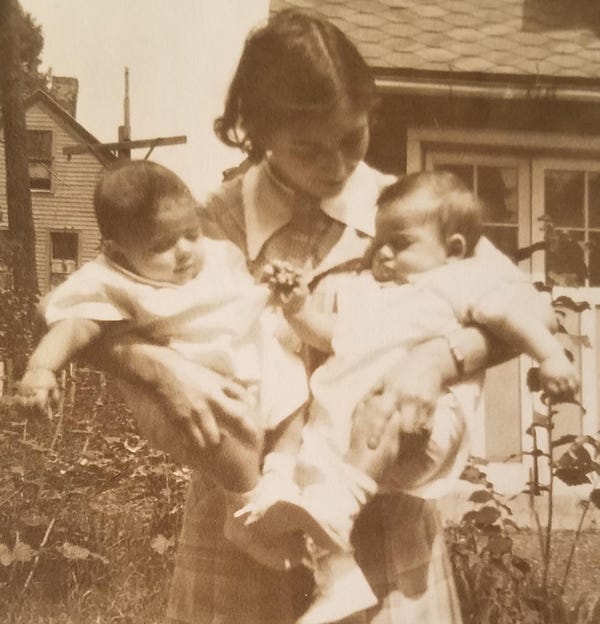
Florence Chancia in spring 1936, holding her Easter surprises. The brothers are unable to identify which twin is which.
(John 11: verse 25) “I am the resurrection and the life. He or she who believes in me will live, even though they die; and whoever lives and believes in me will never die”.
Will you believe this? Happy Easter!
Utica school musicians really knew the score
By Bob & Dick Chancia - March 15, 2020
As 6th graders in 1948, band director Anthony Desiderio chose us to be grade school guest performers at Proctor High School’s annual spring concert. That was a big deal for us!
For the band and orchestra, the concert was the highlight of their year. Orchestra leader Joseph Cilecek picked Conkling’s Mary Ellen Santalucy as his guest soloist.
What wowed us was not our duet but the band’s full score rendition of George Gershwin’s 1924 musical composition “Rhapsody in Blue”. Commissioned by band leader Paul Whiteman, it premiered in 1924 at “An Experiment in Modern Music” concert in New York City. This work was known for its innovative integration of jazzy rhythms combined with elements of classical music.
The Proctor band nailed it and after first chair clarinet Jim McGuire’s opening glissando, (a slide up or down between 2 notes) we were blown away. Cilecek’s orchestra program was equally impressive and the entire concert showcased the quality level these young directors brought to our public school system.
Hired in the mid 40’s with others, they made the rounds of the grade schools, grooming budding instrumentalists for their high school programs. Mr. D was fresh out of the University of Michigan’s nationally renowned music school spearheaded by the recognized William D. Ravelli.
Mr. C did the same for aspiring string players, while a young J. Edward Hacker (a graduate of Ithaca College and the University of Iowa who eventually became music department chairman for the Utica School District and principal trumpet with the Utica Symphony), roamed the west side elementary schools preparing kids for UFA’s rising music program.
After our 1950 Roosevelt School graduation, our sights were set on Proctor’s band. Its quality earned A ratings, without fail, at each annual NYSSMA (New York State School Music Association) statewide contest. This professional organization still evaluates student musicians and ensembles from elementary to high school and adjudicates thousands at its annual spring festival.
At Proctor, Desiderio challenged six clarinetists to perform Rimsky Korsakov’s famous “Flight of the Bumble Bee” standing abreast in front of the band. We did it, along with Rocco Polera, Rich Mazzatti, Tony Cappelli and Gino Frate. If you’re familiar with that piece, you’ll understand the level Mr. D attained with his high school musicians.
The grade school bands and orchestras were also top notch as Desiderio, Hacker and Fred Grossman, to name just three, started kids from scratch and readied them for high school. Many went on to college and made their mark in music education careers.
Clarinetist Polera and trumpeter John Avolio followed Desiderio to Michigan’s “Hail to the Victor’s” band. Polera led Pelham, NY’s music program, rising to school principal. Avolio remained in Michigan, heading programs in Livonia’s schools. Rockino Giglio found corporate success in Elkhart, Indiana’s C.G. Conn instrument manufacturers.
Louis Angelini became a stellar music professor at our Utica College and French horn star John Simonelli went from Roosevelt and UFA to the Philadelphia and Toronto philharmonic orchestras.
Drum teacher George Clasgens influenced many young percussion students like the retired pharmacist, Dr. Rocco Giruzzi. Singling out two others — Jimmy Wormworth is still active and a globally recognized jazz drummer out of New York City. Ronnie Zito has drummed for many Broadway show pit orchestras in the Big Apple.
Anita Scalice, 1951 Proctor salutatorian, honed her cello expertise at Syracuse Uviversity while violin virtuoso Angela Nudo became an internationally accomplished soloist, studying and residing in Europe.
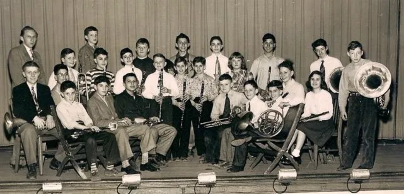
Utica’s Roosevelt School band, circa 1948. First row, seated, from left: Jim Pinto, unknown, Bob Borgavini, Don Fallon, unknown, John Simonelli. Second row: unknown, Joe Karam (seated), Bob Brooks, Diana Bruni. Third row, standing, from left: Ray DiMeo, Gino Frate, Andy Anguish, Tony Howland, Bob Chancia, Dick Chancia, unknown. Back row, standing, left: Director Edward Hacker, unknown, Dan Ingersol, Rocco Giruzzi,Jerome Sacco, unknown, Edgar Schloop, unknown.
Mr. D started us at Roosevelt School in fifth grade. Disappointed because our first clarinets were metal and rented from the school, we reluctantly waited to get good enough to own the coveted wood licorice sticks. Taking Desiderio’s advice, Dad bought us two French-made Buffet models with the articulated G sharp key for easier fingering. Only Selmer rivaled Buffet as the “sweetest clarinet ever made”.
We made many trips to Jimmy Fragetta’s music store on Albany Street for reeds, new key pads and eventual overhauling to meet Desiderio’s standards. He picked his first chair clarinetist by having us audition behind the auditorium’s thick stage curtain to conceal our identities. Dick earned the position as a senior with his big, deep, wooden tone.
Utica’s All-City grade school band rehearsed after school every Thursday at UFA’s new music building. Led by city music superintendent James Carney, Desiderio, Hacker and Grossman alternated directing the group.
Perfecting Harold L. Walter’s two standout 1947 band compositions: “Waggery for Woodwinds” led by Desiderio, and “Bandinage for Brasses”, led by Hacker remain familiar to us. We later did both at spring concerts to packed houses cheering BRAVO! Google and listen to those dazzling scores.
Mr. D not only groomed us for concert band but had us in step to fill the ranks of Proctor’s escalating marching band. He taught us Michigan style half-time shows with snappy drill routines and formations. One show against arch rival UFA was themed “Battle of the Bands” and we tossed grapefruits at the UFA stands.
In city parades, pretty majorettes Paula DeAngelo, Angela Flo, Joanie Alito and Connie Wildrick, crowned 1952 Miss Utica, shared the spotlight.
Marching band pointed us to Syracuse University’s unique “100 Men and a Girl” bowl bound band where we collected unforgettable memories. We also made the Dr. Harwood Simmons led symphonic and wind ensemble bands at SU. As a senior, Bob was elected president of all Orange bands.
We experienced all this because of the foresight of Utica’s school system to strike up the band in the 40’s. With the hiring of ambitious college grads, band and orchestra programs soared. Choral groups also flourished under Helen Wood, Louise Minor and Christine Gardner to recall just three.
One regret: our hero, George Fanelli was a three-sport letterman and not a bandee like us. Back then, we thought music was OK but the grass was greener on the athletic fields, where the football heroes got along with the beautiful girls.
Looking back now, we have no regrets. Make ours music!
Oscar time stirs star struck moments
By Bob & Dick Chancia - January 20, 2020
Most of us will never win an Oscar but may occasionally encounter a celebrity.
Have you experienced it? When it happens, you like to share it. Be honest, meeting famous people feels good. Psychiatrists call it an association complex. Others say it’s name dropping.
Our first close encounter with a star: Genetics class at SU, 1956. Who was the star? No, it wasn’t #44, George Fanelli, Proctor’s Mr. Touchdown, but #44, Jim Brown, consensus All American who later became the greatest running back of ‘em all and a cinema star. Descending the steps of Lyman Hall, the only dialogue: big Jim asked: “Whad’ya get for question 3”? Bob’s response: “B”. The future star of “The Dirty Dozen” said: “Good deal, so did I”. Good deal? That was a BIG deal!
A second encounter came in the sixties, working for Detroit’s J.L. Hudson, the Macy’s of the Midwest. We lived smack between Tiger Stadium and downtown, walking distance to work and the ballpark. One Sunday we went to a game. The Tigers were hosting the Oakland A’s. Most fans hope to catch a ball. Sitting in box seats on the third base line, a foul off the bat of obscure third baseman Don Wert headed toward us. Bob reached out and snagged it. We had our trophy.
Walking back on Michigan Ave., we stopped at Russell’s Steak House. A few tables away, having dinner was the famous loner, Joe DiMaggio, then an A’s batting coach and husband of Marilyn Monroe. You don’t bother Joltin’ Joe when he’s eating. He’s a private kind of guy. We took a risk. Surprise…he was cordial and willing to talk some baseball. “Keep an eye on A’s rookie, Reggie Jackson. He’s going to be a great one”. Joe D signed our ball and it no longer was obscure.
The third encounter: Vacation in Ft. Lauderdale. At a Walgreen’s Pharmacy near the Bahia Mar Yacht Basin, we looked up…there was Frank Sinatra, the Chairman of the Board and best supporting actor in “From Here to Eternity”. Media tabloids informed us he was in the midst of a break up with actress Mia Farrow. He arrived on Random House publisher Bennett Cerf’s yacht. Did we bug him? He was known to be temperamental. We bought a dime postcard. ”All or Nothing at all”! The biggest star of our lifetime took it “Nice ‘n Easy”. We got the card signed. Our way!
The fourth encounter: Back to Ft. Lauderdale and baseball. Prior to the George Steinbrenner era, the Yankees trained in little Yankee Stadium in the Tamarack section of Lauderdale. CBS may have owned the Bronx Bombers then. Armed with a Kodak, we headed there to get some pics. Seated on a green bench were the M&M boys, Mickey Mantle and Roger Maris. They were just off a season hitting a combined 115 home runs. Roger’s 61 broke Babe Ruth’s record. They also starred in the 1962 movie, “Safe at Home” filmed in Ft. Lauderdale.
Only a steel mesh fence separated us from baseball immortality. Would they pose for a picture? They were working; did we intrude? Had to take a shot. They couldn’t have been nicer and even posed for subsequent photos.
The fifth encounter: Dick, a practical joker, wanted a picture holding an Oscar for future kicks. When living in Hollywood in 1974 he had the opportunity to visit the Burbank home of radio and TV personality Ken Murray. Murray had a sister in Utica. Dick spied the coveted statue on Ken’s mantel.
Ken was gracious enough to take the picture of Dick with the special Academy Award he won in 1948 for producing the feature film, “Bill and Coo,” innovative for its use of live birds and animals as the cast. A week later, Dick was at a photo shoot with Rene Russo, star of “Tin Cup” and “The Thomas Crown Affair” at the home of multi Oscar winner Miklos Rozsa. Rozsa did the music score for “Ben-Hur and many other movie epics. The home was full of Oscars. No need for one now. Dick had his picture.
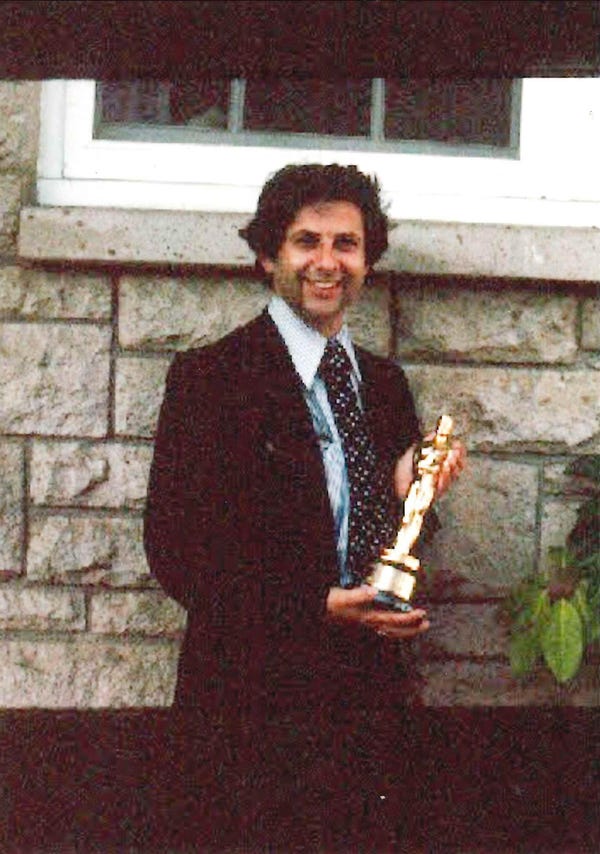
Dick Chancia with Oscar at Ken Murray's Burbank home in 1974.
Last but not least, number six: A few years ago we wrote a comic hip-hop song, “Who Says Grampa Too Old to do Hip-Hop”. We decided it was an opportunity for Tony Bennett to step out of his comfort zone. TB lives in Bob’s neighborhood in Manhattan and occasionally we’d cross paths. Our time came when we spotted Bennett aiding a homeless person.
“We got him”! Would he listen to a few bars of what could be his next hit? Refusing to stop, he continued walking and we back peddled while rapping our song. The ageless crooner politely said he doesn’t do hip-hop, and briskly headed home. We gave up the quest convinced that Bennett left his HIT in New York City. Recently he teamed with Lady Gaga, which revived his career.
The celebrities didn’t disappoint us (OK, maybe Tony Bennett) and why would they? We’re all significant and have stories to tell. From Shakespeare’s major work, As you like it: “All the world’s a stage and all the men and women merely players”. The audiences may differ in size. Ours is YOUtica, an Oscar in its own right!
Miracle on Griswold Street
By Bob Chancia - December 26, 2019
Just over a year ago, the day after Thanksgiving, my precious wife of 44 years, Marian, complained of experiencing knifing pains in the back of her head. I asked, “Are they like a migraine”? Her reply: “Much worse.” She became nauseous and headed to the bathroom. I quickly googled — knifing head pains.
Next I heard a loud thud and found her on the floor, never again communicating with me. The panicky 911 call and wait ended with a trip to Belleview Trauma Center to learn she suffered a severe hemorrhaging brain aneurism with no hope for survival. On Nov. 26, after two and a half days on life support, she passed from my world.
Now about my miracle on Griswold Street: I received a myriad of sympathy cards and on the card from her close friend Terri, was a tiny paper white dove no more than a half inch wide. It fell to the floor of my 57th Street apartment in New York City. Not wanting to toss it out, I placed it in a small plate on the kitchen counter. It remained there all year, well within my sight.
I’ll leave New York soon to spend this winter in Florida before relocating to an apartment on Griswold Street in downtown Detroit, a city I came to love in the 1960s. United Van Lines came and packed my belongings. Three competent packers spent 5 hours wrapping each item in wads and wads of paper. They packed a total of 55 cartons.
I never gave the little white paper dove a thought. They assured me that my furnishings would arrive in Detroit in about 10 days. My brother Dick and I jumped in the car and headed for Detroit.
We drove through much of the night and arrived at 9 a.m. that Saturday. The United Van Lines delivery team of three arrived at 11 and put the furniture pieces in place. Next they dropped off the 55 cartons for us to unpack. It took 2 1/2 days to open each carton, tear away the wads of paper around each item and stuff the paper back in the cartons. Quickly the corridor was lined with paper stuffed cartons. We placed all the items where we thought they belonged.
Finally we had everything in place in my new digs. I glanced down and there on the shiny dark wood floor was the half-inch tiny white paper dove.
How did the tiny dove survive the five-hour packing process in New York by three efficient packers, the 10-hour trip to the Midwest with five other residential loads plus 2 1/2 days unpacking, unwrapping, re-stuffing paper back in empty cartons and lining them in the corridor?
Do you believe in miracles? This is the season we celebrate the miracle of a savior from heaven who came to redeem mankind. You may believe that or not, but I’m convinced that miracles occur in everyday life.
One definition of miracle is: a surprising and welcome event that is not explicable by natural or scientific laws and is therefore considered to be the work of a divine agency. Certainly the miracle of the Nativity qualifies here.
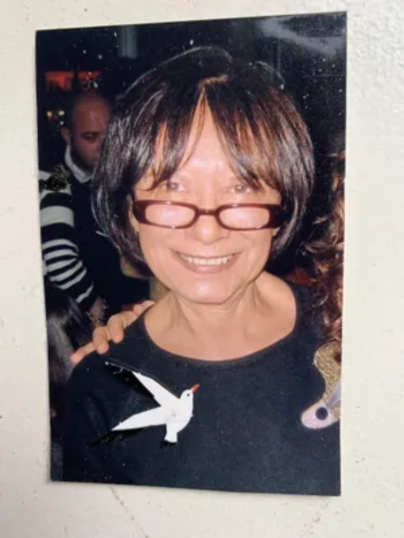
Tucked safely on the wallet sized photo of Marian Chancia is the tiny one-half inch paper dove.
Another definition of the word: a highly improbable or extraordinary development, or accomplishment that brings very welcome consequences. My miracle on Griswold fits this definition.
It’s certainly not probable but definitely surprising and extraordinary! My friend Malio Cardarelli said, “That’s a miracle.” If I had any apprehensions about moving to Detroit, they were squelched. I was now assured all would be OK. I just experienced a miracle on Griswold Street. Wow!
The dove is the biblical symbol of the Holy Spirit. The miracle of Christmas is God sending His Son to seek and save the lost. Merry Christmas to all; especially believers in miracles!
Where have you gone Miss McCalmont?
By Bob & Dick Chancia - December 18, 2019
Does your imagination sometimes throw you a curveball? You think of something that’s not important but still mind boggling. A few weeks ago we were discussing a major issue; well, an issue.
Picture this: you’re a kid again, at a ballgame, show or concert. You confront the young superstar — Aaron Judge, Taylor Swift or Chance the Rapper — for an autograph.
These young stars are millennials. Do they sign in cursive (Palmer Method) or print? Is that a crazy question? It bugs us.
We have a baseball personalized by the Yankee Clipper, Joe DiMaggio. Wow! Check his beautiful push pull cursive penmanship: a work of art from the guy who patrolled centerfield like a gazelle and bashed so many game winning clutch hits. Maybe Joe D had a Miss McCalmont who taught him those push pull, round and round oval exercises before he ever held a bat.
We complained about Miss McCalmott’s demands in elementary school. Push pull exercises started on ruled paper with an upsweep curve followed by countless push pulls, up and down that seemed to go on forever. They finally ended with another upsweep arc. The rounded oval shapes were a few repeated ovals plus just a few push pulls in the center. Whiteout didn’t exist. Miss Fiscus, our 3rd grade teacher at Roosevelt, couldn’t do one push up but she did a mean push pull.
Gripe we did but no one got carpel tunnel syndrome from those workouts. ‘Readin, ‘Writin and ‘Rithmatic were what school was all about way back then. No Dress up Day or Take Dad to school Day stuff. The only apples around were the fresh Macintoshes we brought our teacher. The complete script alphabet was displayed above the blackboard. (Not green board, white or whatever exists today).
Cursive writing was a thing of beauty. We cherished the red, wooden Coca Cola pencils with the elegant white Coca Cola script logo, topped with a rubber eraser. Pepsi Cola was right behind with their sleek semi-script logo. The cursive Ford is in their famous blue oval emblem. Chevrolet bucked that trend with its bow tie symbol. Those logos still prevail today.
At Roosevelt school we struggled with awkward wooden pen holders, scratchy metal writing tips and messy inkwells that fit in a hole at the corner of the wooden desk top. Were they also on the left side, to accommodate lefthanders? That’s a politically correct question to ask now-a-days.
Beautiful penmanship goes way back to the Declaration of Independence. How ‘bout that John Hancock? It’s still a symbol of our identity. How do young adults sign a check? Do they print their John Hancock? Is X allowed? Suggestion: when the holiday greeting cards pile in, check the signatures. Who signs and who prints?
Here’s an oxymoron: Physicians, regardless of their age, are known for bad handwriting. Only the pharmacist can decipher the prescriptions. We guess it’s meant to be that way.
Last fall, as members of our 65th high school reunion committee, we marveled at the beautiful penmanship on the correspondence from the female committee members. Miss McCalmont must be smiling somewhere.
Our kids manipulate the tiny iPhone keyboard with all 10 fingers. Keyboarding, not Palmer Method, is taught to them in grade school.
Popular in the '50s were plastic yellow, green, red or blue lead pencils by Scripto. A turn of the fingers would release some fresh lead. We yearned for a fountain pen and lead pencil set from Parker, Waterman, Sheaffer or Esterbrook. Remember the Parker 51 with its sleek silver toned style? Maybe we’d get a set for graduation?
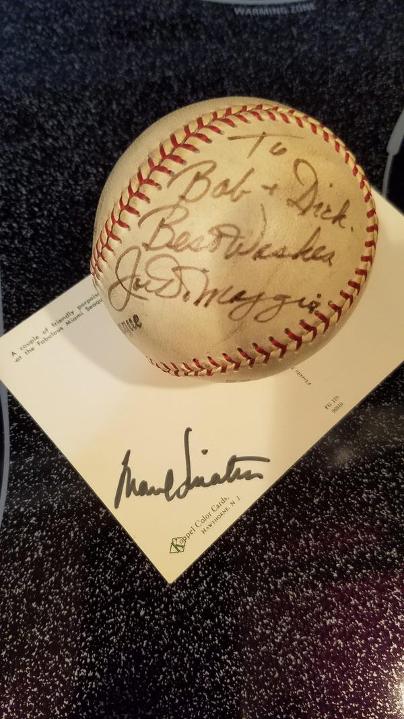
A signed baseball shows Joe DiMaggio could handle a pen and postcard; below, Frank Sinatra did it his way.
Our pal Joe Karam got the first ball point pen in the late '40s. It was a long rocket design that didn’t require liquid ink. Today ball point pens are advertising novelty give-aways that are easily lost.
The Ohio State University Marching Band still depicts the script Ohio on the gridiron. The Buckeye band even dots the eye with the bell of one sousaphone. The University of California at Los Angeles Bruin band also spells a cursive UCLA during their football halftime shows.
We also cherish an autographed post card from Frank Sinatra. Yep, the Chairman of the Board’s signature was as smooth as his vocal chords. Times change and the important thing is: communicate.
The only ballplayer we know who had better penmanship than Joe DiMaggio was George Fanelli. But he couldn’t hit a curve ball.
REMEMBRANCE: Digital age can’t erase the glory of radio days
By Bob & Dick Chancia - November 18, 2019
“Rob, what’s up in Idaho? We have a story in today’s Utica paper. Can you get it on the website ASAP”? Rob, Dick’s youngest, is our site manager. We have no idea how to update our site: twoabsurd.com.
“Caroline, need a favor. How do we post a picture on Facebook?” Dick’s daughter in New York City thinks the request is dumb but lovingly goes through the simple steps with us.
Out west in Houston: “Alex, quit texting us those complicated apps. Our outdated flip phones don’t have the capability”… or is it our outdated minds that can’t comprehend…got an idea where we’re going here? Our “old people” phones translate emogi symbols into a row of bars.
It’s frustrating for octogenarians to deal with the digital age. We get by with computers by keeping a techy nerd on speed dial that makes house calls. Dick’s pal Tom is a Florida snowbird. His winter absence is aggravating.
The kids live miles away but with cell phones, computers, Facebook and web cam, they’re just a click away. Who wudda thunk it? Back in 2006, our 100-year-old Dad would ask “What does www dot com mean”? We weren’t sure in 2006 either.
Our old ballplayer buddy George Fanelli doesn’t text and quit his online service. He never quit on the ball field. Have to call him “Safe at home” on his landline phone.
Nowadays require some involvement with digital devices: cell phones, smart phones, lap tops, I pads, including all the options. It’s blue tooth in the car, wi-fi in Starbucks along with streaming the latest shows.
We make attempts to regulate our kids’ “screen time". Now there’s a new phrase for ya. We realize people contact is still important.
In the 30s, way before hi-tech intrusions, we too had our devices but they were much bigger and not portable. Our radio was in the “parlor”. That’s what we called the living room. It was a piece of fine furniture about a foot deep, two feet wide and four feet high. The family sat around it and listened to dramas acted out with background music and sound effects.
The sound became the stimulus that enabled the mind to complete the whole. Gestalt Psychologist Max Wertheimer realized that if we heard or saw a small part of something familiar, our mind could fill in the missing information.
Recorded music was available thanks to Thomas Edison’s 1877 invention of the phonograph. We called it a Victrola. It also was a large piece of furniture in the parlor. The sound was amplified by a tiny needle touching grooves in a revolving vinyl platter. Scratchy at times but marvelous. You felt Al Jolson was in the room.
Edison’s Victrola was a windup phonograph by the Victor Talking Machine Company of Camden New Jersey. You may recall the familiar trademark: a white dog peering into a horned shaped speaker.
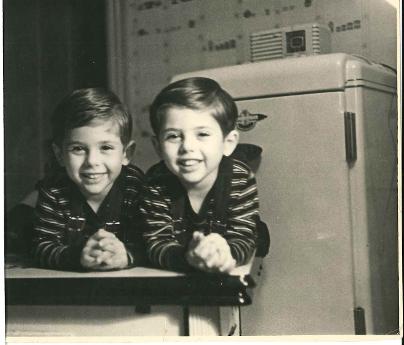
Bob, left, and Dick Chancia enjoy radio days in 1940. Note the device atop of Frigidaire.
Our telephone was not in our pocket or purse. It was rotary dialed and screwed permanently to the kitchen wall. We had to wait our turn with neighbors on a shared “party line”.
Yes, we had our devices. They weren’t glued to us 24-7 or built into our car dashboards. They were cumbersome. No need to regulate “screen time”. The “boob tube” was in the distant future. What did we do for entertainment? We enjoyed the neighborhood movie house once a week. Saturday afternoon matinees featured a B western, Movietone News, cartoons and coming attractions. How did we communicate with family and friends? We talked to them in person.
Want to get in better touch with those glory days? Check out Netflix for Neil Simon’s Brighton Beach Memoirs and Woody Allen’s Radio Days. (Look real close and spot Dick’s son Alex in a few scenes) He was a 4th grader at The Calhoun School on Manhattan’s upper west side. Alex was spotted in the hallway by Woody Allen’s casting agent who was searching for kids to play Woody’s classmates in the movie, Radio Days.
After parental approval, young Alex met Allen at his apartment. Woody asked Alex if he knew who he was. “Yep, your picture’s on the wall in John’s Pizza. My dad and Uncle Bob take me there a lot”.
Woody liked his answer and his face. His mom accompanied him to playground and classroom shoots around the city and Rockaway. Pros did his hair and wardrobe but Alex was most impressed with the catered food. He was paid about 800 bucks for the gig. Only in New York!
Netflix? What’s Netflix? Call the Geek Squad or better yet, ask one of your grandkids!
REMEMBRANCE: ‘Silent Years’ were more than a song and a dance
By Bob & Dick Chancia - October 13, 2019
Flash back to the fond memories of the The Silent Years, before Elvis shook us up: A Friday night school dance in 1951 …
“You ask the girl with the grey poodle skirt and I’ll try for her friend with the maroon bobby sox. C’mon, what ayah afraid of? All she can say is 'NO'."
For 14-year-old high school greenhorns busting out of puberty, asking for a dance couldn’t have been more frightening. All the pretty teen targets were a long way off on the other side of the gym’s slick hardwood floor.
Most of us shy young men were on the opposite side, all working up some confidence; unaware that the pretty teen queens were just as reluctant. But for us, that dreaded “NO” meant a long lonely walk all the way back to the boy’s side.
There were a few cool guys, wearing maroon varsity sweaters, sharp pegged slacks and suede shoes, groovin’ to every spin of the 45 rpm vinyls. They were the exception. A faculty member had chaperone duty and upper class wheels spun the platters in the coach’s office.
“May I have this dance”? was our opening line.
A “YES” meant a 3-minute lifetime searching for conversation during Tony Bennett’s “Because of You” or Jo Stafford’s “You Belong to Me”. We preferred the Wise potato chips and bottles of Coca Cola sold in the locker room below. No rejections to anticipate if you had a quarter or two. The only negative: the unpleasant odor from the cleaning fluid used on the terracotta tile floor.
Had we joined our parents at McGuirls for fish fry, we would have been rested for the Saturday afternoon Proctor football game at Murnane Field. Now, high school football is played on Friday night. Saturdays are reserved for college games. That shift has something to do with television ratings. There were very few TV sets in 1950.
At some dances, a little floor show was held on the gym floor at the mid-way point. Varied skits offered a showcase for our aspiring show biz hopefuls to share their talents. One Friday night in November, the Tau Phi Zeta fraternity sponsored a Sadie Hawkins Dance called “The Turkey Trot”. For that, the gals invited the guys, taking the pressure off us. Not being asked, bruised the ego and left some feeling like turkeys!
We’ll never forget our first Friday night dance that fall. The Saturday afternoon prior, senior halfback George Fanelli scored four touchdowns in a Proctor victory over Watertown. He was dancing with his steady gal, garbed in his maroon varsity cardigan complete with the chenille block “P” decorated with a tiny gold football pin. The coveted initial was meticulously sewn on the left side of the sweater above the pocket by his devoted mom. The athlete’s name was embroidered in script on a panel above the right pocket. Most of the sweaters were purchased at The Sport Shop on Bleecker Street. Our thought: no long lonesome walk across that hardwood floor for him. Something for us to aspire to, as they danced to “Body and Soul”.
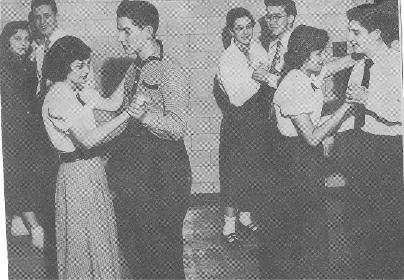
Nat King Cole's hit, "Unforgettable", has those 50's Proctor teens right in step. From left: Marion Vassallo and John Bartell, Katherine Squillace and Anthony Annotone, June Abounader and Richard Edwards, and Lucille Charello and Joseph Fiore.
One Friday night, popular senior cheerleader Junie DiFiore allowed us in the gym office to select the songs. Instantly, two tentative frosh wallflowers assumed total control of the entire dance.
Reflecting, those innocent times were more than a song and a dance. Some refer to the Eisenhower era as the Silent Generation. Born between 1925 through ’45, we recall our folks working hard on turn-of-the century farms or in factories. They brought a strong work ethic into those factories of industrialized society. We learned loyalty and respect from them. Though not technologically advanced, we were taught to value tradition.
Plagued by war as a result of the Great Depression’s economic instability, we witnessed progress and saw America become a global superpower. The prosperity of the 50’s and early 60’s produced the Baby Boomers, then Generation X to Generation Y (The Millennials) and now Z. (mid 90’s to early 2000’s)
Some think Generation Z is the new Silent Generation. They’re entrepreneurial and tech-savvy. They prefer cool products versus vacations, more media consumption and edgy campaigns. They’d like to co-create culture and maybe they will.
Wow, those Silent Years suddenly got louder. Our lazy Fox Trots started to rock with Bill Haley’s Comets, Elvis and the Beatles. A bogus trinity of Sex, Drugs and Rock-and-Roll evolved.
Wha’ happened? A brand new set of values screeched in with the unbearable force of Generations Y and Z.
We can savor what we had: Body, Soul and Spirit. Love was a many splendored thing and life was cherry pink & apple blossom white. We all wanted someone we could trust to steal our hearts. Change sure is inevitable but it’s great to revisit what we can never recapture: Our youth!
GUEST VIEW: Best bet wasn’t a gamble, it was advertising nirvana
By Bob & Dick Chancia - September 1, 2019
Early in the 1950’s our perception of college came from those weekly football parlays. Remember them?
Our older cousin would pick them up at the pool room. (Not Buckley Pool) They were pastel colored strips of paper with match ups for the Saturday college games. If you picked four or five winners that covered the point spread you could win five to 10 bucks for a dollar. The top 40 or 50 teams like UCLA, Michigan, Army, Navy, Notre Dame, Baylor and Syracuse were represented.
Sadly, that was how we chose the schools we applied to. We envied three-letterman jock George Fanelli but we were triple threats in our own nerdy way. We could play clarinet, draw and write.
In 1953, we applied to Michigan, Michigan State and Syracuse. All three met our parlay sheet criteria. Syracuse won out and 'Cuse delivered the complete package. Oh! We had to major in something. Our college entrance course at Proctor High included a few senior year electives. We chose art. Why not? We grew up drawing cars, soldiers and houses. Art teacher Mary Drumm recognized some ability and recommended her alma mater, Syracuse University. The rest was history: Marching band, New Year's Day bowl games, jazz concerts and a cool campus life.
Along with the liberal arts requirements, our advertising major included drawing, design, ad psychology, copy writing, ad production, photography and art history.
What is advertising? Advertisements are paid announcements by companies or individuals who have products or a service to sell. These announcements are placed in magazines, newspapers, billboards, direct mail or on radio and television. That is an over simplification but you get the idea. We got to go on field trips to Madison Avenue in New York City to visit the major ad agencies.
Media dates back to steel carvings made by ancient Egyptians gradually morphing to our Wonderful World Wide Web. Sales pitches evolved exploiting new mediums for increasingly savvy consumers.
We graduated in 1958 with bachelor degrees in advertising. Now what? Being the first in our family with college degrees, the family and neighbors expected big jobs. All we had was a piece of paper and a portfolio of our work. Not wanting to disappoint anyone, we headed to that same Madison Avenue to land the big jobs. Lacking actual experience, pounding pavements for a month in New York City was futile. We headed to upstate Rochester, where we could have our ’52 Chevy convertible.
Fortunately our sample cases included some store ads for Macy's that landed us starter spots in Sibley, Lindsay & Curr’s 5th floor ad department on Main Street. We joined 30 ad people that included illustrators, writers, photographers, media buyers, models and advertising production people. Quite an exciting environment for two upstarts.
After three years, our boss landed a position with J.L. Hudson’s 125-person ad staff in Detroit. We joined him in 1961 and suddenly found ourselves in the nation’s fifth largest city. Wow! We picked up 10 years of big league retail advertising experience in Motown followed by Miami, Los Angeles and Gimbels in the Big Apple. We created the opening campaign for the new Gimbel’s East on Manhattan’s upper Eastside. (the East Side Story)
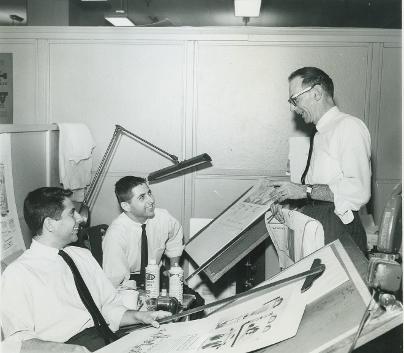
Bob, left, and Dick Chancia talk with art director Robert Roney in 1961 at J. L. Hudson's advertising department in Detroit, Michigan.
Like everything else, advertising has changed full circle. We started with drawing tables, graphite sticks, pastels and T-squares. Felt markers replaced graphite and the Polaroid camera eliminated a lot of presentation drawing. Photography replaced most of the illustration. Now the digital revolution is upon us with computers, special effect software, and an app for anything imaginable.
Egyptians used papyrus to promote. Commercial messages and political displays have been found in the ruins of Pompeii and ancient Arabia.
Our 50 years of store advertising in four major cities were a long way from our kindergarten and first grade crayons at Bleecker Street School. Fortunately this was before having to pay back six figure student loans. College was affordable in those days.
Not being betting guys, wagering on football never became addictive but we did win with those old poolroom parlay sheets. We hit it with Syracuse U and its advertising curriculum. SU prepared us to pitch those big stores. Fortnum and Mason on London’s Piccadilly Street established in 1707 and Harding, Howell & Co. vie for the world’s oldest department stores. Macy’s New York 1858 and Le Bon Marche, Paris 1852 are right up there with the oldest and largest.
What’s in store for young people today? Our advice: be patient; do what you enjoy and are good at. Don’t fret about salary and give it your best shot. We’ll bet good things will be in store for you, too.
GUEST VIEW: Sleep-away camp a real wake-up call
By Bob & Dick Chancia - August 4, 2019
A - S - S - I - S - I - U - M spells Assisium. That’s the place for my vacation. Lots of fun and recreation. A - S - S - I - S - I - U - M you see, first we swim, then we hike, then we play with all our might - Its Assisium for me!
We were taught that song when we first arrived at the sleep-away camp at Fourth Lake in Adirondacks during the summer of 1949. It’s remained in our cerebral computers for 70 years along with other indelible memories.
That summer, Lila Karam, the wise mom of our best buddy Joe, suggested to our very overprotective mom that we would greatly benefit from a summer camp experience along with her son. After a little convincing, the idea took shape and became contagious in the neighborhood.
Besides us, three other kids - Roger Bruni, Joe DeLorenzo and Richard Vedete - accompanied Joe to the Catholic Charities summer camp at Inlet. It later was relocated to another Adirondack Lake and renamed Camp Nazareth.
The Camp Assisium experience was a real wake-up call for us. Getting out of our comfy neighborhood, experiencing structure, camaraderie, discipline, diversity plus lots of fun was the perfect prelude for dorm life at college and more importantly, valuable for basic training at Ft. Dix, New Jersey, which came 10 years later. Our pal, George Fanelli, missed out on the experience as he had already committed to spend most of that summer bean picking.
Besides the song, the memories are forever. Up at the crack of dawn for reveille ’til curfew at 9 pm, all 14 activity packed days concluded with a camp bonfire and sing-along led by Camp Director Funzi Rienzo.
Five army style barrack dwellings with bunk beds, foot lockers and wash room, amazingly foreshadowed the Fort Dix barracks which would be an assignment for a future day. We’ll never forget our counselor, Eddie Fenton from Rome, who in retrospect, was much more amicable than the army sergeants to come.
The bunk houses were arranged in an L around the ball field opposite the Craft Barn; ours faced the lake. The mess hall was positioned just before the lake’s sandy beach. We can still taste the institutional spaghetti and meat sauce, a total antithesis to Mama’s and Coluzza’s Restaurant on Bleecker St., that later became Grimaldi’s. The brown masonite cups of Kool-Aid were a favorite and a staple at every meal.
Glen Kingsbury ran the Craft Barn next to the ball field. Besides the mandatory boondoggles, Bob made a 5-inch-high Indian Chief head, mounted on plywood and painted with bright crimson glaze. We were crushed when it tumbled off our bedroom shelf and smashed to smithereens a few years later. Dick still has his hammered metal circular ashtray with our dad’s name etched on it. It proudly sits in his trophy case of treasured memorabilia, dominated by miniature 50’s car models.
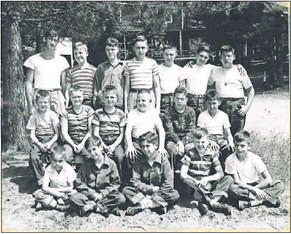
Right after swimming, the afternoon softball games, cabin vs. cabin, were our favorite activity. Dick’s greatest disappointment was when our big game against rival Eagle Bay Camp was rained out the day he was scheduled to pitch.
Instead, we went to town and saw the movie “Mighty Joe Young”, playing at Inlet’s lone movie house. We can still hum the tune “Beautiful Dreamer”, though most of the plot is now forgotten. Written in 1864 by American songwriter Stephen Foster, “Beautiful Dreamer” is the only melody that would calm down Joe, a 15-foot, 2,000 pound mountain gorilla. Joe’s guardian, played by Terry Moore, was able to handle this guardian of the mountain.
It’s ironic that we saw it in a mountain village, only because our softball game was rained out. The 1949 RKO Radio picture’s B&W fantasy film won an Academy Award for Best Visual Effects.
Another friend and future high school classmate, Frank Romano attended that summer and was a real good ball player. Some days included hikes in the mountains and we once got lost in the woods. That is still a vivid memory. We praised counselor Tony Cucci for finally leading us back to camp. An overnight hike to Bald Mountain offered an awesome view of the Fulton Chain of lakes plus we survived a rainy night in sleeping bags on the mountain’s hard rocky surface.
We never achieved Camper of the Week or Camper of the Cycle but wouldn’t trade that summer of ’49 at Camp Assisium for anything. It even topped a one-day New York Central RR excursion to see a Yankee/Red Sox game. Why? The Yankees beat the Red Sox that day and the Bronx fans waved crying towels at our idol Ted Williams every time he came to bat.
Sleep-away Camp was a win-win situation. No sweat Fort Dix…”Its ASSISIUM for ME!”
Now you have the opportunity to get under the Operation Sunshine umbrella and help a child have that experience of a lifetime. Fund a campership online at www.opsun.org. It’ll be a summer well spent by all!
GUEST VIEW: Mr. Thompson, a dad for all students
By Bob & Dick Chancia - June 9, 2019
Those who claim to be students of the “Good Book” are familiar with the designation assigned to Our Father of all creation: “Abba." In the Aramaic language its an intimate term to characterize a very personal relationship. Paraphrasing, the implication is loving, warm, fuzzy and familiar, all adjectives that describe “Daddy” in the ideal sense of that term.
For second and third generation kids of Italian immigrants, "Dad" meant a myriad of experiences. Most, we hope were positive, but even in a predominantly Italian ethnic lineage, one can’t dare to generalize. Whatever kind of dad was modeled to us, when we got to Proctor High, we found a “Daddy."
Rollin W. Thompson, a father figure in the truest sense of the word, literally and figuratively became the Father of Proctor High School. Soon after its doors opened in September 1936, Mr. T was at the helm. He rolled up his shirtsleeves, shed his slightly rumpled suit coat and vest, the dress code of his time and presided over an office staff, faculty and some thousands of students each semester.
His familiar crackling, raspy voice resonated over our homeroom’s loud speaker at the start of each day. Whatever he said, it was seldom profound or academic but always comforting and genuine. Mr. Thompson was our quintessential Dad. Some look back at their father experience at home and feel short changed. But sitting in homeroom, hearing the charge for the day, warmed our hearts. We had a father at Proctor!
Father’s Day - celebrated next Sunday - brings to mind a quote of Thomas Case, an English clergyman of the 1600s. “Every parent is a prophet, priest and king - a king to govern, a prophet to teach and a priest to offer prayer and praise for the family."
Our principal was a Colgate man in the deepest way a college experience manifests loyalty. The Chenango Valley couldn’t have produced a better guy to shepherd the city’s second public high school in a predominantly Italian/American end of town. Even with the surname of Thompson, when tapped for the assignment, he left Roscoe Conkling Elementary School and answered the call.
He influenced scholarly stalwarts like John Moses, a former UFA and Hamilton College valedictorian, Nina Hollenbeck, Louis Sabatano, Philomena Cavallo, Peter Dodge, Senatro LaBella, Helen Schermerhorn and others to help him get the new high school in East Utica off and running.
He proudly brought Colgate’s colors, maroon and white, with him and did we ever flaunt those colors. At almost every monthly Proctor 50’s meeting, 3-sport letterman George Fanelli mutters like a broken record: “Why did Proctor change those colors?”
Even without a name like Mr. Waldo Weatherbee, the fictional principal of Riverdale High in the Archie Andrews universe, Mr. Thompson used to like to predict the weather and outcome of every Proctor/UFA game. He called a student wide assembly before each city rivalry and confidently assured us of the outcome and weather. As a prognosticator, he always brought optimistic forecasts.
Beating UFA defined our season. The maroon gridders could go 8 and 0 or even 0 and 7 but if we beat UFA, the season was a success. Coach Hammes always said that finishing .500 was a successful season. Not for Mr. Thompson. Just beating UFA was enough, so he held those assemblies to spur everyone on to victory.
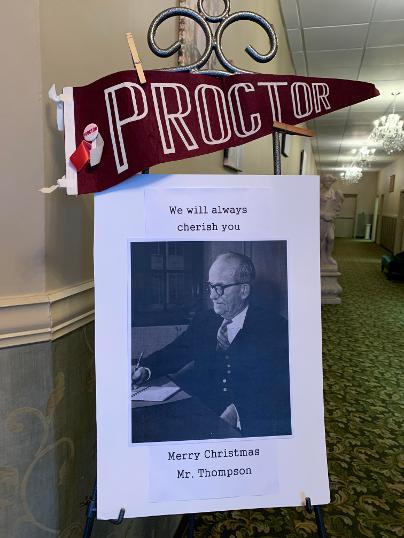
Trips to the principal’s office, dreaded by most students, were regarded by us as friendly chats with a close pal. He was an orator, community servant, Draft Board secretary, Oneida County historian and a mentor to his students, with their best interests at heart. His contributions are well summed up in the words of Henry Adams, taken from the ’53 Proctorian: “An educator affects eternity; he never can tell where his influence stops!”
Our class of 1954 had a stellar student athlete who starred in four sports. Mr. T met with him to discuss his future. College was not an option but the military was his choice. Realizing his academic and athletic potential, Proctor’s dad utilized his Colgate clout. Our star classmate went on to captain football plus star in baseball and lacrosse for the Red Raiders. A business degree led to a fruitful career as an oil exec in Pittsburgh. We witnessed that one case but there were more like it for other alums.
We can’t let Father’s Day 2019 slip by without recalling the founder and Daddy of our beloved Proctor High 83 years ago. He was a loving husband and father to his own biological family but our Pop, too.
For us students of the Bible, the most endearing way we can address our Father in Heaven is “Abba," ‘cause he is a loving daddy. On this Father’s Day, 83 years after the launch of Proctor High, we affectionately say, “Happy Father’s Day, Mr. Thompson."
REMEMBRANCE: Tunesmiths always looking to be more noteworthy
By Bob & Dick Chancia - May 12, 2019
Combine a catchy tune with a clever lyric and you have a song.
“I’ll Be Seeing You”, Bing Crosby’s nostalgic hit by Sammy Fain with lyrics by Irving Kahal, reached No. 1 by 1944. Hoagy Carmichael’s “Stardust” was what the late local disc jockey Joe Graziano termed a chestnut. Other chestnuts from that era were “Tenderly", music and lyrics by Walter Gross and Jack Lawrence, “Blue Moon”, by Rodgers and Hart and “Moonlight Serenade”, an instrumental hit by the Glenn Miller big band.
Graziano chose “Tenderly” as his saxophone solo when he appeared on the nationally televised Ted Mack Original Amateur Hour in 1952, wearing his maroon Proctor varsity sweater.
Bing Crosby and Frank Sinatra were the worshiped crooners of the '40s and '50s. Sinatra vocally mimicked trombonist Tommy Dorsey’s breathing technique, evident in Tommy’s theme song, “I’m Getting Sentimental Over You”. That was just prior to a new icon, Elvis the Pelvis, shaking up the whole scene. Bill Haley’s Comets went crazy and Bobby Darin splished-splashed while taking a bath.
In the summer of ‘54, our Plymouth Place pal, Joe Karam, returned from his family’s summer home in Milford, Pennsylvania, with an observation. He met a cute teeny bopper hooked on soda pop. Together, we decided, “We can write that new Rock and Roll stuff." On our front porch glider, we wrote “Carbonated Cutie”. True story! Long story short, Torrie Zito, later an arranger for Frank Sinatra and Tony Bennett, still lived in our neighborhood; Utica’s Cornhill section.
We hooked up with Torrie and he provided an electronic keyboard accompaniment and the tune was recorded on an old reel-to-reel tape machine. Would that be the next hit for Snooky Lanson to sing on Lucky Strike’s Hit Parade?
Julius LaRosa, of instant fame on Arthur Godfrey’s TV show, was performing at Three Rivers Inn, north of Syracuse. A family friend got us an appointment through the owner of the Inn, Dominick Bruno. We were off and running on the brand new NY State Thruway in our ’52 Chevy convertible.
Julie had a brand new bilingual hit, “Eh Cumpari” at the time. We decided, in the car, to write our Italian novelty song for LaRosa. “Get the Bottle”; (“Porto la Bottiglia”) a ditty about a bella ragazza beguiled by vino was created 40 miles later.
We made it to LaRosa’s dressing room. Julie was preoccupied with a pinball machine. His manager said, “We don’t listen to songs on the road. Send them to our address and we’ll get back to you." Rude awakening! Rejection! The brush off!; our first experience with the tough music business. More of our songs in those tender years included; “Fruit Boots” about dancing with white buckskin shoes and red rubber soles, “Rock down the Isle”, a wedding parity and “Bring me a Choo Choo”, our Christmas song to rival “Santa Claus is Coming to Town”. We put our dreams away for another day and proceeded to find real jobs.
Once a tunesmith, always a tunesmith. Fifty-plus years later - Christmas week 2008 - we headed the Proctor High’50’s club annual holiday party at Alfredo’s on Seneca Turnpike. Danny Falatico Sr.'s “No Name Band” provided the music. The late Falatico was the second baseman with shortstop George Fanelli to complete Proctor High’s keystone combination in the '50s. Why is that relevant? Danny was a great athlete as well as an accomplished musician. That night we did a skit with a few of our songs. Danny advised, “Write a Christmas song, they sell."

CD cover of the Chancia brothers' signature song, "Who says Grandpa too old to do hip-hop?"
Good advice. Avoiding Santa Claus, reindeer and snowmen, we decided to be topical. Bam! “Digital Christmas” was born. Every Christmas season we could count on Hank Brown playing it over and over on his morning show. Hank, of Twist-A-Rama fame, thought we had a hit on our hands. There’s a half dozen others: “Detroit’s Comin”, “City Boy sings a Country Song”, “Who says Grampa too old to do Hip-Hop” etc. Listen to them on our website: twoabsurd.com.
Former Utican, Joe “Black” Saraceno, noted Hollywood songplugger for The Beach Boys, called us with interest in “Detroit's Comin”. In our mid-70s, that got our hopes up. Sadly, Joe passed away midway through the project.
While working at Detroit’s J.L. Hudson Co. in the ‘60’s, we drafted a complete Broadway musical about life in the advertising department of a modern department store. We called it “The Layout”, after the term that described an advertising page design. Other numbers included, a projected show stopper, “Its Original” and “Lets Drink over Lunch”.
In September of ’55, other Utica songsmiths produced a Variety Show Case for Proctor’s alumni scholarship fund. First rate original songs by Bob Isgro, Guy Cimbalo, Torrie Zito, Lou Angelini, Pat Caputo, Gene Nassar and renowned pianist Annunziata thrilled audiences for three nights at Proctor auditorium. The showstoppers that inspired us were, ‘This Show is for You”, “Bellissima”, “Once I had a Man”, “Duetto d’Amore” and “The Show is Over”.
To date, we haven’t hit the big time as songwriters. What else is new? We’re having lots of fun chasing rainbows, looking for that gold record.
REMEMBRANCE: Grass doesn’t grow over those baseball memories
By Bob & Dick Chancia - April 7, 2019
Spring is in the air. The cold snowy winter’s gone. We can almost hear the crack of the bat and smell the horsehide ball. Our childhood fantasy with baseball resurfaces with fuzzy-warm recollections.
Following baseball in the ’40’s required imagination, the premise of Woody Allen’s movie “Radio Days”.
We had few visuals. Our images were mostly black-and-white halftones in the Observer-Dispatch and Daily Press. Full color photos from the old Sport magazine covered our knotty-pine bedroom wallpaper, including a border of Topp’s baseball cards.
In 1948 we listened to the play-by-play of the Boston Red Sox/Cleveland Indians one-game playoff for the American League pennant. It blared from the car radio of band teacher Mr. Desiderio’s new Buick Special parked in front of Roosevelt School. We hung on every pitch.
Why? Because we were’t Yankee fans like most Uticans. Early on, Pop bought us baseballs labeled Bob Feller Fireball. That made Bob a die-hard Cleveland fan. Dick adored Ted Williams and the Red Sox. Now we were pitted against each other for the pennant.
To Dick’s chagrin, Red Sox manager Joe McCarthy chose unsung Denny Galehouse to start over Mel Parnell, Ellis Kinder and Joe Dobson. Cleveland Player Manager Lou Boudreau started rookie 19-game winner Gene Bearden. Boudreau and Keltner belted three dingers. Bearden pitched a gem and the Indians won, 8-3.
Pop, the typical Utica Yankee fan, always won. Mom would console us. “You guys will win one day."
Well, Bob’s day came that afternoon in 1948. After moving to Detroit in 1961, we changed our allegience to the Tigers. Our apartment was walking distance to Old Tiger Stadium and Tiger GM Jim Campbell’s apartment was adjacent to ours. He invited us to his office in 1968 and handed us eight World Series tickets for all three home games.
Many Tigers also lived in the Town House Apartments. We became chums of Mickey Lolich and trainer Bill Behme. Dick started a fan club for the trainer which made the press (Washington Post and Sporting News) and got him an interview on a local Detroit talk radio show with host J.P. McCarthy.
Other Uticans had their own reasons for not rooting for the Yankees. Because of Proctor star Ted Lepcio’s success with the Red Sox, Dick Trinco is still an avid Boston fan. So is Bobby Longo, Bob Brooks and late wildlife artist, Tom Yacovella.
Stan the Man Musial attracted Lou Papale and Pete Giordano to the Cardinals and Detroit all-stars Newhouser and Kell hooked Nicky Soldo, Sal Saporito, Fred Bruzzese and Rich Rastani on the Tigers.
Roger Bruni loved the Indians and Prox star Dave Buccolo swore by his Uncle Georgie Detore’s Pirates. Sluggers Angelo DiRuzza and Artie Battista still proudly flaunt the old Brooklyn Dodger B and Utica Sports Hall of Famer Sam Paniccia, head of the annual Ed Herrmann Cross Country event, loves the Phillies, parent of our Utica Blue Sox. Mike Filipelli, son of Olympic boxing referee Tony, loves those Mets.
The late Red Ricco, actually had Philly Hall of Famer Richie Ashburn room in his home during Richie’s Blue Sox days. Red became a Philly fan for life after that. So we weren’t all Yankee fans. Like Al Martino’s 1946 pop hit “To Each His Own, I’ve found my One and Only team”. (slight paraphrase)
Maybe a persona, locale, team colors, or logo determined our loyalty. Friends and family passed on allegiances along with stats and accomplishments. Most Uticans are captivated by the Yankees.
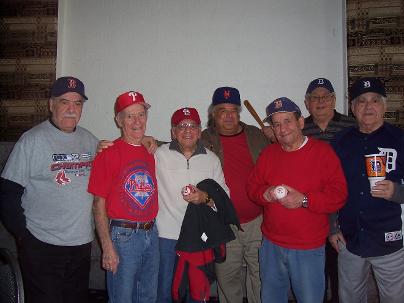
From left: Dick Trinco, Sam Paniccia, Lou Papale, Mike Filipelli, Bob Longo, Angelo DiRuzza and Fred Bruzzese flaunting their favorite team caps.
Why not? With solid Italian-American immigrant roots, it was natural for our parents and grandparents to love Crosetti, Lazzeri and later Rizzuto, Berra and Joltin’ Joe DiMaggio. Proctor shortstop of the 50’s, George Fanelli, sat in the Yankee dugout at a Cooperstown Hall of Fame game with his 1947 Brandegee grade school city champions as guests of Utica’s Comity Club. George continues to sport his Yankee cap. He’s part of the majority but then there are us who dare to be different in a hostile Yankee environment.
The strip of grass between our house and the neighbor’s was our Field of Dreams in the 50’s. We played catch, grounders and pepper there while Mel Allen’s play-by-play of Yankee games could be heard from our kitchen window. “Going, going, gone. DaMag blasts a grand slam."
When our uncles and Dad took us on a red-eye train excursion to see a Yanks/ Red Sox game in 1949, we rooted for the Sox. Every time Williams came to bat the Yankee fans waved their white hankies. The Yanks won but here’s what saved our day: Bob got a facsimile Indian’s cap and miniature Larry Doby Louisville slugger and Dick got the Ted Williams bat and Boston cap. A bigger disappointment than his Sox losing was not finding the right cap. He settled for the red Boston B without the white outline and moaned, “that’s not the right cap." That’s all they’ve got, c’mon we’re gonna miss the train home. Bob’s hat was right on. Who says life is fair?
Some followed teams because of going to Blue Sox games at McConnell Field. Ahh…that sweet aroma of the hotdogs and the beer. Can’t pass by the Red Roof Inn in North Utica without recalling Frank Sinatra’s 1973 hit by Joe Raposa, “Yes, there used to be a ballpark right here.”
We were mesmerized with the uniforms that many of the opponents wore. Some teams sported their major league affiliate’s hand-me-downs. The Binghamton Triplets wore Yankee pinstripes. The Elmira Pioneers donned the old St. Louis Browns garb and the Hartford Braves looked real cool in the colorful old Boston Brave’s tomahawk get-up.
We mimicked the Big Leagues right on our front porch with a toy Kamm’s baseball game ordered from a small ad in Sport Magazine. We made up a league, players, kept stats and swung the flat bottomed bat at the flat marble ball through an opening in the cardboard stadium’s wall. The advertising billboards on McConnell Field’s fence (Utica Club, Beverwick and Bank of Utica) were missing, so we added our own makeshift cardboard fence with ads to complete the fantasy.
Spring is in the air and all those popular NY logos will be in full bloom. But not for everyone. The rite of spring is the right to don the caps of your choice. We’ll wear the Tigers familiar Old English D and you do as you please too. Even in Utica!
Neighborhood Sweet Shops Had Us Cornered
By Bob and Dick Chancia
Jaunts to Roosevelt School in the ’40’s included detours to P.P. Moshaty’s confectionery on Arthur Street near Brinckerhoff. That was the haunt for Cornhill grade schoolers to get energized before the first bell and after the last. We’d find 8th grade class pres. and future congressman, Sherry Boehlert picking up a Powerhouse candy bar. Joan Wagner said: “we girls loved Moshaty’s too”.
Confectionery stores or Sweet Shops go back to 1787 in Kyoto, Japan. The oldest one in England was established in 1827 in Pateley Bridge village. Harrisburg, PA, with a population of 70,000 in 1917, boasted 55 sweet shops. Utica’s grand old neighborhoods had their share of these havens frequented by the school yard set. We savored varieties of penny candy and inexpensive novelties from kites to kazoos.
Dismissed on Wednesday for religious instruction wasn’t popular. Our redeeming grace was checking out Mame Cronin’s on James St. by Blessed Sacrament school. Mame, like Ms. Moshaty was right out of central casting. Both appeared older than their years, typical of the time. Their prudish demeanors mirrored some of our strict school-marmish teachers but Mame had the stuff and in retrospect, we needed her strictness. Each Wednesday, she coaxed the blues right out of our morn… Mame!
We got squirt guns for the playground and caps to better ape Roy Rogers, Lash LaRue or the Durango Kid. Conkling schoolers had Lupinos and Trads on Mohawk plus Carmen’s Confectionery and Mottos on Kossuth. Son Dick’s motto was: “I made the best phosphates around in any flavor and introduced cherry cokes to the world”. We’d go to Trads on Sunday for the OD and Dad once bought us cardboard visors with big league logos. One was Philadelphia A’s green, the other, the old St. Louis Brown’s brown. We kept them long after the rubber band fasteners snapped. That was way before baseball franchising became a zillion dollar industry.
At the 5 Points, next to The Huddle, (Proctor High’s jitterbug hangout) was Ben & Bernies, famous for “The Dripsy”: soft vanilla ice-cream with strawberries and chocolate syrup in a cup. Pretty majorette, Paula D’Angelo would march a mile for a Dripsy. Kids devoured Dum Dum lollipops, licorice pipes, red wax lips and black mustaches. Butch Polera started his coveted collection of Dixie cup lids with tin-types of movie stars there and pool shark Art Battista and Jerry Sessa were forever tilting the pin ball machines. In 5th grade, future Proctor ’54 salutatorian, Donald Green, flaunted a Dick Tracy ring. Green with envy, we rushed to get ours, only to discover that our fingers also turned green.
Future radio host, “Cuppa Joe” Graziano and the Brandegee kids, had Andys on Catherine St. and Joe Naps (owned by Mr. Napoli) on St. Anthony and Bleecker. Further west on Catherine and Kossuth, Roxie DeLorenzo’s Cozy Corner was just as popular. George Fanelli flexed his muscles stocking shelves there. The upper Cornhill crowd had John Howards, where classmate and future owner of Twin Ponds Country Club, Joe Girmonde bought his comic books. Like today, they were distributed by Wolfe News. Eddie Casper (UFA) indulged his sugar highs at Thomas’s on Hobart and Elm.
Dad’s sales territory for Adam’s Gum products included Ed’s Variety on Clinton St. in NY Mills, run by Ed and Josephine Michalski. Corner stores were safe hang outs long before the malling of America. Candy store camaraderie established lifetime bonds, like the Albany St. guys, who still hold reunions. Paul Lange remarked: “D & Ds on Albany was our second home”.
Grandpa Mangano’s establishment on Albany and Mary evolved from a grocery store in 1915 to a confectionery in the 40’s.These stores offered us opportunities to make buying decisions without parental influence. The luxury of a quarter got us an icy creamsicle, 4 oz. Pee Wee soda, mini box of Wise chips or an ice cream drumstick on a sugar cone. A Duncan Yo-Yo or rhinestone studded Goody Filipino twirler was an extravagance. Nonno Mangano taught young Uncle Andy the value of a good work ethic. At just 17, he ran the soda fountain at a Baggs Square confectionery.
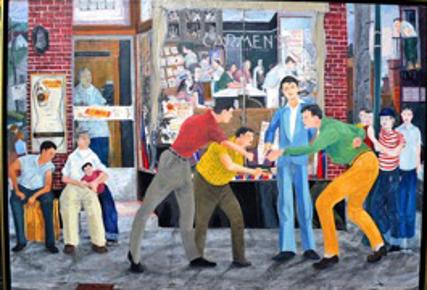
Neighborhood kids at Carmen’s Confectionery playing “Morra”, an Italian finger game where only a loud voice was required.
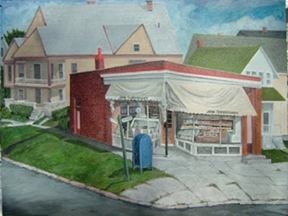
Mitch and Maggy Tebsherany’s Market on the corner of Mohawk and Rutger Street.
Both paintings by well known Utica artist Bob Cimbalo.
In the ’50’s, Uncle Bill Rizzo opened the Campus Inn at Hilton and Arthur, his answer to Pop Tate’s Chok’lit Shoppe of Archie and Jughead fame. Betty and Veronica had nothing on our bobbysoxers, Junie DeFiore and Santina Bretti. Fast times at Proctor High boasted a similar jukebox and old-time soda fountain. The Square View Dinette was UFA’s equivalent.
As America’s landscape pivoted from urban neighborhoods to suburbia, most filling stations and handy bread and milk stops like Tebsheranys on Mohawk disappeared. Nice & Easy and Fastrac Convenience Marts peddle everything from gas to lottery tickets. School kids are no longer the target customer. Kites and soaring balsa-wood gliders just don’t fly anymore.
Ma and Pop stores were our meeting places in simpler times. Each had that indescribable aroma of newsprint mingled with the plethora of sweet scents. What joy for two bits: paddle balls, pea shooters, whistles, jump ropes, tops, Jujyfruits, Black Jack gum, Bazooka and Fleers Double Bubble with the funnies… you name it. We were blessed! Sweet shops had us cornered…couldn’t escape ‘em.
How sweet it was!
GUEST VIEW: Twins can be twice as much fun
By Bob & Dick Chancia - January 27, 2019
Twin mayhem began with history’s first pair.
Esau lost his birthright and blessing to his shrewder brother Jacob’s deception in the Bible’s Genesis account. Greek/Roman mythology’s famous Castor and Pollux’s antics included alternating and even sharing immortality daily between Mt. Olympus and Hades in Homer’s Odyssey. Eeek! Let the twin games continue.
Twice upon a time, on Easter Sunday of 1936, identical twin boys were born in Utica’s Memorial Hospital. Later, we’d hear all the cliches again and again: “I’m seeing double," “Do you play tricks on people?” “Do you fool your parents?” “Do your girl friends mix you up?”
Oh no! This will be an albatross or advantage. We decided early on to make it a lark! In a “you’ve gotta have a gimmick world," here was ours. Why fight it?
The O-D’s birth announcement reported that two Easter bunnies were born…Ugh! The built-in crowd pleaser was off and running. As pre-schoolers, decked in drum-major get-up, we emceed a Wetmore School minstrel show. “Ladies and Gentlemen”…. we only recall grabbing the one microphone from each other to the laughter of the audience. Amusing stories are still unfolding to this day. We balked at dressing alike until high school, realizing it enhanced the gimmick. Two Jacks and a Jill were the ’54 class poll’s choice for Most Popular Seniors. Wham! That never happened before at Proctor. Sparkling “Pinky” Inserra, our Jill, shared that honor with two guys instead of one.
In 9th grade, popular skit director, Senior Bob Del Buono, built a floor length glass-less mirror frame. We stood on opposite sides of the blank frame and simulated a teenager rubbing the mirror clean and going through other motions when peering at a mirror. Our various synchronized routines at school dance floor shows became known as the “Mirror Act." In 1953, there were five sets of twins at Proctor High. Our Class of ’54 boasted the modelesque Castelli twins, Jacki and Judi. Wow, did we admire them! Enjoy some of our funny stories:
Ft. Dix, NJ: We were on the rifle range trying to qualify with the M1 rifle, a basic training requirement. If one failed, he dropped back and didn’t advance with his company’s training cycle. Bob qualified and Dick missed the mark. They offered the sub-par shooters one more opportunity to advance. On that frigid December day, the twins huddled by a garbage can and planned their strategy. It was a no brainer. We could hardly tell ourselves apart in the Army issue fatigues with the same Chancia name tags sewn on. Solution: the guy that passed would try again. Result: both twins qualified and moved ahead with our company’s cycle. Wham! We just put one over on Uncle Sam!
Another Army quip: Bob was in O Company and Dick was across the parade field in M Company, 2nd Training Regiment. Bob was called into the Company Commander’s office after being spotted in the PX during his class time by Sgt. Davies. “That wasn’t me at the PX, it was my twin brother." OK, we’ll buy that but only after you produce your twin brother. After a run across the parade field, we both appeared in the CO’s office. Everyone was taken aback but Bob’s 1st Sgt. (Tops) insisted…”according to Army regulations, you both should be in the same company."
Proctor High's five sets of twins peering through a mirror seeing double in 1953, from left: the DiRuzzas, the Chancias, the Castellis, the Mitslers, and the Sciortinos.
After Tops’s investigation, he learned that since the five Sullivan brothers perished in the same submarine during WW II, brothers must be separated, but identical twins need to be on the same post but not in the same Company. Case closed. We completed that cycle apart but now Bob was given special treatment by his First Sgt. Often, when Tops assigned work chores, he dismissed Bob, ordering,“go and find your brother."
Work capers: A client invited Dick to a Knick game at the Garden. Dick described the guy to Bob, who sat with the total stranger for the first half. At halftime Dick appeared and said, “I thought I’d never find you." His client couldn’t believe he sat and bantered with someone he hadn’t met for an entire half.
Another time, Dick’s office threw him a surprise birthday party but Bob showed up instead. After the group shouted “Surprise” and sang Happy Birthday, Dick appeared yelling…”someone throwing a party for me?"
Wham! The surprise was on them.
Dick played Santa at all his office’s Christmas parties but one year Bob showed up in Santa garb and chatted with the company president as the party began. Suddenly Dick, also in a Santa suit, strolled in singing “Two Gimbel’s Santa’s are better than one."
Wham! The president and office staff were faked out.
At Dick’s wedding reception, Best Man Bob’s toast to the bride was…”don’t worry, your groom has a complete set of spare parts."
These are just a few of the tricks that we continue to inflict on people. We dress alike at class reunions and still love to baffle the crowd. For more laughs and to hear our original songs, check our website: two absurd.com. One day, Twice Upon a Time will conclude but for now, all are laughing happily ever after!
GUEST VIEW: Heading to Florida has its ups and downs
By Bob & Dick Chancia - January 6, 2019
Headin’ to Florida after the holidays to catch some rays and brush off the January blahs? The grass isn’t always greener on the other side of the fence, but it sure is in Florida come January.
What’s better than winter down among the sheltering palms? We experienced it for the first time in 1958. Our SU gridders earned a trip to Miami’s Orange Bowl to play Oklahoma on New Year's Day. No, we weren’t Mr. Inside and Mr. Outside in SU’s backfield. We were two guys in the clarinet row of the Orange Marching Band.
Florida lived up to its billing. We got sand in our shoes and vowed to return. Five years later we left Detroit for a two-week vacation in Miami’s South Beach. First stop, the old art deco Shoreham Norman Hotel on 5th and Ocean, also home of the famous 5th Street Gym where Cassius Clay trained to knock out Sonny Liston that shocked the boxing world. Warm swimming pools, glitzy convertibles, juice bars on Godfrey Road, (named after radio host Arthur Godfrey) tacky sea shell souvenirs, coconuts, Hialeah, dog tracks and plenty of pretty sights…read between the lines. Again, we said, “We’re ‘comin back, only next time, to live!”
We did just that in 1965. Quit our jobs in Motown, and drove our ’59 Chevy Impala convertible to Miami Beach. Permanence can change illusions to disillusions. After a warm winter and unsuccessful job searches it was back to Detroit in the spring. Four years later, from Detroit, we did negotiate employment in Miami and left the cold north again.
Every year many “Sno-birds” leave Utica after the holidays to spend the winter by Florida’s turquoise-colored coastal waters. Rock and Mary Ann Giruzzi have a golf-side apartment in New Smyrna Beach and the Florio Vitullos favor West Palm Beach. Marge and Mike Calenzo like Tampa/St. Pete. Doris Chanatry Hutchinson and the Bob Petronios winter in Naples where Larry Luizzi Jr. is a gourmet chef, year around. Tom and Marge Baumus enjoy Sebring and the Clint Bagshaws do Dunedin.
Former Utica dentist Pat DeCarlis and wife Mary Ann raised their family in Gainesville where their beautiful daughter met and married a baseball star’s son. Would you believe, the son of Yankee home run king Roger Maris? Former Proctor jock George Fanelli hasn’t been down since his parents sold their place in Boca, where Jerry Seinfeld and George Costanza’s TV parents were. We miss our “Sno-bird” friends but it’s nice to welcome them back every spring. Do they have the best of both worlds? That’s debatable.
“Utica’s cold winters are way too long." “We miss the grand kids but the weather is great." “Florida’s not the same anymore…. too much traffic and construction." “We love the ocean, our boat but we miss family, friends and the change of seasons." “We can’t take the long drive down and back every year." (Our achin’ backs) “Shall we cancel cable for four months and get the lower starter price in April or pay $19 or $20 per month and resume the regular rate?" “If we cancel our landline phone, we’d lose our familiar number." Decisions, decisions!
When Rhodes scholar and author, the late Dr. Gene Nassar, asked our dad why he didn’t go to Florida for the winter, he told Gene, “I used to go, take the train down and back with my family and buddies; we all used to go. But on the way back, I’d look out the train window, and at each stop, they’d be loading a coffin or two for the trip north!
"I said, 'to hell with this. Nobody’s gonna load me as freight. I’m gonna die in my own house.'”
We caught the bug after seeing the 1960 movie, “Where the Boys Are” with Connie Francis, Paula Prentiss, George Hamilton and Jim Hutton. Like those spring breakers searching for sun, sand, adventure and romance, we too learned that it wasn’t all fun and games. Searching for Shangri La comes with hurricane warnings, evacuations, Palmetto bugs and other challenges.
What used to be low-rise motels a la the Aztec, Desert Inn, Thunderbird and the famous Castaways has morphed into sky-scraping sand castles along A1A. Old motel row of the 50’s is now accessorized with Bentleys, Jags, Maseratis and Porsches, to mention a few. A new Porsche high-rise even elevates your auto up to your condo unit. What an elaborate evolution since Spanish explorer Juan Ponce de Leon landed there in 1513 and called it “la Florida”. (“The land of flowers.”)
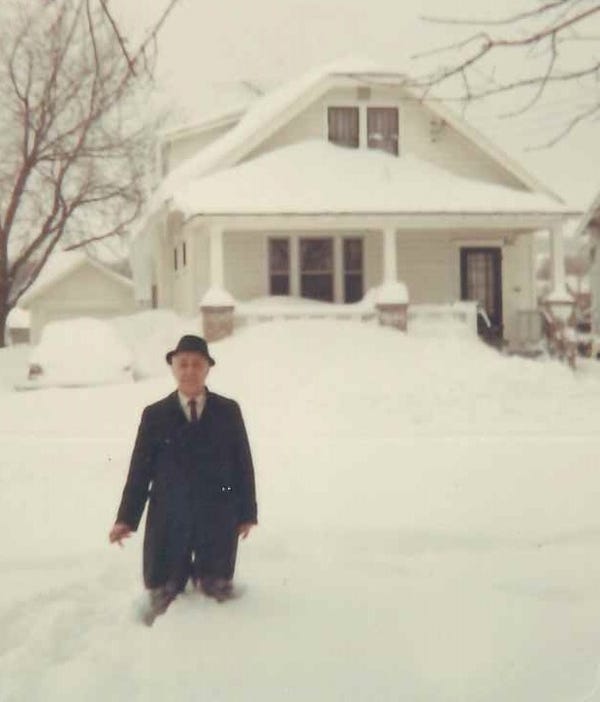
Alex Chancia stands outside his home following the "Blizzard of '66".
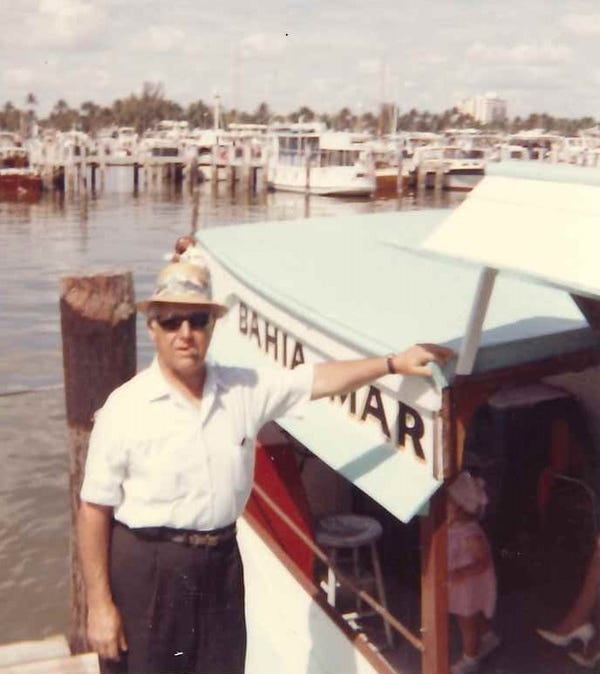
Do what circumstances allow and be content wherever you are; cold, warm and in-between. Happiness isn’t a state but a state of mind. Both New York and Florida have their slice of Heaven but the whole pie is not on this planet. As long as the snow falls and the sun shines, “Sno-birds” can enjoy the best of both worlds: Adirondack firs and the sheltering palms.
REMEMBRANCE: All aboard the Childhood Express!
By Bob & Dick Chancia - December 15, 2018
We turned the orange dial on the transformer to stop the ivory colored metal Baby Ruth freight car on its 3-rail silver toy tracks. Small 8-year-old fingers slid the orange door open to board our mini plaster-of-paris figures (Happy, a Disney 7-dwarf character and a tiny red Santa) into the car. Aunt Junie, a domestic for the Parker family on Sunset Avenue gave us our two make-believe passengers.
It was 1944.
They were hand-me-downs from the sons of her employers. We cherished them and vicariously escaped reality satisfying our wanderlust impulses as they traveled around a real balsa Christmas tree. We, too, meandered through the make-believe city of open and wrapped packages, complete with tall buildings and water towers, simulated by standing cylinder pick up stick and tinker toy boxes.
Glistening tinsel cascaded like water falls and the carefully hung shiny colored glass baubles filled the imaginary sky above. It sparkled with reflections from multi-colored lights creating a meteoric universe of planets and starry galaxies. Two boys wondered with amazement as their make-believe passengers traveled through the paper mache tunnels, on their Lionel train escapade. All electric; nothing digital.
It was 1944.
This train also had a silver Sunoco oil tanker complete with authentic logos and a red coal car that tipped to unload toy coal granules into a coal elevator bin that took the coal to the top. The same car received the load on a section of track in the rear accessed by switch tracks at the press of a button. A flatbed log loader, complete with miniature logs, a coal tender behind a heavy cast iron engine plus the cozy red caboose held up the rear.
The heavy black cast iron engine pulled the chain of cars and ejected puffing smoke when a tiny white pellet was put in its smokestack. Another button was pressed to sound the warning whistle; the same sound as its real counterpart. Wow! Crossing gates with real red and green lights went up and down to prevent metal and rubber toy cars from colliding with the train. We recall a 3-or 4-inch red rubber ’41 Olds sedan stopped by the gates. Some memories transcend the joys, trials and tribulations of time. Nothing plastic yet.
It was 1944.
Amongst the disappointing billfolds, gloves, socks and sweaters were toy drums, gas masks and canteens in khaki canvas cases. Later, we filled one case with baloney sandwiches and the canteen held kool-aid for hikes to Memorial Parkway. One year we were ecstatic to find Rawlings leather Marty Marion ball mitts that Aunt Julie ordered from a Sears catalog. There were genuine leather Ken-Wel footballs and a basketball with laces, art sets, Chinese checkers with marbles, Gibson erector sets and a chemistry set.
But nothing offered the imaginary lure of our Lionel train.
Model train display thrilled this happy family. It was 1944.
The big mahogany furniture piece with its small television screen hidden by doors hadn’t arrived yet to break the attention span of wonder and amazement. That intrusion came six or seven years later. Our model railroad shared the feature spot under the tree. The reason for the season was also center stage. A stable with manger and small figurines recalled the miracle that occurred centuries prior to locomotives. Yet, this under-the-tree dichotomy co-existed, spanning generations. The white bed sheet, cotton snow and big tree-top star enhanced both time segments.
After Christmas, the train set was packed in its blue-and-orange Lionel boxes and stored in an attic closet. Our two-bedroom Craftsman bungalow had no space for a permanent train layout. The upside: the toy train was a once-a-year thrill to anticipate. Unpacking and setting it up plus tree trimming and decorating were always exciting. These times together built lasting family memories.
It was 1944.
The Lionel Corporation was founded in 1900 by Joshua Lionel Cowen and Harry C. Grant in New York City. Cohen sold the first electric train to a Manhattan store owner in 1901 to call attention to other merchandise and the rest is history. In the 1920’s, he expanded the idea of linking toy trains to Christmas that originated in mid-19th century Germany.
Competition always typified America: Coke & Pepsi, Macy’s & Gimbel’s, Hertz & Avis. That held true with toy trains: Lionel and American Flyer. Sports crazy George Fanelli was equally mesmerized with his American Flyer set. Electric trains created unique metaphors where visions of grandeur danced in our heads.
It was 1944.
Where have you gone Lionel? Do you still amaze kids and thrill adults or have you been sidetracked by a techno invasion?
It is 2018.
REMEMBRANCE: Utica is a reason to give thanks
By Bob & Dick Chancia - November 20, 2018
We are about to celebrate another Thanksgiving in our land of the free.
As we used to sing in Theodore Roosevelt School in the 1940’s: "My country,’tis of thee, sweet land of liberty, of thee I sing; land where my fathers died, land of the pilgrims’ pride, from every mountainside let freedom ring!"
Often we dismiss what Thanksgiving is really about. So distracted with making preparations for the abundant feast and getting to the big family gathering, is there any time left to be thankful?
President Abraham Lincoln said on Oct. 3, 1863: "We have been the recipients of the choicest bounties of heaven; we have been preserved these many years in peace and prosperity; we have grown in numbers, wealth and power as no other nation has ever grown. But we have forgotten the gracious hand which preserved us in peace and multiplied and enriched and strengthened us… I do therefore invite my fellow citizens in every part of the United States, and also those who are at sea and those who are sojourning in foreign lands, to set apart and observe the last Thursday of November as a day of Thanksgiving and praise to our beneficent Father who dwelleth in the heavens."
We’d also like to take to heart the very wise words of George Swinnock, an English chaplain and pastor in the 1600s. He wisely advised us to meditate upon the many mercies we’ve received from birth, the dangers we’ve been delivered from, the journeys we’ve been protected in, the seasonable help sent our way, the support and counsel afforded us in distress and the comforts provided in sorrow and darkness.
Let’s never forget the favors bestowed on us and our families. Loved ones, homes, education, opportunities, support systems, all the basic needs and more. Spread these out like valuable jewels and be thankful.
We are especially thankful to have grown up in Utica in the 40’s and 50’s. Post-Depression boom times, wonderful family values, safe and secure neighborhoods with quality teachers and mentors.
The eloquent inscription on the facade of Utica’s Proctor High School says it all with inspiration: "The Intellect, the Will, the Imagination, the Memory…the Reason, the Skill, the Observation, the Spirit."
Thank you for the people, abundant parks and playgrounds, hospitals, churches, libraries, corner stores and downtown. Picture shows from the Rialto, Kallet Drive-in to the marvelous Stanley. Holland Farms, King Cole, Kewpees and the Busy Bee.
Downtown Utica was a busy place in the 1940s and 50s. This shows the block on Genesee Street north of Hopper Street. Among the many businesses there were Sears, Roebuck; the ChinaInn; Daw Drug; Reid-Sheldon; Bev's children's wear; My Boys Shop; Utica Floral; the Savings Bank of Utica; and Loft Candy.
Hank Brown’s Twist-A-Rama, Murnane Field and Valley View, Trinkaus Manor, Utica College and tomato pie, too! And who doesn’t remember Mayor Boyd E. Golder?
Savage Arms, GE, the textile mills and festivals on Bleecker Street, The Blue Sox, Bergers, Boston Store, Wicks & Greenman and Chanantry’s. Utica Club, Grimaldi’s, Hotel Utica, Munson-Williams, Union Station and the Thruway.
These mentioned are a few of the many dew drops of heavenly blessings that collectively moulded the individuals that we’ve become. How can we forget to be thankful on this Thanksgiving Day 2018?
Thanks for the cool reminder, Honest Abe. Should’ve known you’d point us in the right direction! Let freedom ring!
REMEMBRANCE: Pinch hitters crack a homer for Utica’s Bobey Salerno
By Bob & Dick Chancia - August 26, 2018
The Proctor Fifties Club, a group of guys who attended Proctor High School, met monthly for dinner and guy talk. Some meetings included a guest speaker.
An idea was floated that maybe Proctor ’49 grad, Alex “Bobey” Salerno, former Major League umpire, would come and talk to us?
The former pitcher signed a contract with the Boston Red Sox after high school but his playing career ended after a Korean War Jeep accident tore up his right shoulder. His love for baseball led him to Umpire School.
We took a shot and gave Bobey a call. He responded: “When I get back from Florida I’ll be glad to do it."
Wow! That was easy.
We hadn’t seen him since the mid-‘60’s when his umpire crew came to Detroit for a few games. We lived near old Tiger Stadium then and let him use our red Impala convertible in exchange for game tickets.
Forty years later, we connected again.
Bobey packed a record 105 guys into Bleecker Street’s old Son’s of Italy Hall. Craig Muder, then O-D sports editor and now communications director for the National Baseball Hall of Fame in Cooperstown, and a photographer covered the event.
Bobey captivated the guys with baseball anecdotes that included working 3rd base in the 1961 season finale in Yankee Stadium when Roger Maris hit his historic 61st homer to break Babe Ruth’s record.
A few days later, the O-D ran the story. Bobey was thrilled.
We had another pal who became an American League man in blue.
Ron Luciano, Syracuse University All-American gridder from Endicott, lived a floor below us in Marion Dorm. In an intramural softball game between floors, we were on opposing teams. Dick came to bat and Luciano was the catcher. The strappin’ 6’4” backstop dwarfed the mini 5’5” batter.
Ron yelled “swing” and Dick caught the ball on the sweet spot. It sailed over the outfielder’s head.
No one believed a bloop hitter would smash the game-winning dinger!
Luciano went on to the Minnesota Vikings and Buffalo Bills. After a career-ending injury, he also became a big league ump. Ron later worked in the NBC baseball booth and authored “The Umpire Strikes Back” and “The Fall of the Roman Umpire."
In ’68, Bobey and Bill Valentine were fired from baseball for being the ringleaders in an attempt to unionize American League umpires. Surprisingly, a few weeks after Salerno and Valentine were terminated, the union was formed, but Bobey and Valentine were ostracized from baseball for life.
Ironically Bobey’s demise paved the way for our friend Ron Luciano to move up from the minor leagues.
Bitter and forgotten, Bobey asked us to help him get his pension back from baseball.
Being ad men, we put our heads together. We were told that Robert Manfred, Major League Baseball Commissioner Bud Selig’s top attorney, was from Rome. After some detective work, we called a high school friend of Manfred and pled our case.
Our new advocate set up an appointment with Manfred in baseball’s headquarters on Park Avenue in New York City. The Proctor guys said it couldn’t be done.
Armed with a slick presentation, Dick drove Bobey to NYC and Bob booked a hotel suite. After an Italian dinner came the power play. The church next to the café and hotel was holding its Wednesday eve prayer meeting.
Bobey said, “Let’s stop in and say a prayer."
Great idea! We needed a blast of divine power.
It calls to mind that profound quote from another pitcher, former Cleveland Indian Leroy “Satchel” Paige. “If ya don’t pray when the sun shines, don’t pray when it rains."
"Satch,” Negro League legend, was hired late in age and well before the Civil Rights Movement by Indian’s flamboyant owner Bill Veeck. Raised by his Bible-wise Grandma, his prayers really paid off.
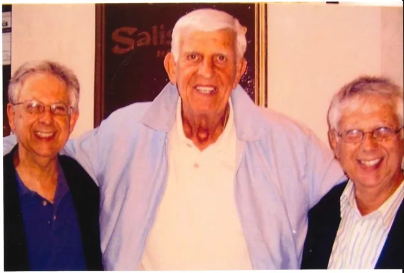
Dick, left, and Bob Chancia stand with Alex "Bobey" Salerno during their 2006 trip to New York City.
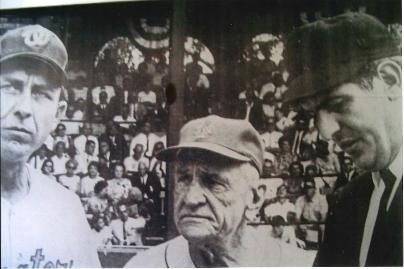
The next morning we were in the swank 17th floor Park Avenue baseball offices, anxious to make our pitch. Amid smartly framed color photos of all the major league teams, we pinched ourselves to make sure this wasn’t a dream.
Finally Manfred appeared and led us to a conference room complete with pastries and beverages. He was cool and asked how things were in Utica/Rome. Then, three guys from Utica Proctor took on baseball’s top attorney (now the commissioner) from Rome Free Academy.
Ya can’t make this stuff up!
He closed with the disappointing news that Bobey signed off on his pension buyout way back in the 60’s.
“Case closed, Yer out!" Just like the Jack Norworth/Albert VonTilzer 1908 Tin Pan Alley song, “Take Me out to the Ball Game”… For its one, two, three strikes you’re out at the old ballgame.
At the time, baseball was battling negative press with the Performance Enhancing Drug scandal. We seized on the opportunity and informed Manfred that the New York Times Sports Editor was waiting for the outcome of this meeting (true story). Manfred left the room and returned with a BAT Organization leader to consider our case.
BAT stands for Baseball Assistance Team. Independent from pensions, they acquire money from grants, corporations, golf tournaments and other fundraisers to aid the baseball family.
The encounter resulted in a monthly payoff for Alex “Bobey” Salerno.
We were so excited, we had to tell someone. From the Thruway we phoned Bobey’s fellow MUNY Leaguer, George Fanelli, famous for his historic homer off MUNY ace Bucky Buckholtz. “By George, we got the payoff!"
Answered prayer! A perfect pitch! A pretty payoff!
Hey … ya gotta believe!
Alex “Bobey” Salerno passed away in 2007, one year before his induction into the Greater Utica Sports Hall of Fame.
YESTERYEAR: Roll back those lazy, hazy, crazy days of bicycles
By Bob & Dick Chancia - August 5, 2018
The Summer of ’42: those days of soda and popsicles and bikes.
Dad took us to National Auto Stores on Oriskany Plaza, now an O-D parking lot, to buy tricycles. We spotted kiddy pedal cars like our friend Joe DeLorenzo had. We coveted his little station wagon but rarely got to drive it.
Dad picked out twin super deluxe Rollfast trikes with three balloon tire spoked wheels, tall chrome handlebar mirrors, bells, reflectors, and leather seats - the works! We pestered for the cars but Father knew best. The unique twin trikes were loaded into our ’41 Buick. They became the envy of the block and began our fascination with bicycles.
Dad bought only the best. He remembered his fascination with wheels back in the early 1900s. In those pre-Depression days he nailed a few boards to an orange crate, added roller skate wheels and BAM!... a scooter. His first bike was a combo of an old frame, handle bars and wheels confiscated from various junk piles. No fenders necessary. That fit the bill to deliver his daily papers and the old Saturday Globe.
When we outgrew the trikes, it was back to National Auto for two-wheelers. Just after the war our new red-and-white Rollfasts lacked chrome but had black metal handlebars. Rollfast Bicycles was a partnership between D.P. Harris Co. of New York and H.P. Snyder Co. of Little Falls. Two-wheel vehicles for human transport that require balancing date back to the early 19th century. The term bicycle was coined in France in the 1860’s.
Big was always better with Pop. He got us full-size models. Wooden blocks placed around the pedals compensated for our lack of reach. Girl friends, Patty Calderella and Dorothy Looft, had 24-inch bikes that we could easily handle. One day, riding through St.Agnes cemetery, they offered a proposition. A kiss behind a gravestone, probably our first, got us the smaller bikes to ride. It was an offer we didn’t refuse.
We knew what make every friend had. Tony Howland had Sears Roebuck’s J.C. Higgins brand. His dad upgraded him with an English racing bike. We frowned at the skinny tires, boring black color, hand brakes and gears with a tangle of wire cables. Those would become the bikes of the future. Joe Karam’s was a cream-and-rust Columbia with a circular speedometer on the handlebars.
Cute little Marie DeLorenzo had a Mercury but used to steal rides on her friend Pricilla’s Schwinn Phantom. Marie fondly recalls, “Then I got beat up." Plymouth Place Pirates teammate Rock Giruzzi rode a streamlined Monarch and Rita Lonero had a junior size green-and-white Rollfast. The frames on the girls’ models sloped down for skirtability versus the boys’ horizontal bar frames that often held a passenger. No gender issues then. Bikes were registered with mini metal license plates attached with a tin clasp under the seat. They were cool.
A Sunday Roto Gravure pictured Bing Crosby with sons - Gary, Dennis, Phil and Lindsay - on their deluxe models complete with built in horn tanks, rear fender carriers and lights attached to the front fender. WOW! We showed it to Dad, not realizing he would try to duplicate them. Our post-war Rollfasts were replaced with maroon-and-grey Roadmasters with all the bells and whistles made by Cleveland Welding Co. Hours were spent washing them and polishing the chrome with white Noxon…”and we looked neat upon the seats of our bicycles bought for two." (adapted from Harry Dacre’s “Bicycle Built for Two,” written in 1892.) The song, inspired by Daisy Greville (Countess of Warwick ), one of King Edward V1’s many mistresses, became famous immediately when performed on the New York Bowery.
We rode to sandlot ball fields with our Ken-Well mitts on the handlebars. Proctor infielder George Fanelli walked his girlfriend home after school and not to be late for practice, pedaled her bike back. We wove red, white and blue crepe paper between the spokes on holidays. Clothespins connected Topp’s baseball cards to moving spokes making a motor sound. Probably a Ted Williams or Joe DiMaggio card, if kept mint would have collectors drooling today. Oh well, Mom would have tossed them out anyway.
Our mini-car collection also includes models of the ’55 Schwinn Cruiser, ’52 Columbia RX7 and ’48 Roadmaster Luxury Liner. Recently we bought two full size replicas: One like our Roadmasters and a Schwinn. Utica artist and friend Bob Cimbalo drove his van to Weston Vermont’s Country Store and hauled the’48 Roadmaster reproduction to Utica.
Utica advocate and native Howard Welch, owner of Welch’s Bicycle & Ski Shop on Whitesboro St., has repaired and donated bikes since 1974 and attracts riders from all over the U.S. Welch sold us the’55 Schwinn Cruiser Deluxe reproduction. It was built from actual 1955 blue prints, retrieved from Chicago archives that were covered with dust and coffee stains to commemorate Schwinn’s 100 Anniversary in 1995.
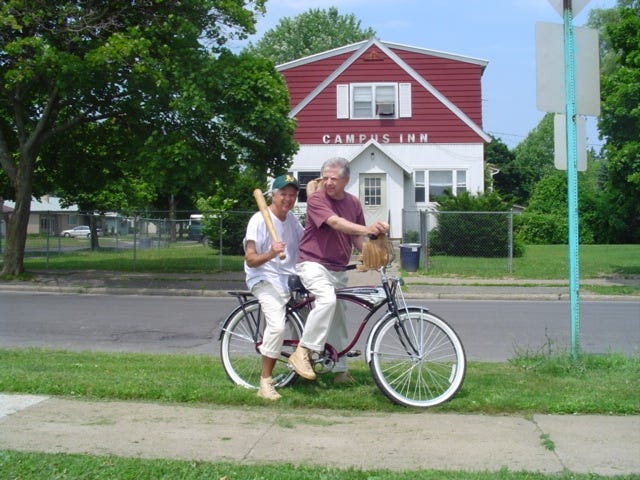
Bob, left, and Dick Chancia aboard their 1955 Schwinn Cruiser Deluxe reproduction in 2004.
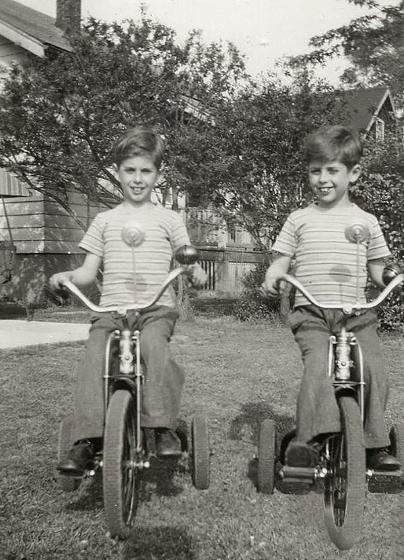
Ignaz Schwinn built bicycles in 1895 to liberate people. Suddenly, covering the distance between our block and Quinn playground liberated us in the ‘40’s too. We had the power to go where we wanted, when we wanted. Bikes delivered our newspapers and kept us fit without costly gym fees. Paraphrasing Mountain Bike Magazine: freedom, exhilaration, discovery…the liberty of a bike made kids feel like grown-ups and grown-ups like kids.
As recent as 2011, manufacturer’s like Detroit Bikes, leapfrogged back to Detroit’s roots as a cycling town, intending to double American bicycle production. At least 7 bicycle makers have set up shop in Metro Detroit. NYC is saturated with bike rentals. Sign toting hawkers in Co. tee-shirts badger tourists to take a ride plus racks of Citibikes offer speedy rentals with a plastic card. America is still spinning its wheels but we valued pride of ownership; hoping to find a bike under the tree kept kids awake on Christmas Eve.
Ahh…to roll back those lazy, hazy, crazy days of summer that seemed to linger. Poor Pop always muttered, “I never bought one of anything."
GUEST VIEW: With bricks and stones they built our homes
By Bob & Dick Chancia - July 15, 2018
Once upon a time in the late 1800s, Italian immigrants with foresight, ambition and hope left home to seek their fortunes.
Like the 1886 English fable, "The Three Little Pigs," they were told before leaving, "whatever you do, do it the best that you can because that’s the way to get along in the world."
When these big dreamers departed Ellis Island, many found their way to Utica, following a sponsor or paisano. Their fortitude surely rubbed off on their offspring.
The next generation, skilled as contractors, masons, electricians, plumbers and homemakers flourished in Utica’s post-World War II boom. Having survived the Great Depression, Utica reaped the benefits of their talents and like many towns in the USA, realized an unprecedented building boom.
The children of those first immigrants literally built their American dream. Post-war money was plentiful so post-war dream homes dotted the hills and valleys of Utica.
The flight from ethnic neighborhoods of lower East Utica to Corn Hill, Armory and Sherman Drive resulted in capes, colonials, and ranch style abodes all expertly crafted.
The list of craftsmen far exceeded the few mentioned: Johnny Roberta, John DiPastina, Tommy Cavallo, John Santa Maria, Tony Bartolotti, Frank Romano, Tommy Damiano, Georgie Nole and Frank Dellecese.
Tall handsome Johnny Roberta had Roberta Lane, lined with his handiwork, near Culver Avenue and upper Eagle Street named after him. We remember him and Dad at our kitchen table discussing how the kitchen counter tops should be.
Pop fabricated custom Formica counter tops, augmenting his day job, to pay for our double college tuition. He furnished our basement with Craftsman power tools from Sears and a huge pressing table where the sheets of formica were cemented to plywood and clamped overnight to dry. A 6-foot wide cellar window was cut out to remove the tops.
He expertly scribed each sink top to fit the slight variances of the walls. After fabrication, the tops were hauled to the construction site, where they slid perfectly between the new walls. Not to waste any of the pressed down formica, he jig-sawed pig shaped cutting boards (porky boards) from the sink cut-outs. We peddled these colorful products around the neighborhood and even sold two dozen to Boston Store Merchandise Manager Selma Abounader.
In 1950, our walks from Plymouth Place, up Armory Drive to Proctor High School passed mostly barren land. Soon, the fruit of these builders filled the empty lots. John Di Pastina built an all stone cape validating his masonry expertise. His dream house still stands on Madison Avenue near Armory Drive.
Some of the excess stones were used to build our backyard fireplace. That bold specimen of masonry can still be found at 610 Plymouth Place. Many family backyard cook-outs come to mind because of it. A 3-foot deep foundation held up the 4 foot high body and steel cooking grates attached to sand colored interior fire bricks. The top, with fire-proof chimney, and side arms were capped with heavy slate slabs. Like a monarch’s throne, it dominated our yard. You won’t find its equal at Jay-K or Home Depot.
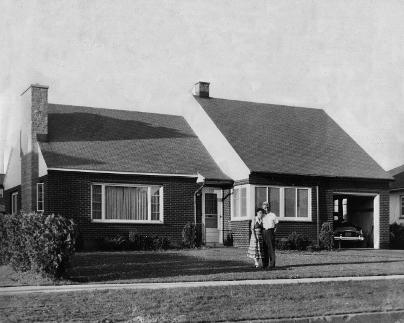
Aunt Helen and Uncle John Saponaro, proudly standing in front of their dream house on Armory Drive in 1949. The red brick cape is still sturdy today.
Both public swimming pools, the all-stone Buckley and all-brick Addison Miller were WPA-built gems. Two crown jewels of stonemasonry are East Utica’s old firehouse on Madison Avenue and South Utica’s on Woodlawn Avenue. Ex-Proctor athlete George Fanelli boasts about his house on upper Sherman Drive, built by John Santa Maria, originally for Rock Spina of Rock’s Tire and Battery. It’s another stone gem emblematic of the neighborhood. The abundance of brick and stone may have come from old streetcar pavements which vanished as late as 1941.
Tommy Damiano, another Utica builder has a showcase of his craft on Victoria Drive in South Utica. Dad did counter tops for him, Tony Bartolotti and Georgie Nole, all builders of Utica’s many dream homes. Georgie Nole’s sprawling limestone ranch on Armory Drive remains a classic. He built a red brick house next to his for our Uncle John and Aunt Helen. Uncle John, a partner and civil engineer for Utica Structural Steel designed his dream home and the Noles built it to his specs.
So fond of his apprentice days to his bricklayer dad, Italian-American novelist and screenwriter John Fante’s many stories feature bricklayers and stonemasons. Prime Minister Winston Churchill did bricklaying for a hobby and was known colloquially as a "Brickey."
"Dream no small dreams" was all we recall from Texas Speaker of the House Sam Rayburn’s commencement address to the 1956 SU grads. Those were days of big dreamers and Utica was abundant with these sons of Italian immigrants. They designed and built custom homes for radio personality Danny Fusco, Utica/Rome bus company owner Mickey D’Alessandro and Russell LoGalbo, to name a few.
Spartacus "Spot" DeLia, son of first generation contractor Elis G., built roads from Route 28 to 12B and the golf course at Inlet. Our neighbors, Helen and Rita Lonero, played many hopscotch games on DeLia-built sidewalks imprinted with their Uncle Elis’s name.
Many of the houses around Proctor High were built by Frank A. Dellecese, father of prominent architect Frank Dellecese. These big dreamers changed the face of our city and their noble wives transformed our dream houses into homes. No wonder the Big Bad Wolf couldn’t blow them down. Our builders did the very best they could do… and they did it one stone at a time. Isn’t that how its done?
MEMORIAL DAY: End-of-May holiday holds many memories
By Bob & Dick Chancia - May 27, 2018
UTICA NY JAN 20 1945 758A
COMMANDING OFFICER CO D 8 BN MC
PLEASE ADVISE MY SON SGT ANTHONY MANGANO THAT HIS BROTHER
CARL WAS KILLED IN ACTION ON JAN 3RD
P MANGANO. 745 AM
How many members of our Armed Forces received phone messages from their families like this one that our grampa sent to Uncle Andy during WW2?
Above is the actual wording on a confirmation print out that informed him of his paratrooper brother Carl’s death in Belgium during the Battle of the Bulge.
We can all empathize with how Uncle Andy felt at 8:43 AM, as the stamp on the confirmation wire indicated when he received the phone message. Now 73 years later, we salute and thank our military heroes who perished and served defending us and our freedoms in every era. Some returned home. Many, like Uncle Carl, didn’t.
The first notice came that he was missing in action and our family was devastated. Then that final telegram was followed by the small flag with a gold star placed in the parlor window, signifying a service person perished. Only God’s grace could enable families to cope and carry on.
The many trips to Union Station with family to see our uncles off to service are indelible in our minds. The station was bustling with Red Caps, cabbies, news stands, diners and crowds. Fleeting moments of excitement somewhat dulled the sinking feelings and anxiety. We wept with Aunt Louise when Uncle Kirk went off and again when Aunt Julie sent Uncle Lou off. Then Cousin Connie bid farewell to future hubby Carmen Lombardo. Those bleak days were like long dreary rain delays waiting for the game to resume and the sun to shine again. We could only pray, trust and hope.
Utica flourished in the war years. Savage Arms and Remington Arms, to name two, were thriving with government contracts. Utica Structural Steel Co. provided steel for military bridges and our city was busy working and reaping. Rosie the Riveters left home to fill the workplace voids. The make up of our country’s work force would never be the same.
The Andrew Sisters were entertaining the Allied forces and Bob Hope’s troop was on the USO circuit. Many sports and movie stars answered their country’s call from 1941-’45. Brandegee school yarder George Fanelli couldn’t wait for the return of “Brown Bomber” Joe Louis and “Yankee Clipper” Joe DiMaggio. We were crushed that the careers of our heroes Ted Williams and Bob Feller were also interrupted.
Our school, Syracuse University, erected pre-fab buildings to accommodate the influx of GIs that would use the GI Bill to get a college degree.
Uncle Lou served in Germany, in Patton’s 6th Armored Division. Uncle Kirk went to the Philippines as an artillery man after training at a few stateside bases. Aunt Louise told many stories of her treks with other soldier’s wives to visit him while stateside. Cousin Connie faithfully corresponded with Carmen and toughed it out ’til he returned and they married in September ’49.
Uncle Joe served with the Army Air Corps in England, where he married Aunt Kay, his war bride in Hornchurch, a suburb of London. Except for occasional visits to Utica, he became an Englishman and they lived happily ever after there. Uncle Andy, a Master Sgt. trained infantrymen at Ft. McClellan, Alabama and Uncle Vic Farina, owner of Dwarfline Cottages in Verona Beach was a Sailor Boy. Cousin Chichie Pape was stationed in the Aleutian Islands.
Many, like our Plymouth Place neighbor, beautiful Marie Looft McDermott, got the shocking news that her handsome new fighter pilot husband John was killed when his plane was shot down. She met him at a Parkway band concert and he walked her home.
It was love at first sight.
The Big One, WW 2, really made an impression on two 6-year-olds. We were forever drawing soldiers and war planes. Dick only drew soldiers in their khaki and dark brown officers dress uniform with the billed round cap, never in the Army fatigues. We were so infatuated with the uniforms that when we arrived at SU as frosh in ’54, we quickly joined ROTC. Why?...the uniforms!
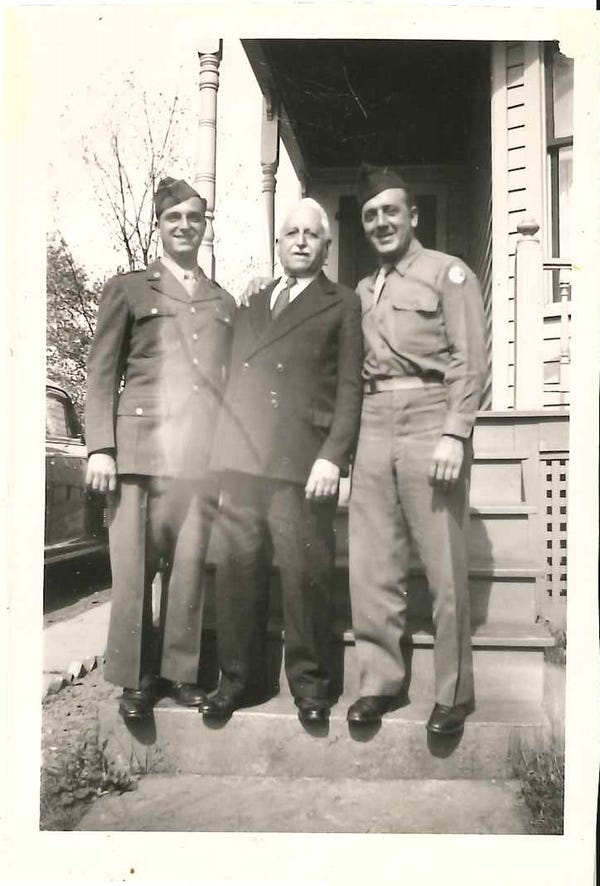
Lou Ciancia and Kirk Coriale, uncles of the authors, flank their father, Gaetano Ciancia at 1109 Albany Street, Utica, during Army furlough. Gaetano is the author's grandfather.
In the 40’s, soldier and sailor suits were so popular that many moms dressed their kids in them. Cousin Jerry Sessa, four years older, played soldiers with his cardboard forts and platoons of small green metal infantry men. The good old USA always won. His attic work space smelled of airplane glue and dope paint, where he made model war planes with balsa sticks and tissue paper. All sorts of war toys, like simulated steel helmets, canteens, tanks and jeeps were popular. Jerry later served with the Army in Korea.
Aunt Betty, Uncle Carl’s widow and her fatherless daughter, cousin Carol Ann of Bloomfield, New Jersey, spent two weeks with us every summer. We have priceless memories of their annual visits, showing off Utica and the Adirondacks to them. Looking back, we’re sure now that Aunt Betty wanted her daughter to build lasting relationships with her daddy’s family. While serving at Ft. Dix, New Jersey, in 1958/59, we used weekend passes to enjoy New York City and visit them in Bloomfield. They got to show off the Garden State to us.
The uncles supplied us with WW 2 mementos. We had all their company insignia patches sewn on the sleeves of our winter mackinaws and they always clashed with the bold red/black plaids. Our favorite was the circular blue Air Corps (pre Air Force) one with the gold wings. They also sent us empty waffle textured grenades and shells, marksmanship and good conduct medals, small military breast pocket ribbons (called “fruit salad”) and brass uniform tacks and buttons. Brasso kept them brassy.
These small memories become more precious with each Memorial Day. The trips to Calvary and Forest Hill Cemeteries on Decoration Day (what we called it then) always included a stop at the Parkway/Oneida St. corner to buy some mini
flags for the soldiers’ graves. The vendor’s colorful balloons, pinwheels and novelties were irresistible BUT...
The greatest memory of all is remembering the precious service men and women who experienced both perilous and meaningful days defending and protecting our liberties. GI Joes and Janes: we doff our billed caps and salute one and all with immeasurable thanks and plaudits... from sea to shining sea!
GUEST VIEW: Birth of a salesman came with rewards
By Bob & Dick Chancia - April 29, 2018
Most Italian immigrants came to America as tradesmen: bakers, shoemakers, carpenters, masons, butchers, tailors, etc. Many of their children - the second generation - followed suit.
There were some exceptions like our dad. Giving up his dream of becoming a dentist, he went to the affordable Utica School of Commerce and majored in business. After graduating well prepared to get a job, he started his career in business at the Utica Trust and Deposit Company on Bleecker Street. His father, one of Utica’s finest cobblers, was pleased and proud.
Our pop spent his spare time with pal Bushy Graham who became Bantam weight champion of the world in 1928 with a victory over Izzy Schwartz in Ebbets Field, then home of the Brooklyn Dodgers. Bushy, called The Bantam Phantom, had a fight in Cincinnati and our dad, Bushy’s ringside second, asked his boss for a few days off to be in the ring with Bushy. The answer was no, but Dad skipped out to Cincinnati anyway. He lost his job and the favor of his father.
One door closed and another opened. Alex Chancia was offered a spot to sell Milk Shake candy bars, then a competitor of Milky Way.
Hence, “The Birth of a Salesman." Armed with a very unique company car, Allie traveled the eastern seaboard spending a few days per town peddling the bars that sold for a nickel apiece. That experience led to a better spot with the American Chicle Company. Now he was selling well established brands like Dentyne, Chiclets, Black Jack, Beemans, Clove, Sen Sen and later Clorets. He drove his ’41 Buick north to Ogdensburg (the Canadian border) and south to Binghamton. (the Southern tier)
Sometimes a Dentyne girl garbed like a ‘40’s night club cigarette girl traveled with him. She strolled the sidewalks handing out samples of Dentyne gum while he made his calls. Not a bad gig. She was as pretty as our high school home room heart-throb, Tina Bretti. Mom wasn’t thrilled with the Dentyne girl.
His success in the midst of Beech Nut (based in Canajoharie) territory earned him two gold watches. One awarded In New York City’s Waldorf Astoria in 1944 as Eastern Sales Division man of the year. After 25 years he retired with his second gold watch. Bob wears the Bulova and Dick proudly wears the Hamilton today.
Our garage was stacked with boxes of chewing gum, and the trunk of the ’41 Buick Special was really special. There he stored boxes of Fleers Double Bubble that jobbers provided and sometimes Hershey bars with almonds. They were scarce during the war and we sold them door to door in the neighborhood. Salesmen beget salesmen. Once, in Spanish class, Mrs. Makuch rebuked us for chewing gum.
“If you’re going to chew gum bring enough for the entire class," she commanded.
To her surprise, the next day we did.
Allie wasn’t the only successful second generation salesman in Utica. One neighbor on Plymouth Place, Mike DeLorenzo, sold Parodi cigars on the road. We recall many visits to Mr. D’s garage getting red, white and green Parodi promotional hats and novelty wooden cartoon postcards.
Another neighbor, Gabe Karam, peddled White Rose canned goods. Samples from Gabe were welcome in those post-Depression days. Bob Falvo sold macaroni products for Procino & Rossi (P&R) out of Auburn.
Today, pitching products on the road requires a college degree and comes with the fancy title of marketing rep. Baseball star George Fanelli aspired to sell Ken-Wel baseball mitts in the Leatherstocking Region. But it wasn't to be.
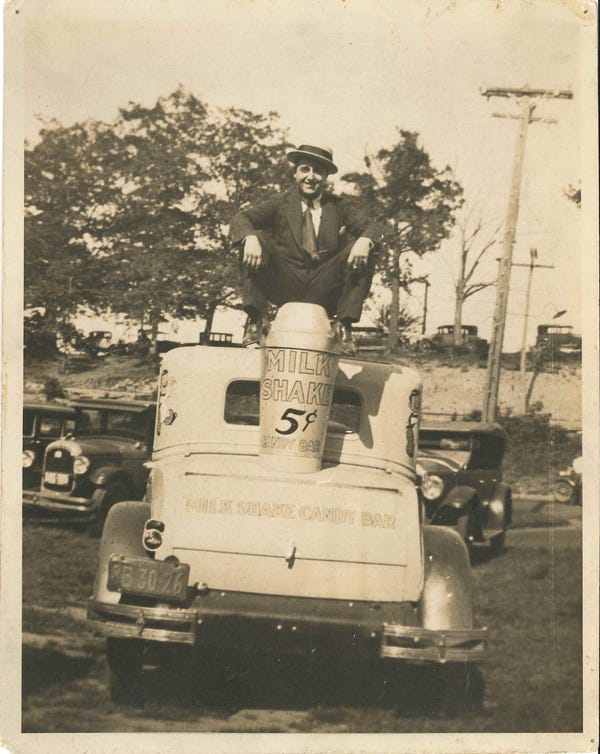
Utica salesman Alex Chancia, shown here in June 1930 top is 1929 Chevy at Bristol Connecticut's Lake Compound, North America's oldest operating amusement park and one-time home to the world's top-rated roller coaster.
Our friend Butch Polera’s dad sold meat products for Gold Medal and Durr Packing. We still share the story when in 1948 our dads met in Binghamton and passed the time going to a movie. The 20th Century Fox comedy, Scudda Hoo! Scudda Hay!, starring June Haver was the feature film. It’s known for Marylyn Monroe’s one-line bit part and little Natalie Wood’s cameo appearance. Whenever Dad met Mr. Polera they would say simultaneously, “Scuuda Hoo! Scudda Hay!”.
Our own O-D Opinions Editor, Dave Dudajek, was inspired by his hardworking salesman dad to do well in whatever he did. Our Uncle Louis Ciancia was equally successful selling insurance policies for The Metropolitan Insurance Company. He would make weekly house calls collecting the quarter or 50-cent premiums. Selling insurance is no piece of candy. Bob still collects dividends from a policy dad bought for him when a teenager.
We could go on and on. These best sellers were “no losers” like Willy Loman, portrayed in Arthur Miller’s Death of a Salesman. Willy’s false perception of himself and others brought about his ruin.
Our Utica guys dug in and kept their noses to the grindstone. Their efforts provided our living. Good salesmen never die. Their legacy keeps on living!
Havin’ a hee-haw time during March Madness
By Bob & Dick Chancia - April 1, 2018
It was March Madness, 1954 style.
We had no ESPN bogus bracket predictions every week all winter long. Fewer NCAA rules and restrictions; no investigations. No highly sought-after recruits or millionaire coaches, no alley oops and slamma jamma dunks. No madness.
But somehow we made madness happen.
Enter: Donkey Basketball.
Are you kidding me? What was that all about? Proctor High hired a troop of 10 donkeys, a couple trained instructors from a local farm and we hit the hardwood. Late in March the members of the Block P Club (varsity lettermen) climbed on these critters and went for the nets with basic basketball rules in place.
No Nikes or Adidas required, just some ordinary jocks havin’ a hoop game on jackasses. The gym became pandemonium. These trained hoofed quadrupeds included long-eared mules of all types. One a clown, another a balker, a stubborn nellie and nasty neddy. We got to ride, too. Disadvantaged size wise to earn a Block P as athletes, we were determined and became sports team managers. We got the coveted chenille letters and were in the game.
There we were with the jocks being instructed by expert farmhands.
“The mules have their own temperaments, just like people."
Some are rambunctious, others lovable or down right rude, some mellow and all stubborn at best.
“Treat them gently."
It was a crap shoot. You rode on the one you drew. These mules, like their 50’s celebrity counterpart “Francis," the talking star of seven popular Universal films, were equally cynical and sardonic. Sadly, our Proctor jockeys weren’t able to establish any rapport like the young soldier played by Donald O’Conner did with his babbling mule.
Footballer Mike Calenzo showboated and hammed it up for the crowd. As the good book says: pride goeth before a fall. His mule dumped him and other accidents occurred. The only dribbling was done by the donkeys and they didn’t raise their hoofs and ask to go to the rest room.
Head Coach Phil Hammes to the rescue. He wielded a mean, wide industrial broom. Our Junior class president, Lou D’Amore, and senior class president Dick Camarra didn’t come off very presidential. They flip-flopped all over the floor trying to maintain some control. Best Athlete Ralph Antone, alias “The Truck," like all the brawny stars, was flailing atop the hoofed beast trying to pass the ball. The guys looked more like giant tortoises straggling toward the rim.
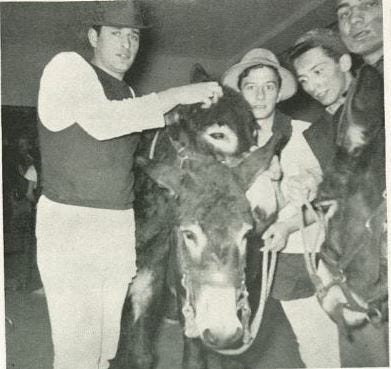
1954 Proctor athletes, left to right: Dick Camarra, Gene Favio, Lou D'Amore and Fred Alsante cuddling the critters.
Us slight-built twin managers, still waiting patiently for our growth spurt, held on for dear life. We were mostly distracted eyeing movie-starish Jacki and Judi Castelli, twin cheerleaders who were egging us on. Three-sport star “Gorgeous George” Fanelli recalls when he played in March ’51. “What gorgeous? I felt goofy - all the way out there."
Absolute mayhem and fun! What a contrast to today’s media circus. No wonder they called us the innocent generation. There wasn’t any One Shining Moment and no one climbed the ladder to cut down the nets. Just another kind of madness for another era.
Donkey Basketball has been played in the U.S. since the 1930s. It’s usually staged as a one-shot fundraiser, typically in public schools. Commercial farms provide the donkeys and equipment and split the profits with the hiring party. Targeted by animal rights activists as cruel to animals, it has lost its popularity. There are companies still promoting it, though, some with Donkey Baseball and Races, too.
Fast forward to 2018. Today is not about mules, but office pools.
Find out Monday.
GUEST VIEW: Those ’50s cars could drive a kid crazy
By Bob & Dick Chancia - February 25, 2018
In the silent 50’s we had no hand-held devices to keep our minds occupied, so we invented our own pastimes.
When it was too hot for street ball, car watching was really cool. With our pal Laurnie, (Larry Luizzi) we’d sit on the grassy mound of Dolly Darman’s lawn at the corner of Plymouth Place and Mohawk Street and play cars. Three car-crazy kids took turns and claimed the car that passed by. Whoever got the best cars was the winner! That was the game: real basic, but a joy ride.
The good times and high-style 50’s embraced flamboyant autos. Tailfins, chrome and horsepower led the way. It was a post-war seller’s market created by the World War II industry shutdown.
After the war one had to be on a waiting list to get a new car. Dealers had two or three cars in the showroom and a few more in the back lot unlike today’s required huge inventory, owned by holding companies. McRorie Sautter phoned Dad; “Your new Buick Super is in."
We went ballistic. Our new robin’s-egg blue fastback was sure super. Mom gave Dad that look. Two days later the car ended up with Uncle Kirk who could better handle the payments. Losing a new car at 10 was as traumatic as a teen jilted by his high school sweetheart.
Utica, a middle city with lazy traffic in the 50’s, was ideal for car watching. Downtown Utica, especially, had a plethora of car dealerships within easy reach. We couldn’t wait ‘til fall, when the new models rolled in the showrooms. Laurnie, being 7 years older with his license, drove us to all the dealerships and we’d gloat over the latest models. That was our annual tradition.
Utica Oldsmobile was on Court Street and McRorie Sautter Buick on State at Columbia, Ray Benson Chevrolet on Lafayette and Dahl Motors Ford on Elizabeth. East on Bleecker Street was the original Carbone Studebaker, later Studebaker/Packard near King Cole Plaza in South Utica. Harry Heiman Chrysler/Plymouth was on Lafayette and Mel Gooch Cadillac/Pontiac in South Utica by the Uptown Theatre. Pontero’s on South Street introduced the new Kaiser/Frazers. Legendary Proctor coach Phil Hammes drove a new Kaiser. C.J. Fletcher had Nash on Genesee south of the Stanley and Gordon Davis Lincoln/Mercury was also near the Uptown. Howard Newlove Hudson was on Oneida Square.
Commercial Drive, today’s car dealer’s row, was farmland.
High schoolers with wheels in the 50’s were rare. Proctor shortstop George Fanelli kept his’39 Chevy parked and skipped practice to take a ride in Babbie DiIorio’s wood-paneled aqua Chrysler hardtop. Anna Theresa Laino drove her baby blue Pontiac fastback to Proctor and Angelo DiRuzza was proud of his Dad’s rare new Tucker. The Tucker later joined Edsel with its horse-collar grille as decade dinosaurs.
Not only were the new models distinctive in styling, but they had dazzling two-and three-tone pastel color combinations with matching interiors. No 50 shades of grey then. Today’s high-tech dashboards and seats are efficient but they’re like sitting in a dentist’s chair. Who doesn’t recall that pink Caddy convertible with the Bat-mobile persona that boxing champ Sugar Ray Robinson drove? Today, you have to go to Havana to escape the glut of white, sliver, grey and black only cars.
Post war cars came out firing on all eight cylinders. Studebaker launched its breakthrough “bullet nose” front in those Howdy Doody days and Chevy unveiled their legendary Corvette. At the Rialto we had 3-D glasses and behind the wheel, peered through massive panoramic windshields. While Elvis gyrated, we glided on tubeless tires and fast new federal and state turnpikes. The Thomas E. Dewey NY State Thruway opened in 1954. When baseball’s Dodgers and Giants moved west, Dodge and Chrysler moved into their forward look with push-button dashboard gear selectors to rival alleged flying saucers and Alan Shepard’s spaceship.
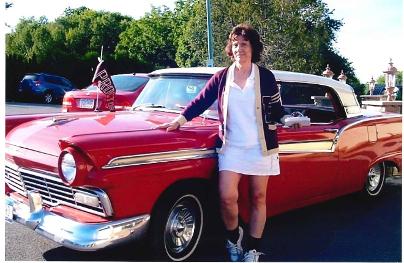
50's bobby-soxer Corky Romagnoli posing in 2008 next to Bobby D's '57 Ford Skyliner.
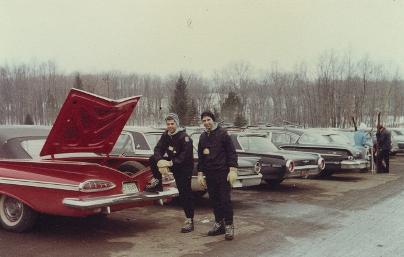
Buick’s gunsight hood ornaments, portholes and waterfall grills were classics along with the sad mouth chrome bar Oldsmobile grills. Yep, the decade that brought us McDonald's and Disneyland, Dynaflo and Hydromantic drive plus mandatory window price stickers also dealt us imports: Datsuns, Toyotas, VW Bugs, a new state of Alaska and the Korean War.
What a decade. Roger Bannister’s 4-minute mile, seatbelts, Playboy magazine and the Salk vaccine. But we remained car crazy!
We rode with Laurnie and his wife Babe to a Colgate/Cornell game in his shiny’53 emerald ’88 Olds. He idolized that car and was forever washing it. We parked in Cornell’s Schoellkopf Field lot and Babe opened her door…WHAM! The car parking beside us slammed into the open door and Laurnie was livid. What eased the pain was discovering we were sitting next to their former classmate Loretta Taylor, Prox salutatorian of 1950. The Big Red won, but sitting by that beautiful redhead softened the blow.
In 2008 we held a 50’s car show at the monthly meeting of the Proctor Fifties Club at Daniele’s Valley View. Photos of cars were projected along with a model car display. Former Utica Assessor Bob Dellecese brought his classic red-and-cream ’57 Ford Skyliner for photo ops. We both have curio cabinets at home stacked with miniature replicas of those 50’s technicolor cars.
Sure, we can get into today’s cars. But you’ll never get those 50’s cars out of us! As Yankee broadcaster Mel Allen would shout: “How ‘bout that”!
GUEST VIEW: Utica O-D fostered budding scribes
By Bob & Dick Chancia - February 4, 2018
In the fabulous ’50’s, we learned the value of speaking softly by carrying a big pen.
To test our skills as scribes, the classroom was our lab. A two-part course was offered at Proctor High School, labeled "Journalism 1 and 2" and aptly taught by Peter Dodge.
In Journalism 1, we learned the rudiments of news reporting: who, what, when and where. Just the facts please - no "fake news" allowed. News stories had to be accurate and timely, always seeking to scoop the competitors. We were also exposed to the art of the editorial: expressing opinions in an interesting and convincing manner.
Both of these classes made up the staff of our school’s newspaper, called "The Pacemaker." One of it’s first editors was Barbara DiIorio in 1950. If you excelled, like Jeanette Putrelo, Ben Carucci or Bobby Isgro, you had a regular column named after you, like "Jean’s Jottings," "Ben Points" or "Bits by Bob."
We reported all the goings on: school plays, prom and ball themes, dates etc. Sometimes these columns included juicy gossip tidbits besides reporting whatever of interest was happening. Star athlete George Fanelli was the paper’s sports editor in 1951 and he wrote a gossip column called "George…all the way." Other stellar scribes that come to mind are Betty Timpano, Frank Giruzzi, Helen Lonero, Frances Lupi, Nick Piperata, Angela Zegarelli, Joan Huss and Mary Cardillo.
Way back then, we co-authored articles as we do now. One was about the blocking machine our grid team smashed into to hone their blocking techniques. As team managers, our job was to tie the canvas padding on the apparatus that protected the linemen from the impact. The machine was named "Bertha" by line coach Ed Herrmann. The name stuck. We titled our article "Big Bertha, Big Hit at Proctor."
We had to have the big gal dressed in her pads for 3 p.m. practice and undressed at 6. No, that wasn’t the birth of the women’s revolution. Bertha kept Proctor’s linemen in check. Once, when tackle Ray Marashian was griping, coach Herrmann yelled, "Go take the pads off Bertha." Ray was humbled and embarrassed doing the water boy’s job.
The creme de la creme was writing for the Utica O-D. They offered a full page every Sunday to all the city’s high schools. Only the best stuff submitted was published. Writing and editing for the O-D’s city-wide page was the task of both journalism classes. Our Big Bertha story made that page and ran with a photo by one of our classmates.
All kinds of timely topics, both news and editorial made their way on that page, giving budding scribes a coveted opportunity and showcase. Chalk one up for the O-D! We couldn’t wait ’til Sunday, to see what cool stuff was goin’ on in Utica’s schools. Our by-lines reached beyond the walls of Proctor. Who knows how many budding scribes were encouraged by the generosity of the O-D?
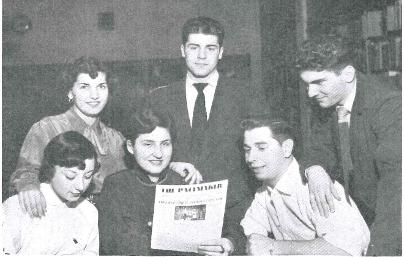
Thomas R. Proctor's 1951 journalism classmates, from left, seated: Marilyn Beratta, Barbara Dilorio and Frank Iagnocco; standing: Jeannette Putrelo, George Fanelli and Jack Paparella.
We learned early that missing the deadline meant losing the headline and good reporting was always reliable. Research was important and we developed interview skills to gather the facts. To paraphrase Mark Twain: The difference between almost the right word and the right word is the difference between the lightning bug and the lightning. It was the silent ’50’s, but we picked up our pens and let the ink wells overflow!
The 1951 Proctor valedictorian, Lois Gerace, went on to hold top creative positions in leading NYC ad agencies. In 1975, she founded Advertising to Women Inc. Her motto: "Do what terrifies you. Everything else is boring." She coined memorable ad slogans like "You’re not getting older, you’re getting better" for Loving Care and "Want him to be more of a man? Try being more of a woman" for Coty.
Other notable scribes that often graced the pages of the O-D were Rhodes scholar and Utica College English Professor Emeritus, Eugene Nassar, renown local historians, Frank Tomaino and Malio Cardarelli, former USA Today White House correspondent, Richard Benedetto and Frank Lentricchia, professor emeritus of Literature at Duke University. Popular writer of Italian American folk-lore, Mario Fumarola can’t go unmentioned.
The newspaper, a European invention dates back to 1566 in Venice. Germany published the first weekly editions in 1609. Thanks to Johann Gutenberg for launching a revolution with his first printing press in the 1400s. Thus began the ideals of liberty and freedom of information exchange.
Thanks Mr. Dodge for the ace tutoring and mucho gracias Utica O-D for cutting budding scribes loose. The Voice of Proctor, then called "Vox Prox" echoed all around town. Who, What, When and Where? Utica’s O-D, where else?
GUEST VIEW: Utica was tailor made for snazzy dressers
By Bob & Dick Chancia - January 21, 2018
In the late ’40’s and ’50’s, unlike today, Utica’s high school dudes dressed to the nines.
An economic shift was happening. The pivot point was the end of World War II. By fall of ’45, we endured 16 years of hardship through the Depression. Now we had the means to dress up and we didn’t have to go far to do it.
Utica’s Bleecker Street was right up there with Central London’s Savile Row as a focus for men’s fashion. Proctor High’s hallowed halls were decked with some of the nattiest guys and Proctor’s dolls loved it. Why not? They dressed to the hilt for school, too!
Each graduating class’s senior poll had a category for Best Dressed guy and gal. Here’s a list of the "Beau Brummells" who held that crown: ’46, Louis Sirianni; ’47, Ray Iagnocco; ’48, Michael Toti; ’49, Lou Patrizio; ’50, Joe Pape; ’51, Frank Broccoli; ’52, Fred Bruzzese; ’53, Manny Rizza; ’54, Mike King, and ’55, Nick LaBella.
The list of haberdashers was no shabby number either.
Six of seven favorite places where these Dapper Dans got their duds were operated by East Uticans. John Palmisano’s Ideal Men’s Shop on Kossuth near Bleecker had handsome George Fanelli and fireball Tom Trinco as their star customers. Danny Daniels on Bleecker near Mohawk featured shirts with the "Mr. B" collar, named after bandleader and American jazz and pop singer Billy Eckstine. Further west on Bleecker, Jerry Didio’s Geralds and Johnny Wakeel’s had the finery where the "Big 3", Tony Peters, future local TV newscaster Jerry Fiore and John Durante got their GQ reputations. Kahn’s Men Shop, also on Bleecker, was a favorite spot.
Every Proctor jock who earned a coveted Block "P" rushed to Angelo Saggese at The Sport Shop on Bleecker for a maroon or white varsity cardigan to sew it on. The King, Tony Vitullo, had his headquarters on Hopper Street for suits, sport coats and tuxedos for our school proms. This leading haberdashery, A. Vitullos, is now in the New Hartford Shopping Center.
Popular blue jeans (we called ‘em dungarees) with the cuffs rolled up were strictly for play and after school. No way were they classy enough for the classroom. Today’s laid-back generation wear cut-offs, tees with a slogan, flip-flops, gym clothes and backpacks all day, night and year round. Not us! For school, the norm was rust or pool table green dress slacks, with the pant legs often pegged, side stitched in-seams and a small buckle on the seat. A snazzy matching shirt with cloth covered buttons, suede pocket or collar trim, was always tucked in the trousers and belted with a sleek strip of half inch wide suede. That was cool!
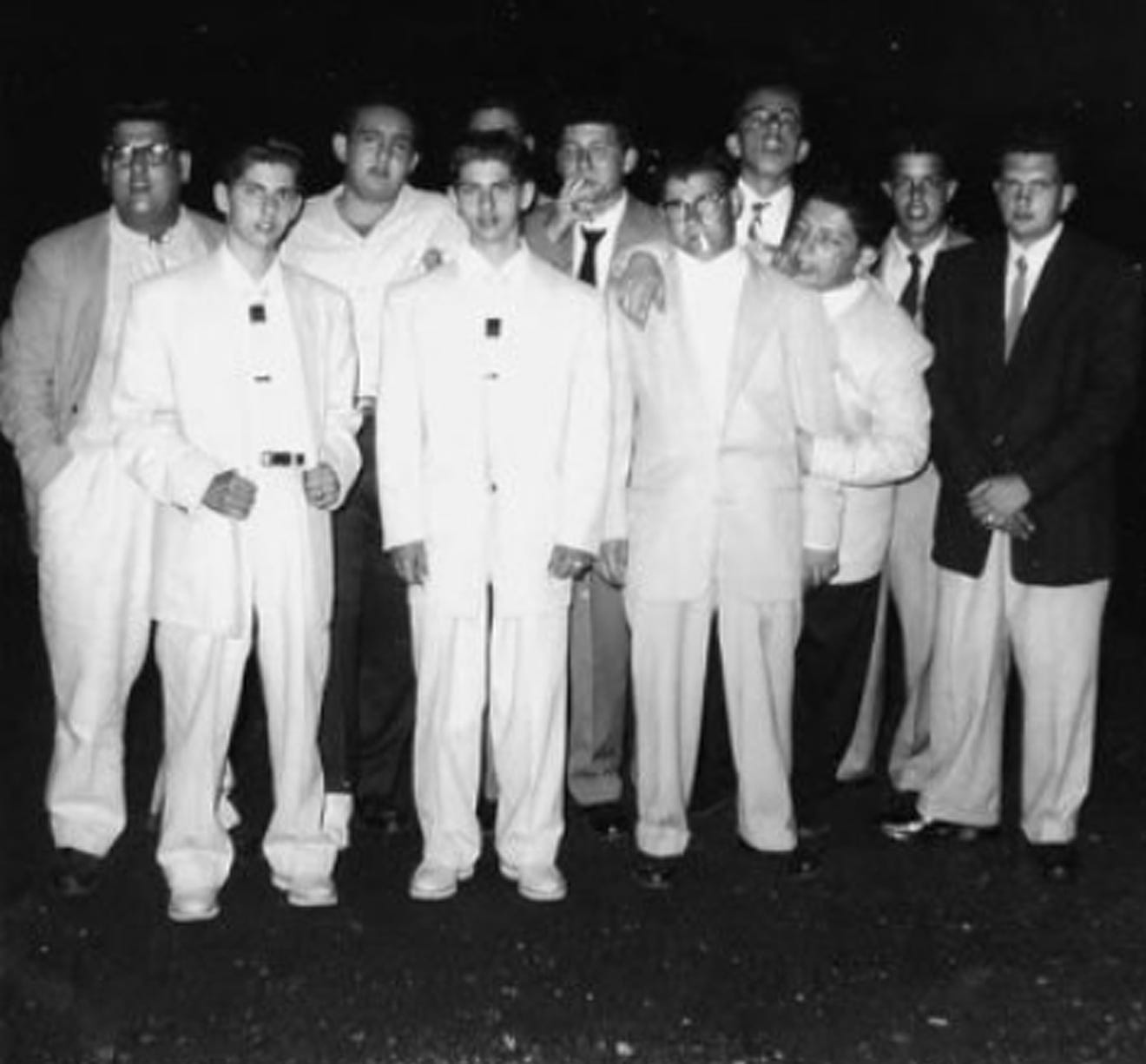
Snazzy Proctor dudes, circa 1954, front, from left: Bob Chancia, Dick Chancia, Angelo Giacovelli, Bruno Fava, Rock Paladino. Back, from left: Joe Karam, Vin Parrella, unknown (hidden), Malio Cardarelli, Tony Capelli and Gino Frate.
Another typical get up was neatly pressed classy charcoal black trousers, sharp pink dress shirt with the Mister "B" rolled collar under the Varsity sweater with the chenille block "P" letter. Only the next to last button was buttoned. Midnight blue suede dress shoes, maybe tasseled, completed the ensemble.
Monday night shopping trips to the many downtown stores were a weekly ritual. Downtown featured Wicks & Greenman’s on Franklin Square, Joe Mittleman’s, Brill’s and Glick’s on upper Genesee and Al Gordon’s University Shop. Gordon also operated My Boy Shops, where grade school slickers got outfitted. Footwear was the finishing touch. Suede shoes from Mahar Bros. on Lafayette and Flemma’s Florsheim headquarters footed the look. For lower budgets, there were the chain stores, Thom McCann, Endicott Johnson and Miles.
It was neat dressing up for school. Many parents were tailors employed by Joseph & Feiss and other clothiers, so looking sharp was in our DNA. An ice cream-colored one-button roll lapel collared worsted suit and sleek suede dress shoes were a sight to behold in East Utica. We learned early when Mom took us to My Boy Shops for our Christmas and Easter outfits and we were fit to a T by Mr. Gordon. By any measure…good old Utica was tailor made for us snazzy guys!
GUEST VIEW: Bowled over just 44 miles from Utica
By Bob & Dick Chancia - December 17, 2017
Celebration, Cure, Camellia, Gasparilla, (Gasp) Famous Idaho Potato, Dollar General, Quick Lane, Foster Farms, Camping World and Taxslayer.
Can you figure what this is all about?
Here’s a hint: Rose, Sugar, Orange and Cotton.
If you’re thinking Holiday Bowl Games, you’re right on. What used to be four New Year’s Day Bowl Games has mushroomed to 40 and counting. Former Utica businessman George Fanelli said, "I shudda sponsored The Fanelli Trucking Bowl."
We recall waiting for New Year’s Day to watch the granddaddy of all parades: the Tournament of Roses down Colorado Boulevard (old US Rt. 66) in Pasadena, California. Then we changed channels (no remote) to view the Cotton Bowl Classic from Dallas, followed by Miami’s Orange Bowl and the Sugar Bowl from New Orleans.
Finally, at around 4:30 p.m., Pasadena’s Rose Bowl. What a special way for couch potatoes to shake off some New Year ’s Eve partying and begin a New Year.
Our dream was to participate in a bowl game.
Being high school bandies, this was pure fantasy. We actually made our college choice desiring to march in the Rose Bowl game and parade. We had advocates! Both Tony Desiderio, Proctor High band director, and Phil Hammes, physical education director, were University of Michigan alums. Hoping for a Rose Bowl trip, Michigan was the non-negotiable. It seemed like the Wolverines smelled roses every year. Reality check: average grades from out of state resulted in the inevitable Dear John letters. Even after personal appeals from both advocates, the reply was still…No Way Ro-se!
Now what? Guidance Counselor John Moses and Art Teacher Mary Drumm, a Syracuse University grad, suggested SU for our interest in advertising design. The Orange just came off a New Year’s Day 1953 trouncing by Alabama (61-6) in their first bowl appearance. Not likely they’d get more bowl invites. After considering Michigan State and UCLA, close-to-home Syracuse, with their band, then dubbed "100 Men and a Girl," was our reluctant choice.
Long story short: Michigan never made a bowl appearance the next four years. SU had a guy named Brown, wearing jersey No. 44. For the first time, a long train ride, dinner in the diner and sleeping in a Pullman car, speeding to Dallas, Texas, "Big D", Wow!... the Cotton Bowl parade and New Year’s Day game vs. TCU.
Dancing with Kilgore Rangerettes on New Year’s Eve, 70-degree weather in January, a glitzy hotel and famous Texas steakhouses. Marching in the parade and game completed our thrilling consolation prize. Bowled over: Even after graduating, SU’s band director invited us to march in two more bowl games: ‘59’s Orange Bowl vs. Oklahoma and ’60’s Cotton Bowl vs. Texas, when the Orange won the national title. The next No. 44, Heisman Trophy winner Ernie Davis from nearby Elmira, starred in that game.
Back to today’s Bowl menu of 40 and counting. Somehow holiday bowls have lost their luster. Overexposure that kicks off in mid-December and drags on to early January for the National Championship game is like most of life today – Overkill!
The thrill of waiting for New Year’s Day’s traditional Cotton, Orange, Sugar and Rose is history. Who can keep track of who’s in what bowl except the sponsors and money brokers who call the plays in media muddled America. Most bowl game names are now preceded by the sponsors, like the Chick-fil-A Peach Bowl, Hyundai Sun Bowl and Northwestern Mutual Rose Bowl. Hey, maybe a Fanelli Trucking Bowl ain’t such a bad idea.
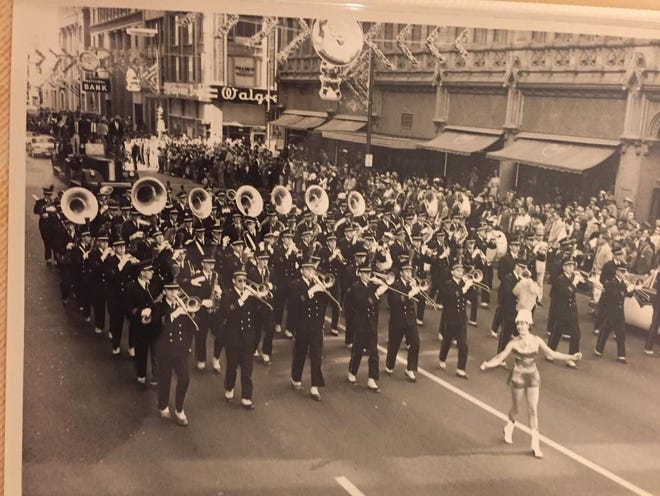
Syracuse University's "100 Men and a Girl" band marching through Dallas in the 1957 Cotton Bowl parade.
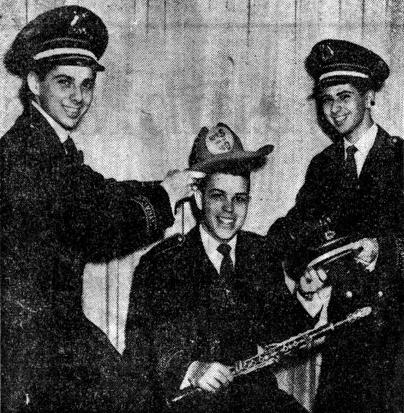
Ah…those good old silent ‘50’s, when less really was more! And thank God for those mediocre grades and staying in New York state, less than an hour away from Utica. Two Cotton Bowls and one Orange appearance, plus the Cotton Bowl and King Orange Jamboree Parades. Rare lifetime opportunities, compliments of ‘CUSE. Who wudda thunk it?... And let’s not forget, back then, 40 was just 4… and only 44 miles from Utica.
GUEST VIEW: Utica blew its own horn during the “Big Band Era”
By Bob & Dick Chancia - October 22, 2017
May 1945, Cousin Angie got married. The “football” reception was held - where else? - DeRosa Hall on Bleecker Street.
Those 40’s celebrations were sometimes called “football weddings” because they featured wrapped sandwiches piled on a table and thrown to the guests. In that pre-DJ and Rock era, two 9-year-olds were captivated by the band, especially the rich reedy cadenzas from the saxophone player.
In 1946, it was a different venue: Hotel Utica’s ballroom; another family wedding. We positioned ourselves in front of the orchestra. In reality it was a dance band. The only string instrument was a base fiddle.
Lenny Sinisgalli’s saxophone caught our eye. The bell of his golden horn crooked up like a big smoking pipe. That did it! We wanted to play the sax!
The Big Band’s makeup: four or five saxophones, two altos, two tenors and a baritone. The brass: a few trumpets and slide trombones with mutes, a piano, and to establish the beat, drums in the rear with a base fiddle.
The sax players had metal stands that held clarinets (called licorice sticks) or saxophones, when the clarinets were played. The musicians had cardboard or Masonite band fronts with angled tops that held small lamps and sheet music. The band’s logo or initials screened in glittered letters on the fronts gave the band their identity. The music books were called “charts."
“Get up number 9, STARDUST,” the leader would shout.
It was the 40’s, when the Big Band Era was sweeping our nation. The stars were Glenn Miller, Harry James, Benny Goodman, Artie Shaw and the Dorsey brothers (sax man, Jimmy and trombonist, Tommy).
In 1947, Lila Karam, our best pal Joe’s mom, took us to see the United Artists film “The Fabulous Dorseys." Lila was from the same mining town, Shenandoah, Pennsylvania, as the Dorseys.
Our own Utica had an abundance of first-rate bands. Leaders Lawrence Luizzi, Tony Rogers, (Johnny Maggio) his brother Frankie Howard, Freddy Lawrence and Roger Scharf had the best musicians around. Local favorites, Sal Alberico, Art Fragetta, Mickey Collea, Nick DeCarlis, Chuck Zongrone and many more, played gigs with those bands.
In 1922, “The Big Five” musicians formed a band sponsored on radio by Lovejoy shock absorbers and the first hot water heaters. They traveled the country prior to becoming Lawrence Luizzi’s orchestra. As addicted fans, we learned that Utica’s top band leader, Lawrence Luizzi, a mandolin player born in Puglia, Italy, was our neighbor on Plymouth Place. His orchestra, Hotel Hamilton’s house band, played many proms in the area. If a school couldn’t book him, they rescheduled their prom.
Proctor icon George Fanelli recalls his 1951 Senior Ball, “One Touch of Venus," The band? “Who else but Lawrence Luizzi?"
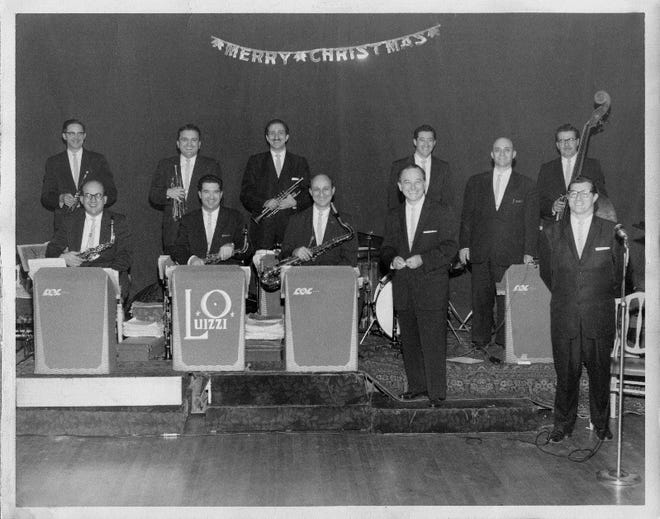
The Lawrence Luizzi Orchestra of the 1940's-50's. Front, from left: Tony Policelli, Steve Sciortino, Art Fragetta, Lawrence O. Luizzi and Pat Santacroce. Back, from left: Unidentified, Sal Van, Frank Sciortino, Iggie Origlio, Joe "Day" Iuorno and Nick DeCarlis.
Legend has it that “The Hokey Pokey” popular at every Utica wedding, went national. Our own Lawrence Luizzi claimed he wrote it but never received any acknowledgement. The only living Luizzi band member, vocalist Pat Santacroce, highly praised Luizzi as a first-class man of dignity, compassion and style; a true leader who was like a father to him. The advice he gave me: “Sing what you feel," Santacroce said.
So enamored, in fifth grade we rented metal clarinets (disappointed they weren’t licorice sticks or saxes) from the Utica school system. The advice was that saxophone players learn clarinet first, then adjust a few fingerings on the sax later.
In high school, we started our own dance combo. It featured drummers, future Judge Anthony Garramone, and Jimmy Wormworth, legendary in New York City and global jazz circles. His son James pounds the skins for Conan O’Brien’s late night band.
We joined Don Fallon’s all-city high school big band that played UFA dances and one Hamilton College ball. Our generation’s standouts were Frank Galime, Jimmy Graziano, Jim McGuire, Dan Falatico, Dick Mazzatti and the Zito brothers (Torrie and Ron). Torrie went on to arrange music for Sinatra and Tony Bennett. Last we knew, Ron was drumming in Broadway show orchestras. Stan Collela from Syracuse and the magical Mangione brothers (Chuck, of flugelhorn fame, and Gap) out of Rochester also played in Utica.
From the wedding halls, Parkway Gardens, The Ritz, Chesterfield, Twin Ponds and Trinkaus Manor, to the Hotel Utica, Hamilton and Martin ballrooms, the dance band reigned in Utica. Utica blew its own horn in the “Big Band Era” and Lawrence O. Luizzi, not Tommy Dorsey, was the star!
This magic kingdom just 40 minutes away
By Bob & Dick Chancia - September 3, 2017
A typical Sunday at our house in 1944: Mama and our aunts cleared the table after the traditional macaroni, (today we call it pasta) braciole, sausage and meatball dinner. Yes, there was salad but that came after the main course. (An Italian custom.)
Dad announced “Let’s go for a ride." Our ears perked up. Hopefully, Sylvan Beach! The midway was our Disney World before the Magic Kingdom ever existed. We were ecstatic and jumped in the back seat of Pop’s ‘41 black-and-grey Buick Special fastback coupe. Mama insisted on a two-door. She feared rambunctious boys could fall out of a rear door.
A ride … that’s what families did in those radio days. Five minutes out of our driveway came that annoying question from the back seat “Are we almost there?" That same question was repeated in unison about every five minutes.
Ten years before the Thruway, we had a 40-minute drive south on Genesee Street to Route 5 past “The Boat” Restaurant in Vernon. (The place is still there.) Then a right on Route 31. Burma Shave roadside messages occupied us ‘til we came to Uncle Vic Farina’s Dwarf line cottages on the left in Verona Beach. We knew we were close. I, (Dick) took my kids to Dwarf line in the 1990s to show them what Disney World was like in the '40s. No annoying delays or expensive motel and airline tickets necessary.
Finally, the sight of boats, and then - that midway. The adrenalin was peaking. Maybe a rectangular slab of ice cream in a wafer cone, coated with hot fudge and peanuts? Then our favorite attraction: Driving in circles in primary colored art deco kiddie cars. We had to have more than one five-minute ride for a dime. The rickety wooden carousel with its staticky organ music sounded like a Beethoven symphony to us. For a nickel, we cranked a handle in the Arcade and saw flip card thrillers that simulated animation. After a pony ride, we pitched baseballs at stacked leaded bottles, tossed darts at balloons and shot baskets, hoping to take home a plaster-of-Paris Donald Duck or Kewpie doll statue with the glitter falling off. Our boyhood hero, George Fanelli, claimed he held the beach foul shot record with plenty of carnival prizes to prove it.
A fond memory was in 1948 when our family rented a cottage for a week. It was owned by a gentleman named Giraby. He had watercolor sketches of future plans to replace the shabby cabins. Five families crowded into one house. The women and kids stayed all week and the men returned the next weekend. The nightly walks to the midway were interrupted with Ski-Ball. Aunt Louise used her saved coupons and claimed a tacky lamp, saving a trip to the S&H redemption center. Our older cousin Jerry (known as Jahpone) Sessa drove bumper cars and like Dick Trinco (later voted Proctor’s best dancer), would dance the weekend away at DiCastro’s to the improvising of Jimmy Cavallo’s blaring tenor sax. Cousin Connie wooed her future hubby there with swingin’ jitterbugging.
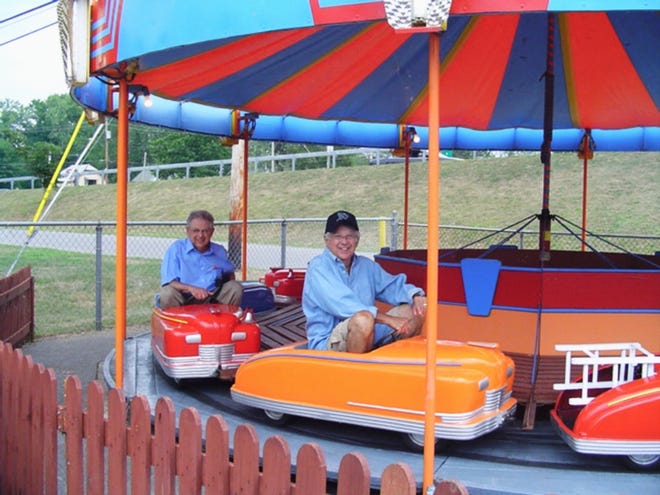
Native Uticans Dick and Bob Chancia enjoy their favorite attraction during a recent visit to Sylvan Beach.
We’ll never forget the Major League All-Star game that summer of ’48. It was a day game in baseball’s glory days when the World Series and All Star games weren’t played at night. Prime time television revenue wasn’t a factor.
We heard the game on radio (American League won, 5-2) but had to wait ‘til morning for the box score. We crossed the park and bought a Utica Daily Press at the old Victory chain store that supplied necessities for the tourists. What did Richie Ashburn do? How about Pat Mullin and Hoot Evers? Another highlight was renting a bicycle built for two and taking turns riding with older cuz Jerry.
Sunday ended at Eddies. Our folks had his famous “Original Hot Ham” (capicola) sandwich but we relished the hot dogs with mustard. It’s been said that one Saturday, Eddie ran out of ham and phoned Gold Medal salesman John Polera Sr. John advised, “It’s the weekend; substitute capicola." That was the birth of Eddie’s famous “Original Hot Ham” sandwich. The Stewart family diner attracted celebrities featured at Russell’s Danceland like Tommy Dorsey and Frank Sinatra.
The ride home along that familiar vista of Oneida Lake plus a Donald Duck or Kewpie Doll statuette eased the pain of leaving. There’d be more Sylvan Beach memoirs. We knew we’d hear again, “Let’s go for a ride."
Utica’s always been a flavorful place
By Bob Chancia - July 16, 2017
My hometown is famous for chicken riggies, Utica greens, tomato pie and half moons, to name a few.
That is now. But this was then -- when I remember growing up with some delicacies long gone that I’d sure give my eye teeth to bite into one more time.
Driving around with pals in my first car, a coral ’52 Chevy convertible, was the way we spent many evenings in those simpler times of the 1950s.
Who recalls that orange antique popcorn wagon faithfully parked on Genesee Street near Parkway East? It was a stop we couldn’t resist. The grease-stained brown bag of hot oily-butter-like popcorn not only messed up our fingers but also the manual gear shift. It was well worth the two bits. Legend claims that humble entrepreneur put his kids through medical school.
Remember Kewpee’s Drive-in on Oneida Square? Those tasty paper-wrapped burgers with pickles, mustard and ketchup were the throwbacks that inspired McDonald’s and other burger chains. Their favorite chocolate frosted malts are the ancestor to Wendy’s Frostys of today.
That familiar bell on Mezzaninie’s snack wagon signaled the savoring of genuine Italian lemon ice carefully sculpted with a teaspoon on a wafer cone by Mr. Mezzy himself, only a nickel. Slurp! Many times our evening jaunts ended at the Busy Bee Drive-in on upper Oneida Street. Alber and Harry Moshaty, the Lebanese proprietors, were proud of their all-beef grilled franks, wrapped in juicy bacon on a toasted open roll. The brothers were the carhops, too, and in their mid-eastern accent, they called their specialty “Bigs in da Blankit." Oh, for those dog days.
King Cole ice cream, both hard and soft, was unparalleled globally and by far Utica’s most popular destination. Uncle Andy often drove my cousins and me there. Once, when we spilled some chocolate on the upholstery of his new black-and-grey ’46 Hudson Commodore, we were beside ourselves. Luckily, he never sat in the back. Wasn’t that one of the ugliest car designs ever?
The Karmelcorn store on Genesee by the old Knights of Columbus was a perfect reward after weekly grade school swimming classes at the K of C. On the corner of Broad and Culver was the Beach Grove dairy store. They made the best frozen custard by far and may have even invented it. I tasted some, almost as good, in the late ‘90’s, at the famous Gilles of Milwaukee.
My next door neighbor on Plymouth Place was Dorence Owens, our Graffenburg Dairy milkman. In the ‘40’s, he delivered house to house in a horse drawn wagon. He’d tote his wire milk bottle carrier right into our kitchen for Mom to select from. I always hoped she’d choose a quart of Orangeade or chocolate milk but her post-Depression era budget only allowed for the pasteurized milk. I think Mr. Owens knew my passion ‘cause sometimes I’d be surprised and find Orangeade or Chocolate milk in the milk shoot on the side of our modest ‘20’s craftsman bungalow.
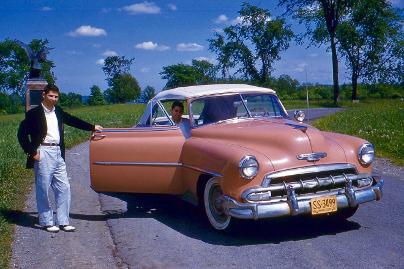
Bob Chancia stands beside his first car, a 1952 Chevy rag top.
Our beloved Bleecker Street was dotted with carts peddling icy raw clams on the half shell. My buddy George Fanelli insists Hindu was the fastest. He cracked the clams open in record speed and splashed on the hot spicy sauce to your preference.
Trino’s Pizzeria made its debut in 1952 on that same street next to Malara’s Records. I’m still combing the Big Apple for a crispy thin crust pie with fresh only herbs, mozzarella and tomato sauce that tastes like theirs. Can’t find it!
Senatro Paladino’s Italian salumeria was always good for a sampling of the sharpest imported provolone cheese, just one of their many palate pleasers.
Gene’s Chili Hut, owned by the Durantes, concocted the world’s best chili and chili dogs around but my Uncle Freddie’s Parasol, also on Oriskany Boulevard, introduced California carhops to Utica.
I pined for the taste of Rob Roy’s Orange pineapple ice cream until I discovered it at Springer’s in Stone Harbor, New Jersey. They offer that old Utica favorite of the ‘40’s in their selection of 50 plus flavors. Not even New York City’s Lindy’s can match Manny’s Cheesecake, formerly on the Parkway, and who can ever forget the scrumptious fish fry and potato chips at Jean’s Beans in South Utica?
Ahhh, those tastes of Utica Past. Who needed chicken riggies?
GUEST VIEW: The games we played, from marbles to MUNY League
By Dick Chancia - June 11, 2017
Like today, games filled the days of kids growing up in the '40s. What preceded T-ball, Little Lleague, youth soccer and digital electronics?
Baseball, the national pastime was king.
My bedroom walls were covered with SPORT magazine portraits of big leaguers.
For me, baseball was usually played in the street. We lived on a dead end with minimum traffic. A wooden Adirondack bat, (made in Dolgeville) pink Spauldine and chalk for bases were all the equipment necessary. The white picket fence by Joe Darman’s corner home on Mohawk Street and Plymouth Place provided the short porch for the pink ball to go yard. (Home run).
Occasionally we hung our Ken-Wel mitts (made in Utica) on the handlebars of our Rollfasts (made in Little Falls) and peddled to Proctor High’s ball fields for a version of hardball (four or five on a side).
Yep, baseball every day, void of smart phones and parental interference. We did our own negotiating: choosing sides, ground rules etc. Flip the bat; one fist up the handle at a time settled the differences.
Prior to adult supervised Little League, we did have some organized baseball. The Kiwanis league had three age divisions. The neighborhood leader picked up an application from Duke Roemer at City Hall, named the team and filled in the roster. The Kiwanis Club provided schedules and umpires but not uniforms. Some of the more enterprising teams got a local sponsor to provide tee shirts.
Sandlot baseball all summer. My team, the Plymouth Place Pirates, featured future school board head Rock Giruzzi and congressman-to-be Sherwood Boehlert. I can’t resist some name dropping. More genteel games like marbles, Duncan and Philippino twirler y-yo contests were confined to the muddy school yard.
Most grade schools had baseball and basketball programs that crowned a city champ. George Fanelli recalled the thrill of winning the ’47 baseball title over Roosevelt with Brandegee team mates Bruno Arcuri, Nick Abdou and Harry Esposito. Crowds at Addison Miller watched fast pitch softball duels between Lenchner’s Pep Caputo and Cavallo’s Fred Sisti. An adventure to McConnell Field in North Utica to root on future Hall of Famer Richie Ashburn and our Blue Sox was a special treat.
When the leaves began to fall, the game changed to touch football. Later in the season, a neighborhood garage with a hoop or a Quinn playground court was available for 3-on-3 basketball. Our only deadline: be home for supper! Utica Boy’s Clubs provided youth basketball leagues. Those more skilled went on to compete in high school. Friday night basketball in Proctor’s or UFA’s new gym and Saturday afternoon prep football at Murnane Field were popular events. Fanelli once scored four touchdowns in a Proctor win over Watertown. Parochial high schools, St. Francis and Utica Catholic Academy (now consolidated as Notre Dame) played hoop home games at the Knights of Columbus.
Fortunately Utica had Municipal league basketball and baseball. The MUNY league provided an opportunity for former high school players to hone their skills. Teams like Excel Cleaners and Skiba Post enabled young men to play well into their 30s. Popular players included Ralph Polera, Roger Lemke (son Mark went on to play for the Atlanta Braves), “Chops” Bohanna, Ronnie Barr, George Fanelli, Dick Miller, Dickie Frank, Clarence Bass, Alan Gilberti, Nonnie Pensero and many more.
My favorite, George Fanelli, a good basketball player at Proctor, became a prolific scorer in the MUNY League. He learned to use his speed and the fast break for high percentage lay-ups. His career high 26 points compares to 40 in today’s 3-point shot era.
Southpaw Adam Zuir and first baseman John Devens of Skiba Post were as heroic to me as Detroit Tigers' Hal Newhouser and Rudy York. George Hyder and George “Chops” Bohanna played well into their 40s. They finished their workday at 5, traded their lunch pails for ball gloves, and played their hearts out ’til dark. No lucrative multi-year contracts. They just loved to play. I recall going to McConnell Field to watch a major league barnstorming team led by former Proctor star Ted Lepcio, (then with the Boston Red Sox) face our MUNY League all stars. Yankee pitcher Bob Kuzava’s curve ball was overwhelming.
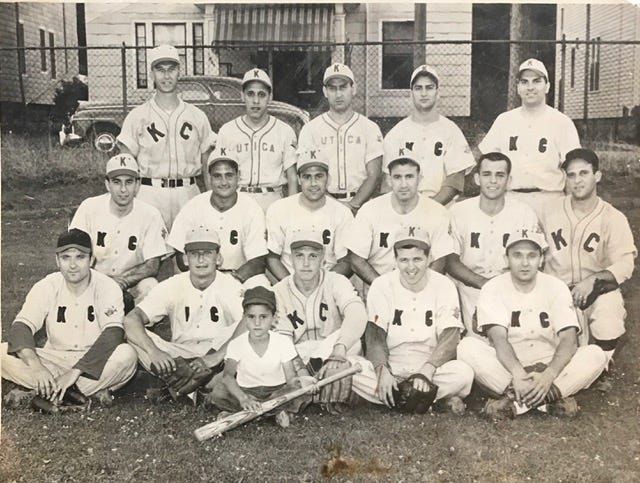
(Kiwanis) Municipal League Knights of Columbus team in the late 1950s. From left, front row: Ray Slogar Sr., Al Pakish, Faye Billings, Joe White, John Giaquinto; middle: John Bringantino, Tony "Bull" Fabbio, George Fanelli, John Alliasso, Fran DeJoseph, Dick Robertello back: Fran Kraus, Steve Gigliotti, Dan Falatico Sr., Junior Romano, Jack Paparella; bat boy: Ray Slogar Jr.
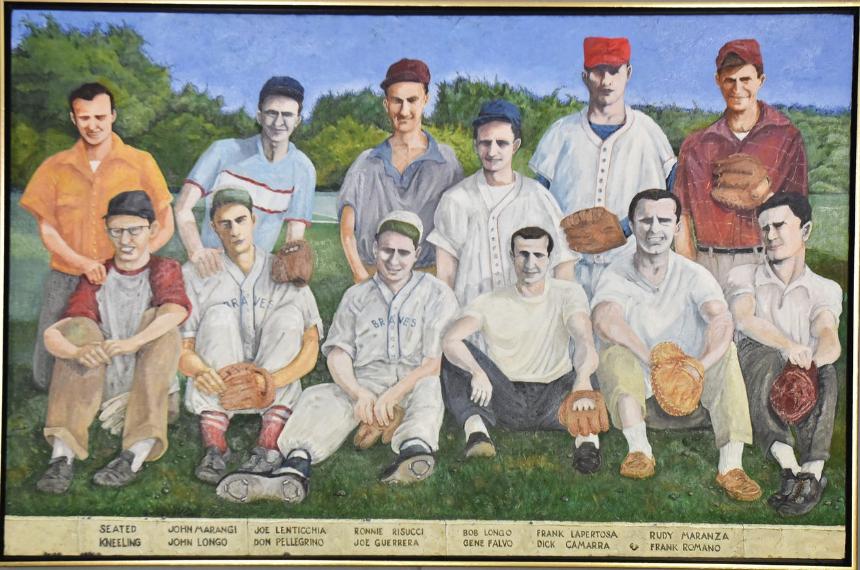
Semi-pro football’s Frankfort and Utica Vets gave local gridders a chance to play with ex-college players from Syracuse, Colgate and other nearby schools. The Tri State Hospital League (Marcy, Rome and Utica State) was the top basketball group. Former Niagara star Francis Willenburg (later Monsignor) was a headliner.
We followed our pro heroes a day late in the morning Press or evening O-D.
Each day I’d check the paper to see what Ted Williams did the night before. No round-the-clock ESPN SportsCenter, as television was yet to come.
What happened to the MUNY League? Televised games replaced the need for fans to watch the local guys. Change is inevitable but nothing was as intimate as our neighborhood pals playing for the love of the game. Our concern was the camaraderie and results. We were spared coverage of off the field antics; only what happened between the lines mattered. Some of our guys might have made the big time but opportunities were elusive.
The games were great, the guys loved playing and I loved following them. “Where have you gone “Chops” Bohanna”?
Remembrance: Well-placed kick a fond memory 66 years later
By Dick Chancia - November 14, 2016
High school football was hot in the late 40s and early 50s. Rome Free Academy’s Black Knights dominated Central New York's gridiron. The Air Base employed thousands from all over the country, and RFA’s recruiting was wide and diversified.
Proctor, in East Utica fielded sons of immigrants, predominately of Italian descent. The New York Yankees, with names like Crosetti, Lazzeri and later DiMaggio, Rizzuto and Berra became East Utica’s team.
The RFA-Proctor game was usually a night game in Rome on Friday of Halloween week. The typical Prox footballer was short and sturdy. We called them “fireplugs."
Rome's Orange and Black put a scare into Utica’s Maroon and White. (The first Proctor principal, Rollin W. Thompson, a Colgate alum, brought his alma mater’s colors with him).
The economical Proctor look was white jerseys, maroon numerals and baggy khaki pants. The Knights were intimidating in orange helmets, black jerseys and pants with thick orange striping.
They also added mean looking lamp black under their eyes. Halfback/punter George Fanelli said to center Bob Moracco, "They’re gonna kill us!” He understood the psychology of fierce uniforms. Today, Nike markets combat-style uniforms to top college programs. The Oregon Ducks, Syracuse and others use this advantage of intimidation.
Somehow, one point separated Proctor from heavily favored Rome with over two minutes left. The 3,500 fans were ready to erupt. Proctor had to punt deep in its own territory. A Rome possession would run out the clock. All 11 Maroon were important, but five key players had to execute.
Center Bob Moracco, must hike, to use a word from yesteryear. The punter, George Fanelli was small but agile and skilled. (Fanelli went on to excel in Municipal League baseball and basketball.) Punting demands discipline. Placekicking requires less technique and includes scoring gratification. Today we call Moracco’s job, the long snapper, a specialty position in college and pro football.
The snap (hike) must be chest high and accurate. The punter needs the ball to spiral in flight, insuring distance and hang time. Airborne up to three seconds allows defenders to get downfield and prevent a return deep in scoring territory: The Red Zone. Rome’s George Grande only needed to catch the punt and RFA could run out the last minutes. Moracco and Fanelli executed. Grande attempted the reception.
Proctor’s next key player, Joe DeTraglia, a squat tough interior lineman known as “The Bruiser,” got downfield and put a hit on Grande causing a fumble. DeTraglia, built close to the ground, fell on the valuable pigskin. It was Proctor's ball in the Red Zone with two minutes and seconds on the clock.
Two Proctor plays failed, leaving 30 seconds to play. "Time out!" called legendary Proctor coach Phil Hammes. Hammes, a University of Michigan graduate who later would become principal of Proctor, had a knack for gaining the respect of these tough street kids. Hammes decided from the sideline. The holder, Joe Tebesherany rushed on the field with the play.
“We’re gonna kick a field goal!"
Fanelli: "Who’s gonna kick it?”
Tebesherany: “Lou Fondario."
Fondario was a sophomore on this veteran team, but physically, a man among boys. From a family of railroad workers, Fondario had calves and thighs of steel. Placekickers back then kicked the ball head on, meeting the ball with the toes of the foot, unlike today’s soccer style, approaching from an angle using the side of the foot.
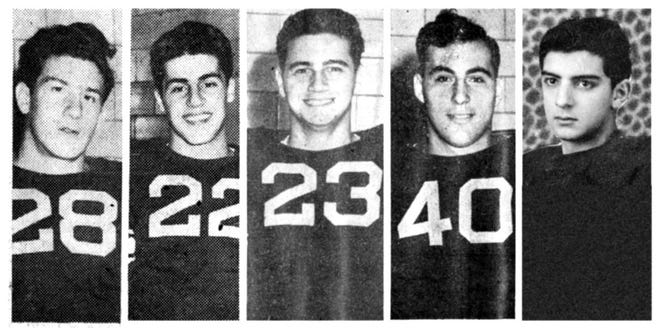
From left: Lou Fondario, George Fanelli, Bob Moraco, Joe DeTraglia and Joe Tebsherany.
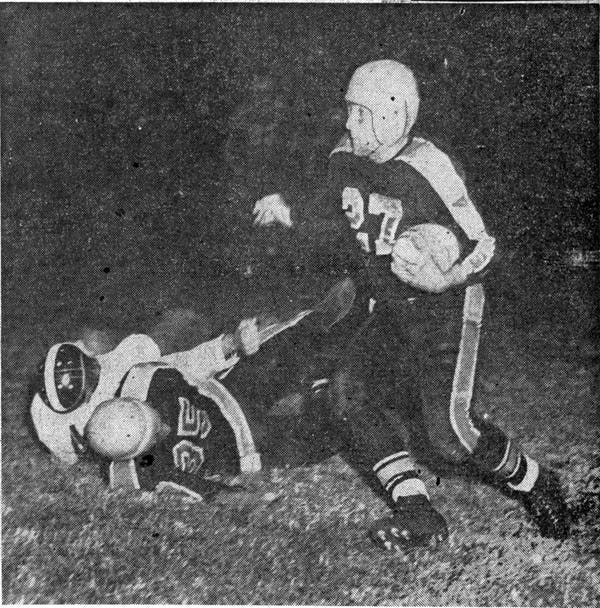
With a field goal, the kicker has a couple of steps to gain momentum, versus up to four or five with a kickoff. Moracco, the long snapper, must execute again. Get the ball chest high to the kneeling holder, Tebesherany. Joe Teb had the unsung role of catching the ball and placing it with the index finger and hand positioned away from the ball, giving the kicker a large target.
Fondario’s two-step approach… BOOM!
Fanelli, from his halfback position, watched the line drive sail straight and barely over the cross bar. The ref raised his arms. Three points.
Proctor won 23-21!
It was the first successful field goal in Proctor’s 15-year football history.
Now, 66 years later, that game in 1950, on a crisp Halloween Friday night in Rome, is still haunting and dearest to my heart. Those “fireplugs” from East Utica spooked the vaunted Black Knights with… what? A field goal!
When I meet the guys from those glory days in an east side coffee shop, the “Field Goal Game” often comes up.
To this 100-pound, 14-year-old in Proctor’s skimpy Marching Band, the bus trip, the pre-game coffee break on Dominick Street, and the historic field goal were way over the top.
New York Times 1971 Advertising Bio
By Philip H. Dougherty - February 10, 1971
Recently, the folks who are in charge of advertising for Gimbels New York de cided that what they needed, instead of one art director overseeing everything, was two art directors with re sponsibilities divided like the rest of the store's merchan dising.
One man, in other words, would be art director of ad vertising of soft lines (what you can wear) and the other for hard lines (what you can't).
Gimbels, with 10 stores in the metropolitan area, want ed top talent and, according to Doris Menkes, its adver tising director, “It was a hard search.”
But eventually it turned up Richard L. Chancia, a hard lines pro who was advertis ing director of the Robinson Furniture Company, Detroit.
Now, listen to this, gang— a real one in a million. He had a twin brother, Robert L., a soft‐lines expert who was fashion art director for the Jordan Marsh Company of Miami.
Well just like the “Miracle on 34th Street, Part II” the twins—who haven't worked together since J. L. Hudson, Detroit, in the early sixties— are back together doing their thing, reunited by the power of retail advertising. It sort of brings a tear to the eye.
Utica, N.Y.'s answers to the Smothers Brothers were playing meet the press yes terday morning in Mrs. Menkes's office and the con versation was beginning to get to the differences be tween retail and national ad vertising (and not just the rates).
It was about that time that the big boss, Richard S. Meyer, vice president for sales promotion, dropped by and, offered his thoughts. “With retail advertising you have no way of disguising its performance,” he said. “It's much more to the point and lacks some of the sophistica tion of national advertising.”
“Not as conceptual—more of a direct presentation,” of fered Dick Chancia, who is five minutes older than his brother and therefore has the light to say more.
But the twins might be conceptual types on Madison Avenue right now if it wasn't for the fact that, when they arrived here in 1958 with their fresh Syracuse Univer sity fine arts degrees, jobs were scarce.
The advice seemed to be, “Go upstate, get experience and come back.” And so they did, picking Rochester, where they bent their twig at the Sibley, Lindsay & Curr de partment store.
In those days, work was so unappealing that they wel comed the draft, which took them into a six‐month tour with the Army in chic, fash ionable Fort Dix, N. J.— with weekend passes in New York. Listen, there are worse fates.
Just because Dick is hard line and Bob soft line doesn't mean the twain shan't meet. They'll be working together (there's a hole in the wall between their offices) on over‐all advertising, such as the material that is being prepared already for the opening (hopefully next fall) of Super Gimbels at Lexing ton Avenue and 86th Street.
And while they're doing that they'll also be working on the approximately 7,500 ads that come out of the de partment each year and find their way into nine news papers in New York, Long Island, Westchester, New Jersey and Connecticut. The store is also pretty hot for radio, but that doesn't re quire too much art direction.
See the article in its original context from February 10, 1971, Page 68.
Gimbels' sales are promot ed by more than $9‐million annually, counting both media and direct mail.
For the newspaper ads, which are done here for all the stores, most of the art work is done by free‐lancers, while the layouts and copy are done in the department. “It's tough to get good copy people,” said Mrs. Menkes, “and it's tough to keep them with this pace.”
“The volume is overwhelm ing,” said Dick, the married twin, who was later to add his personal philosophy on retail advertising art direc tion: “Don't mistake the printed page for an art gal lery and don't let the graphic image stand in the way of the selling image.”
“And,” said brother Bob, getting to his feet, “Two heads are better than one.” How's that that for the last word.